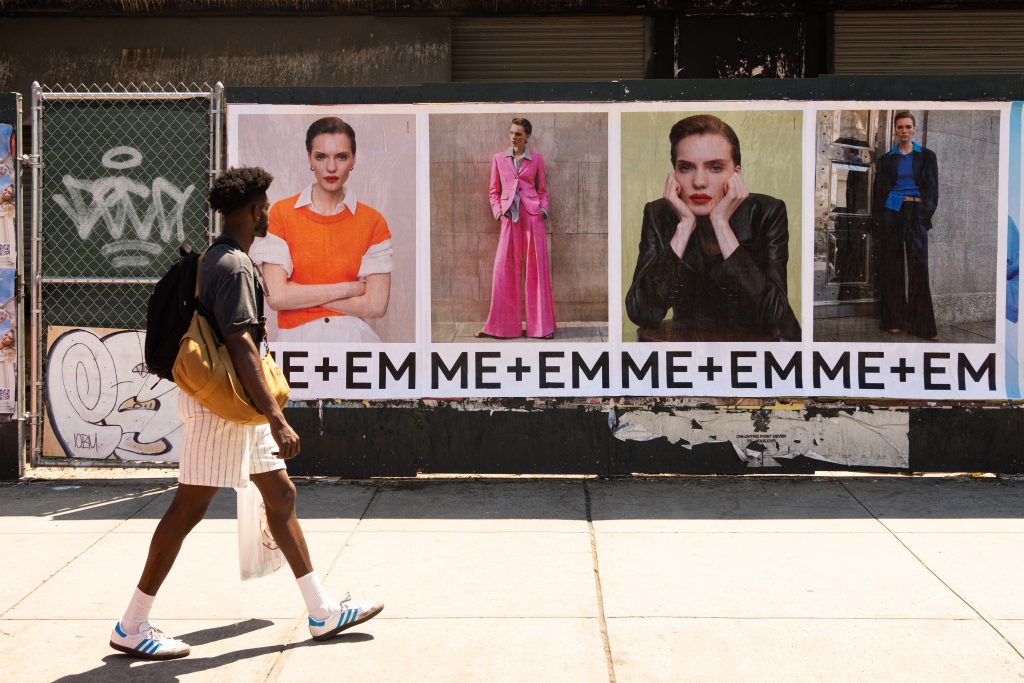
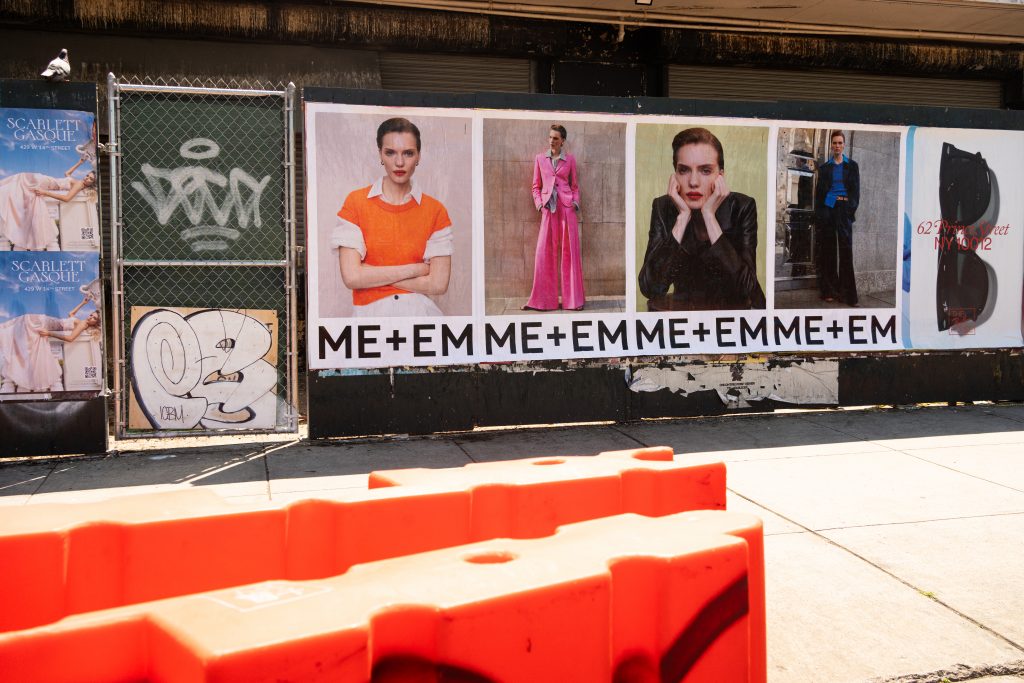
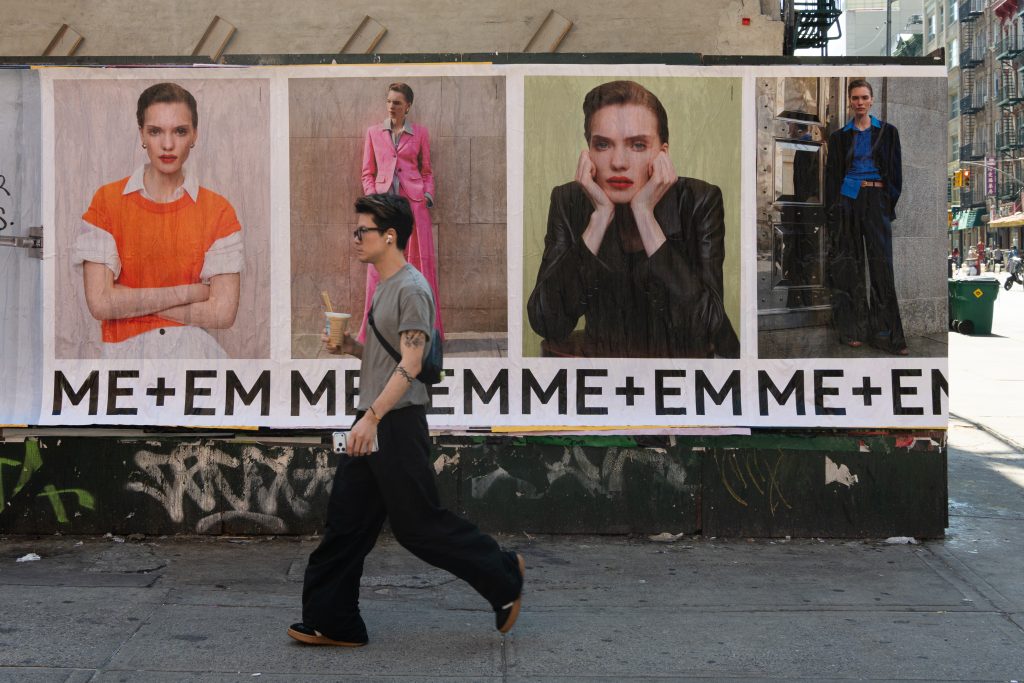
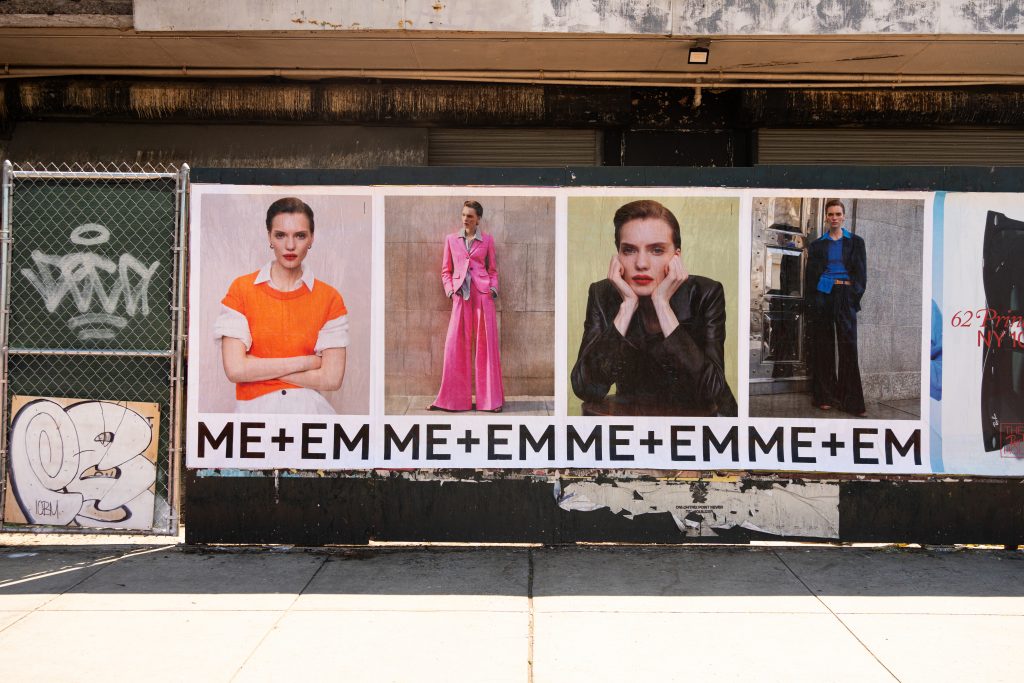
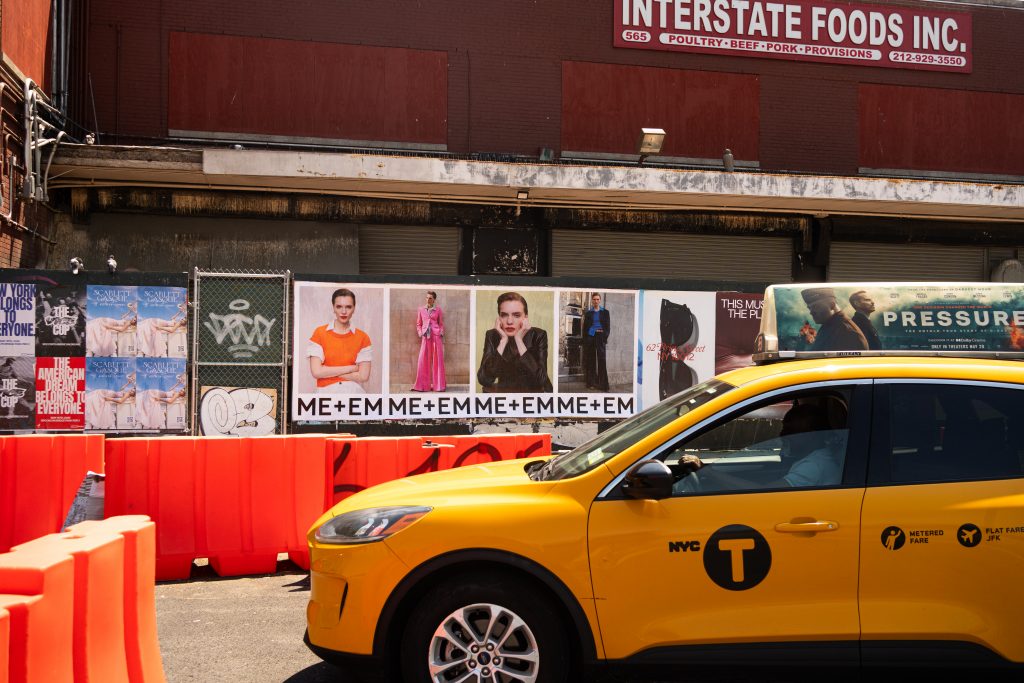
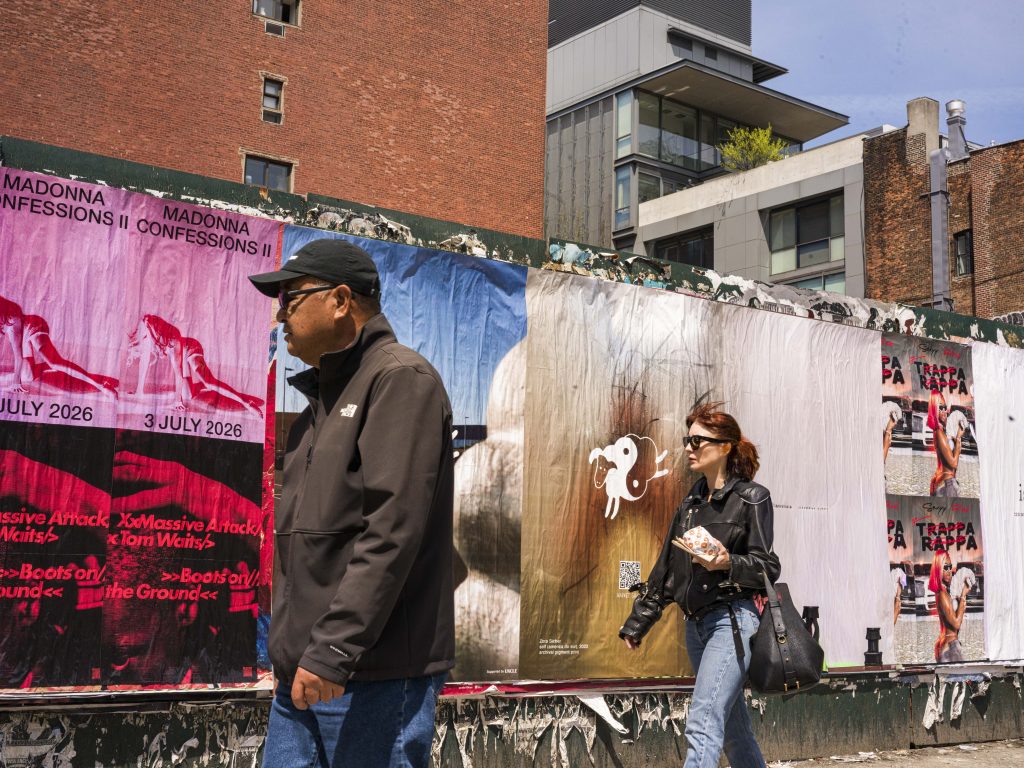
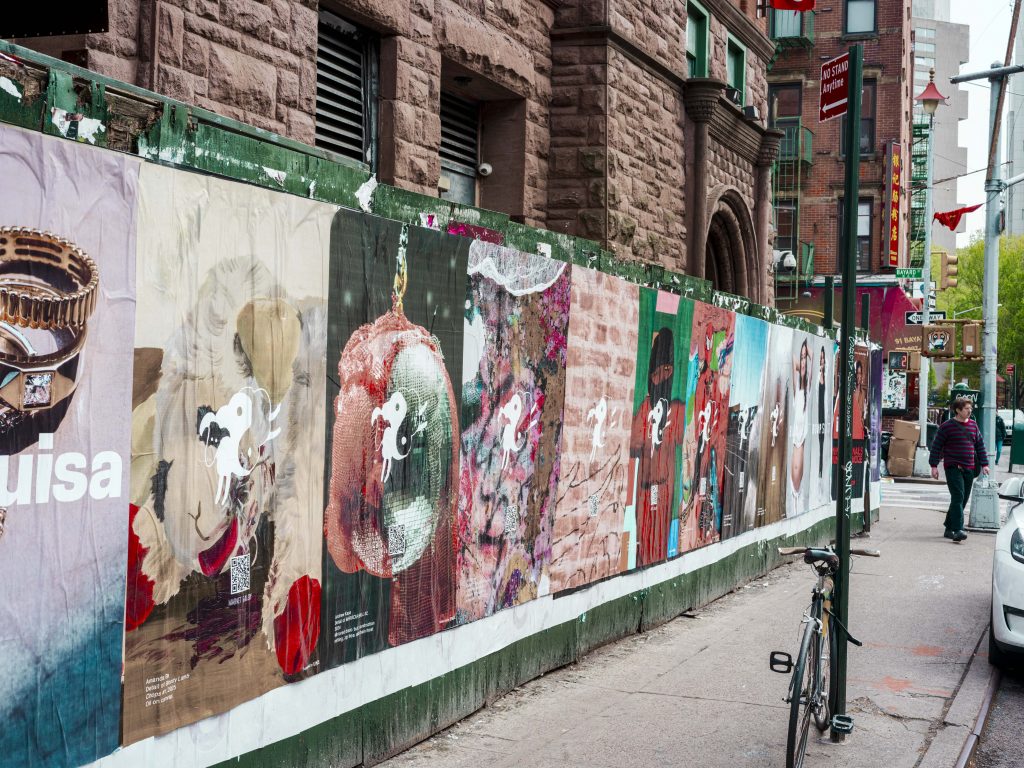
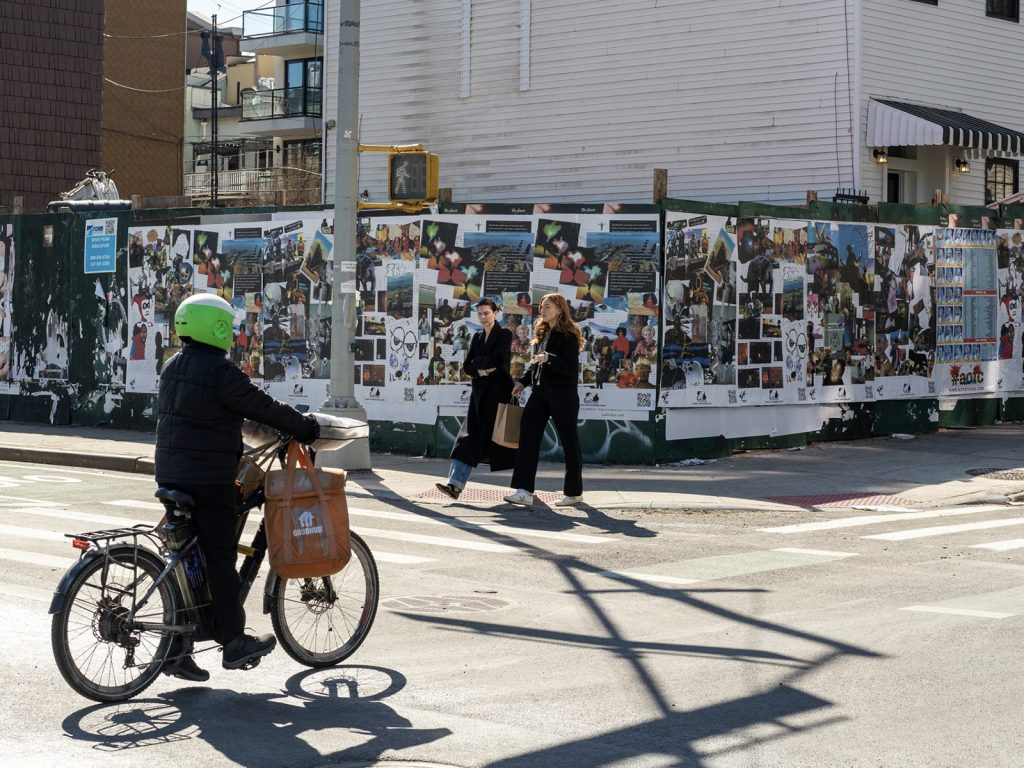
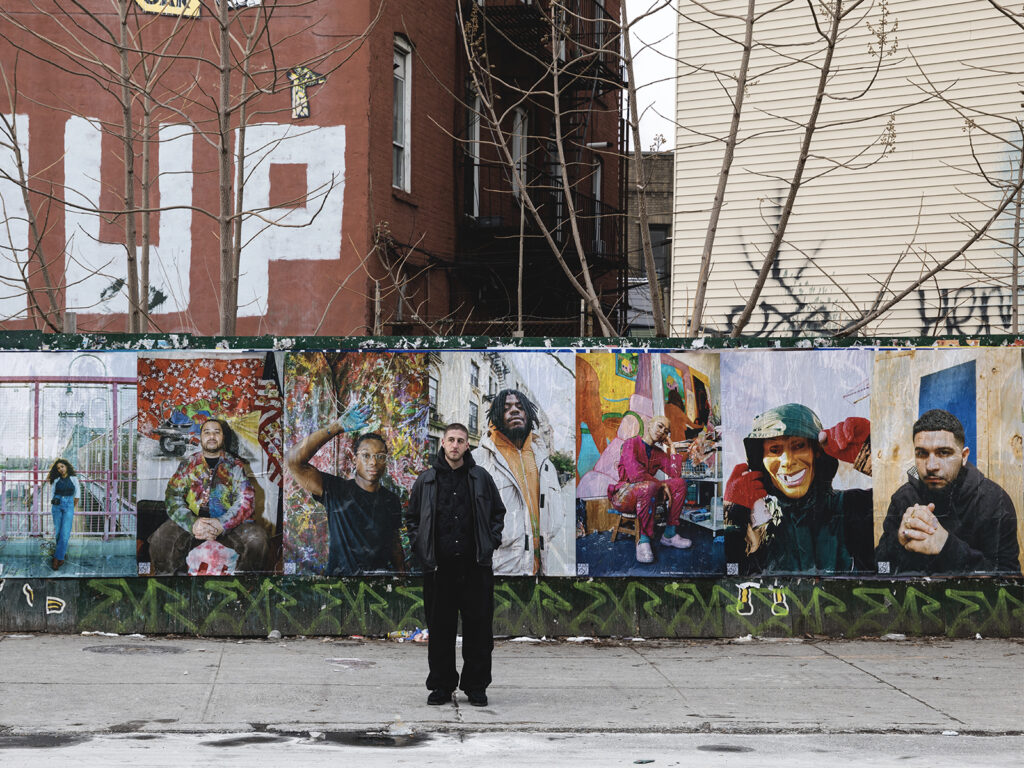
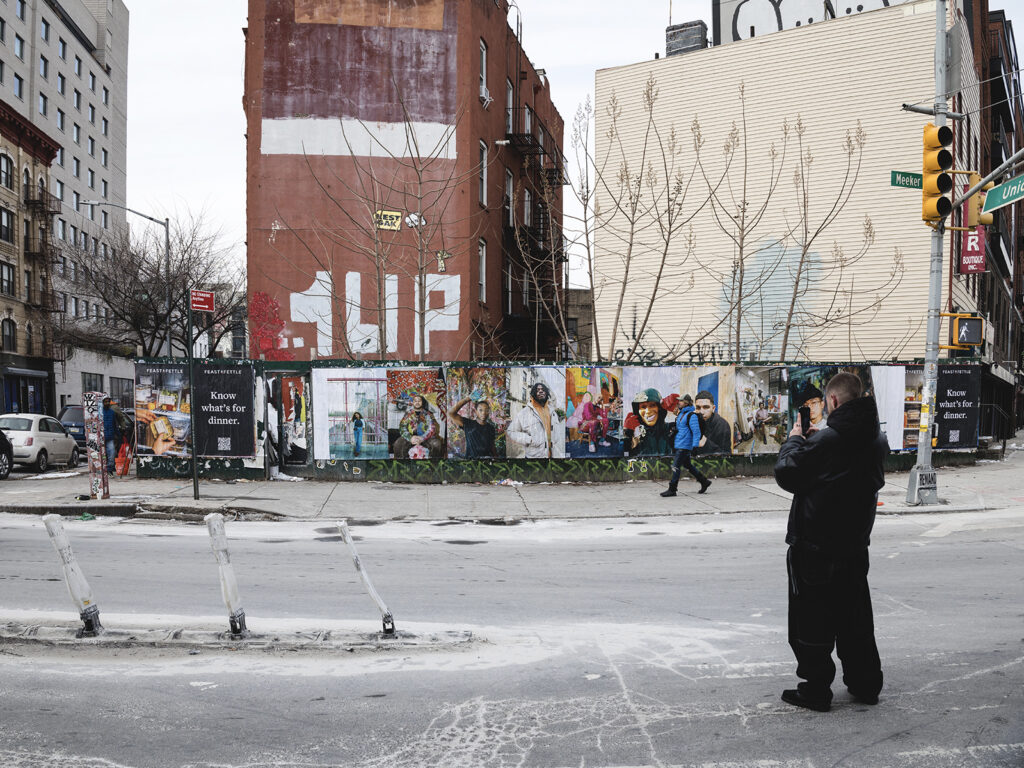
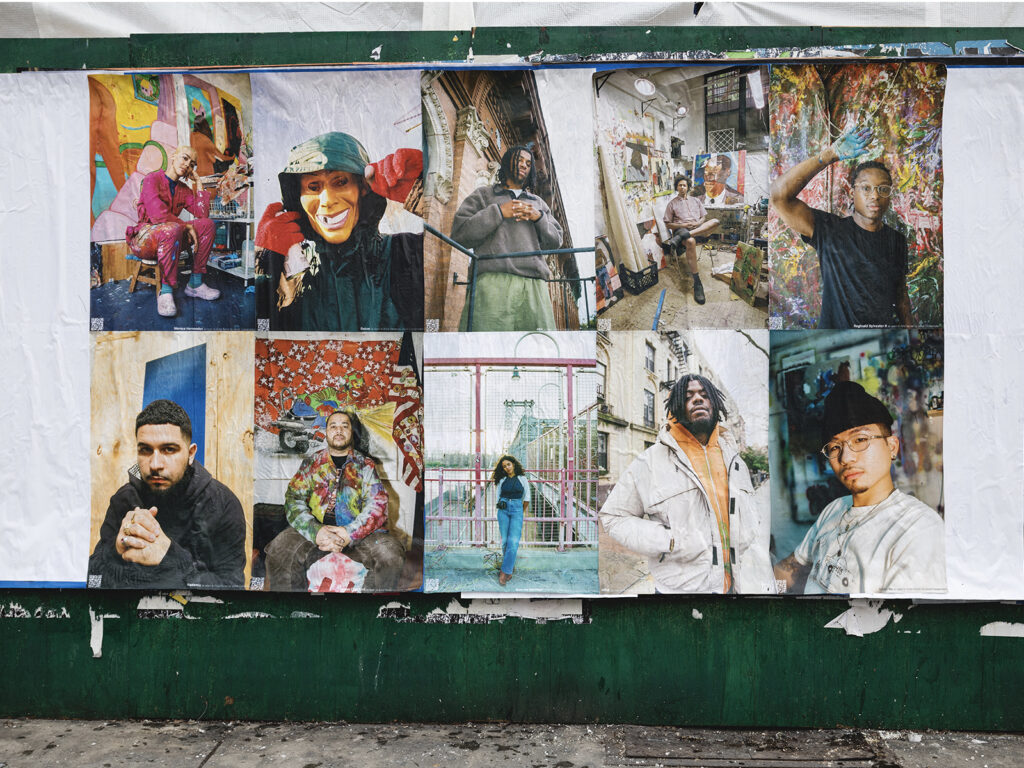
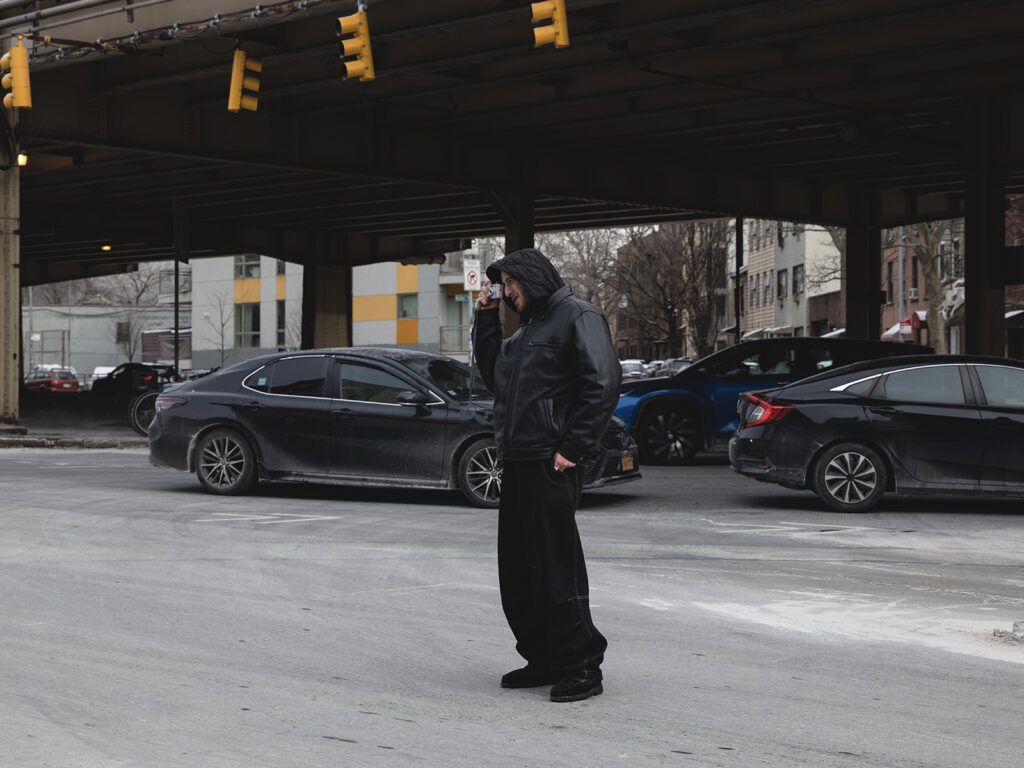
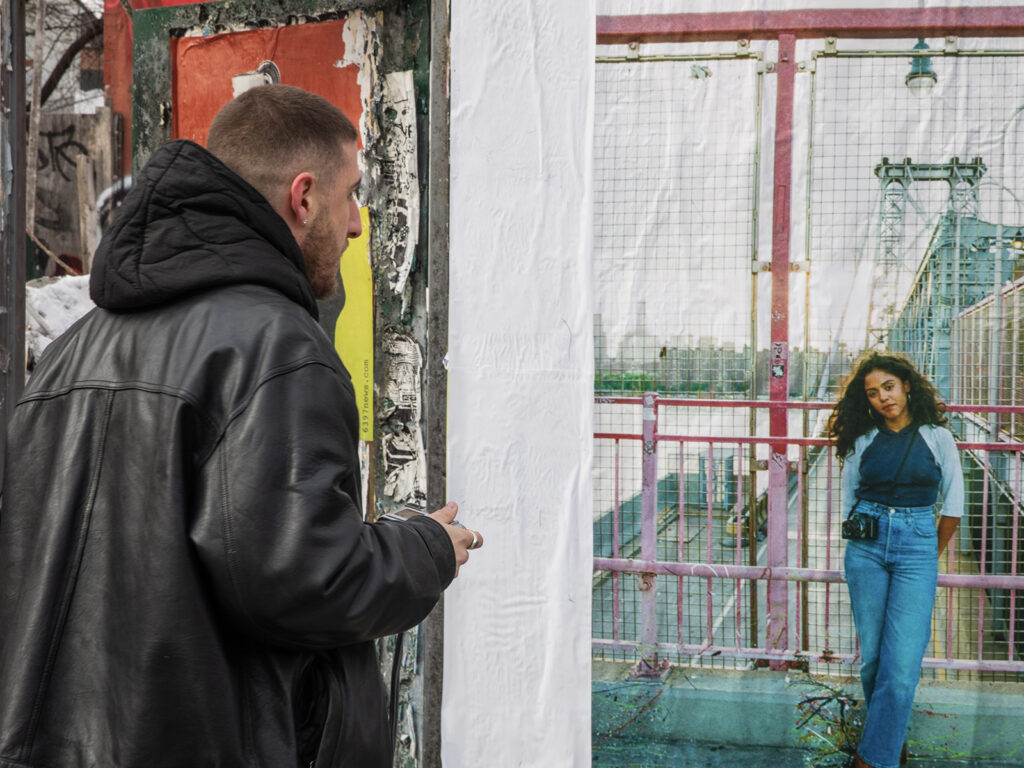
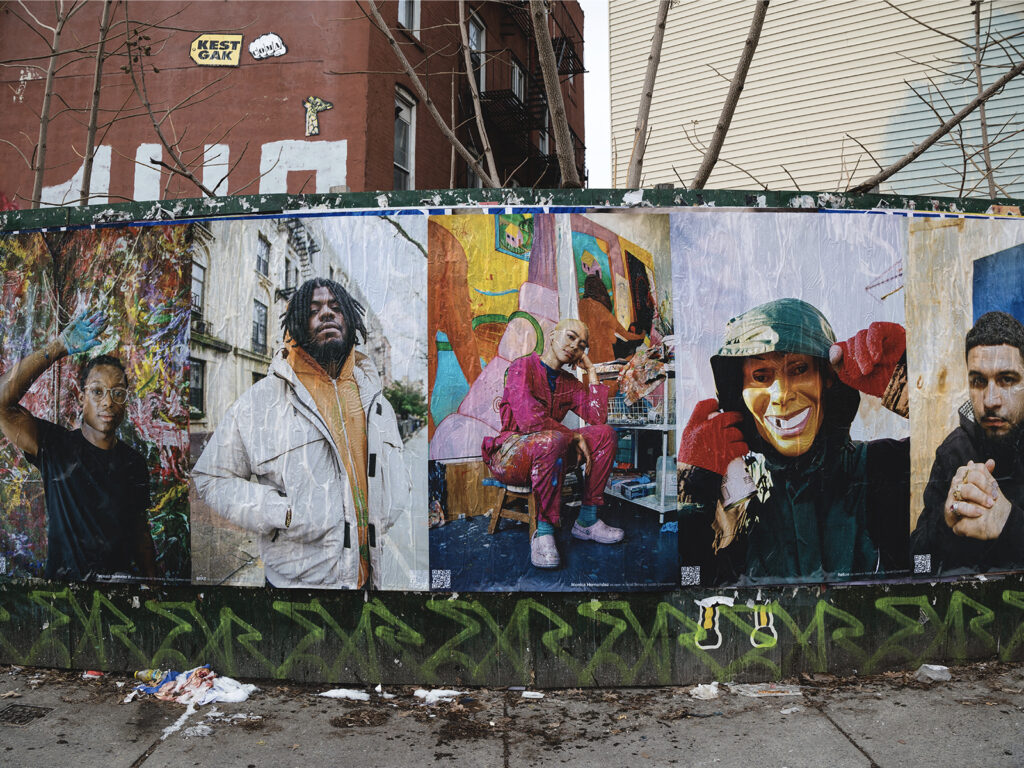
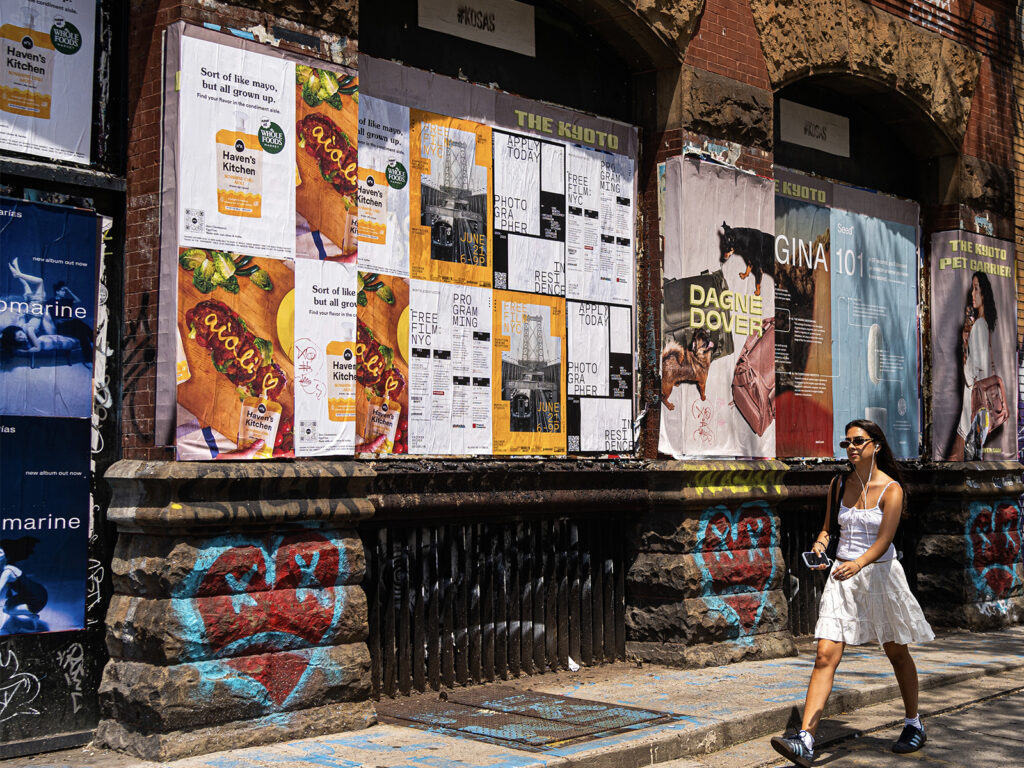
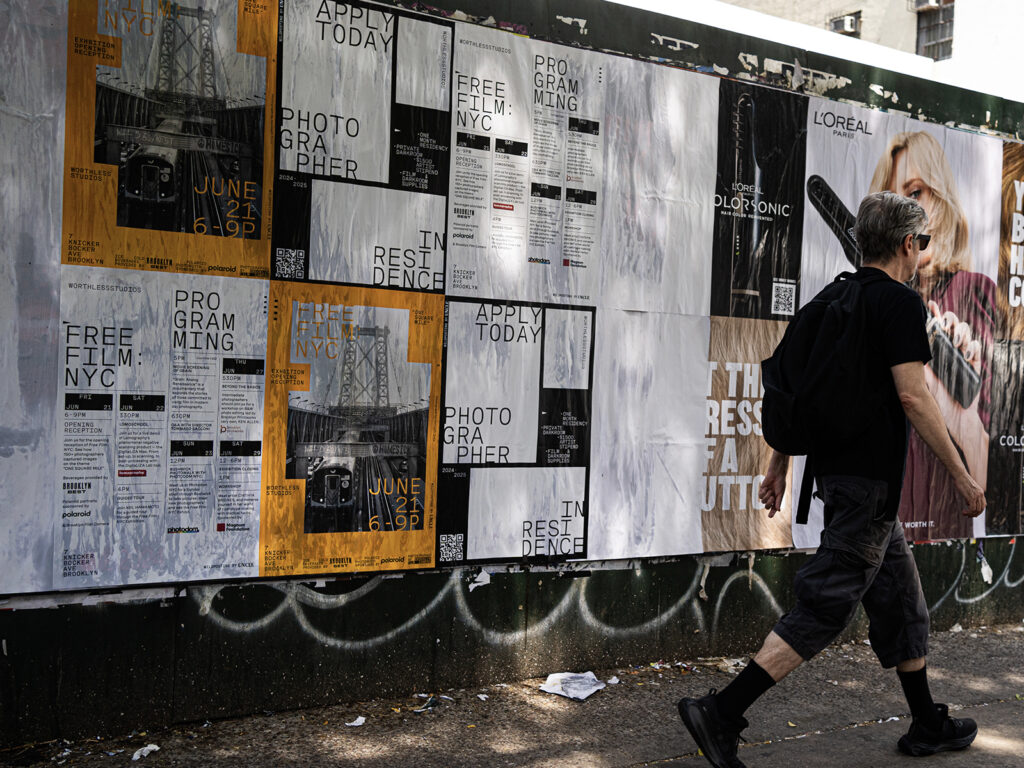
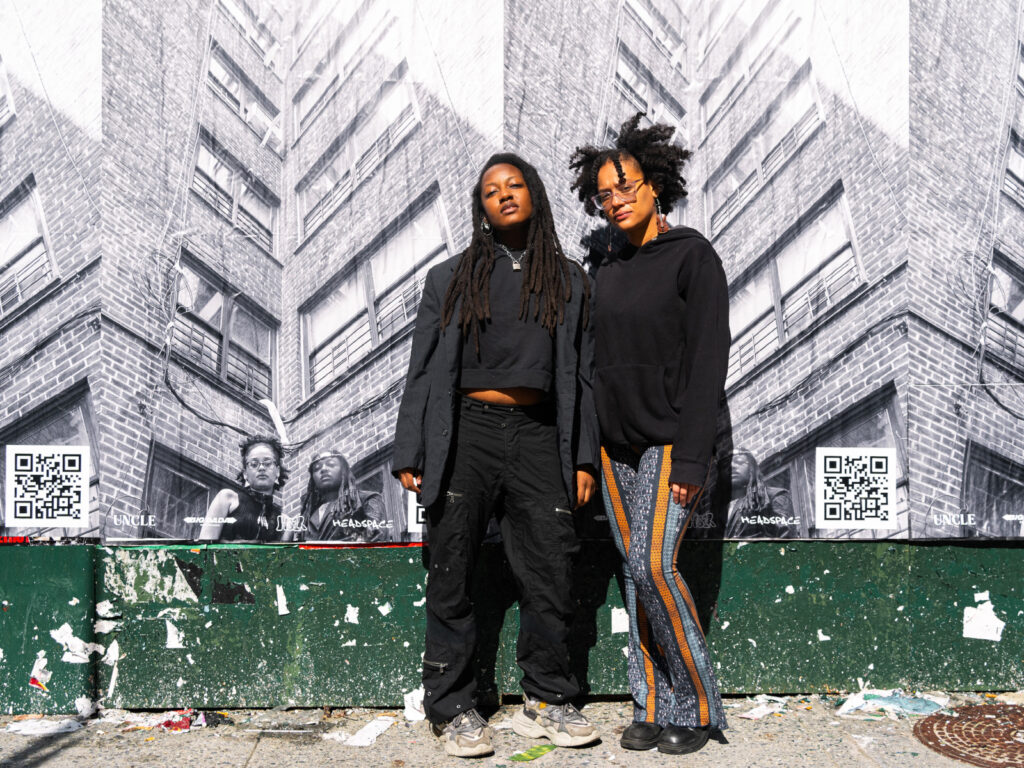
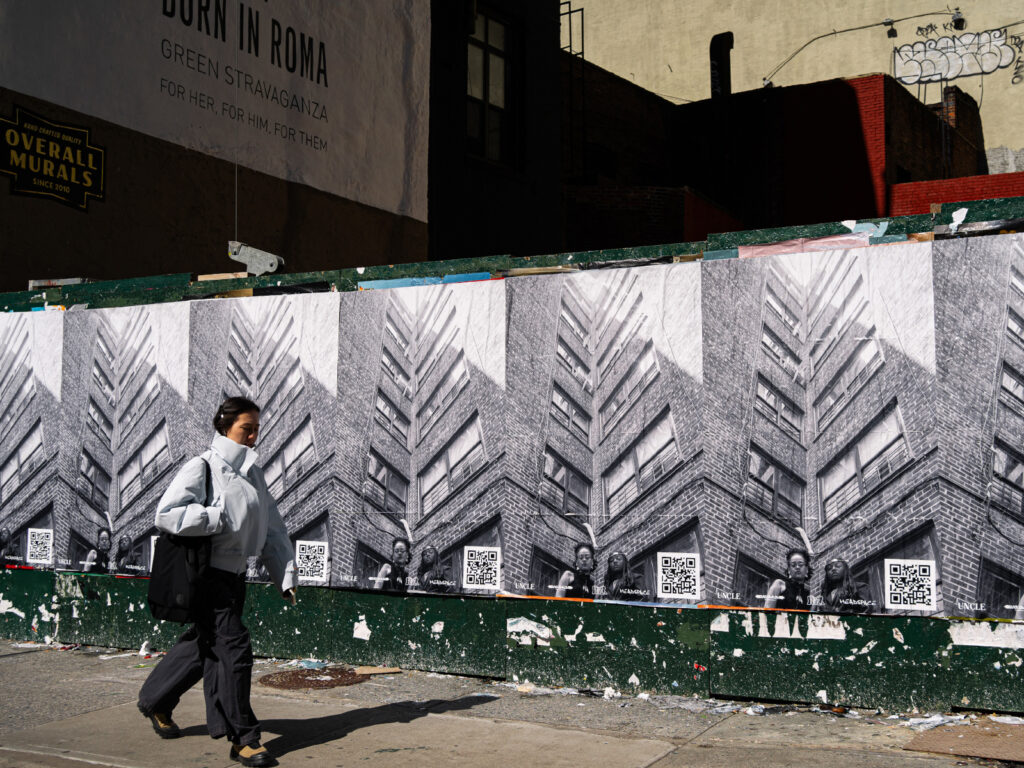
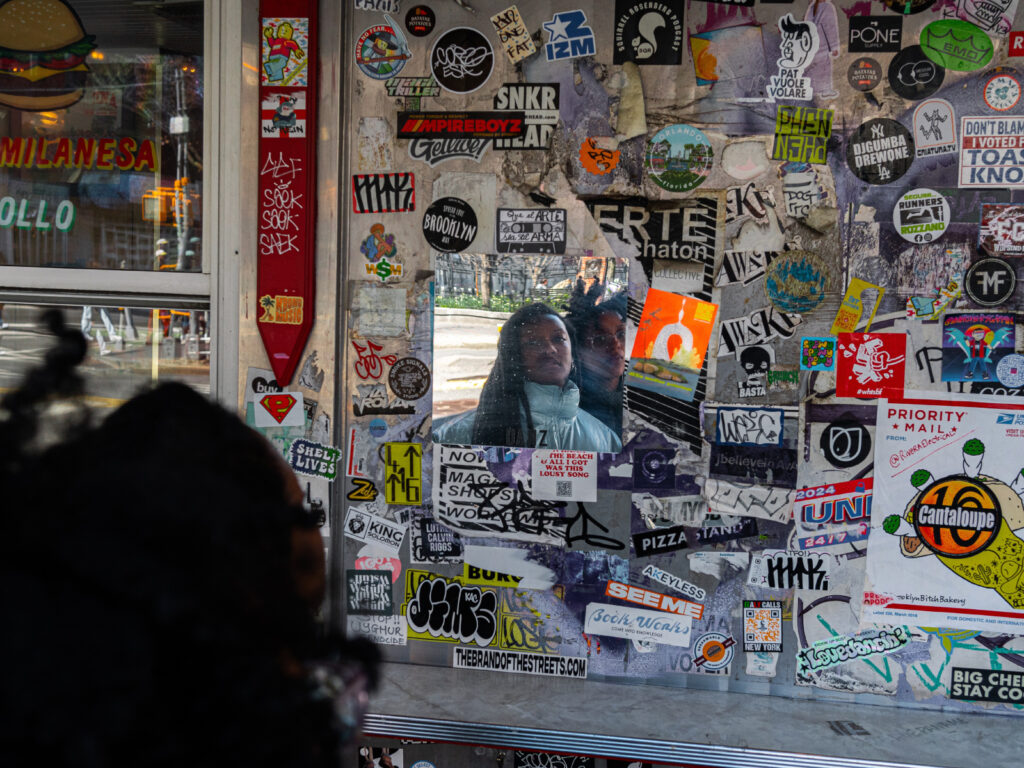
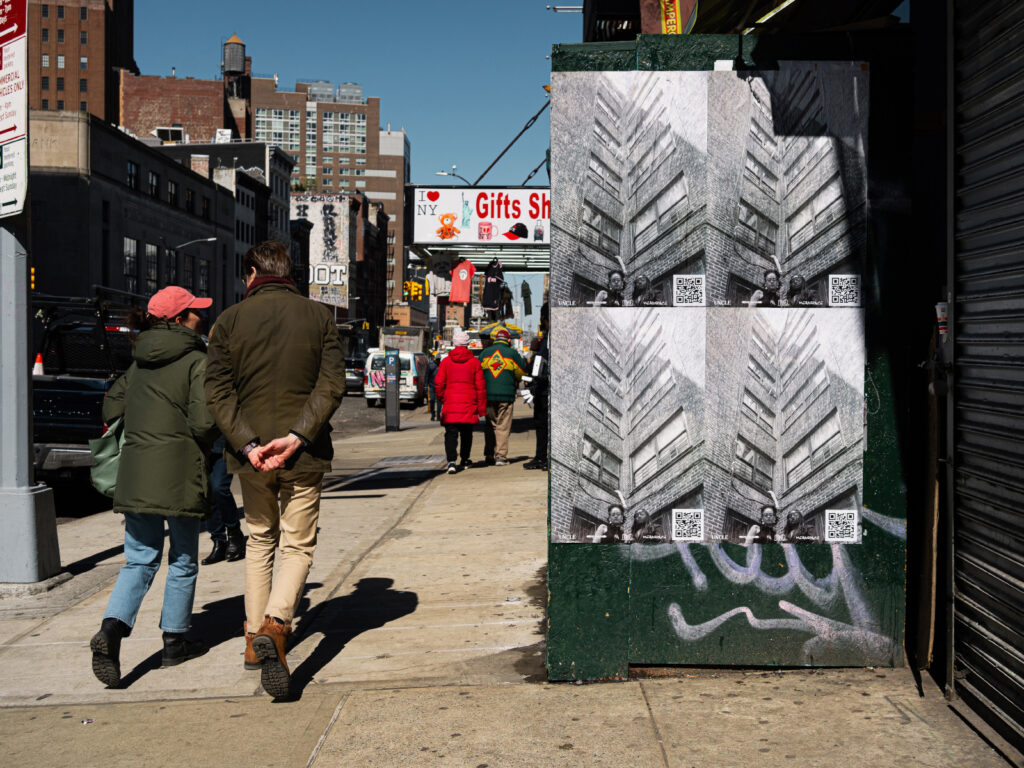
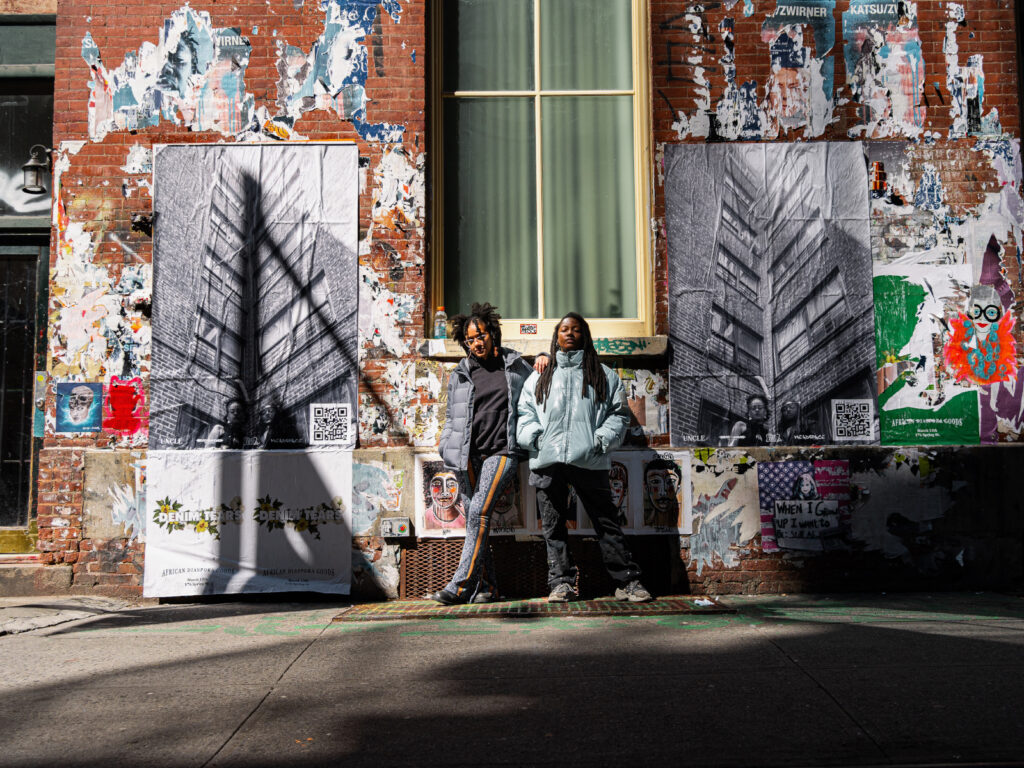
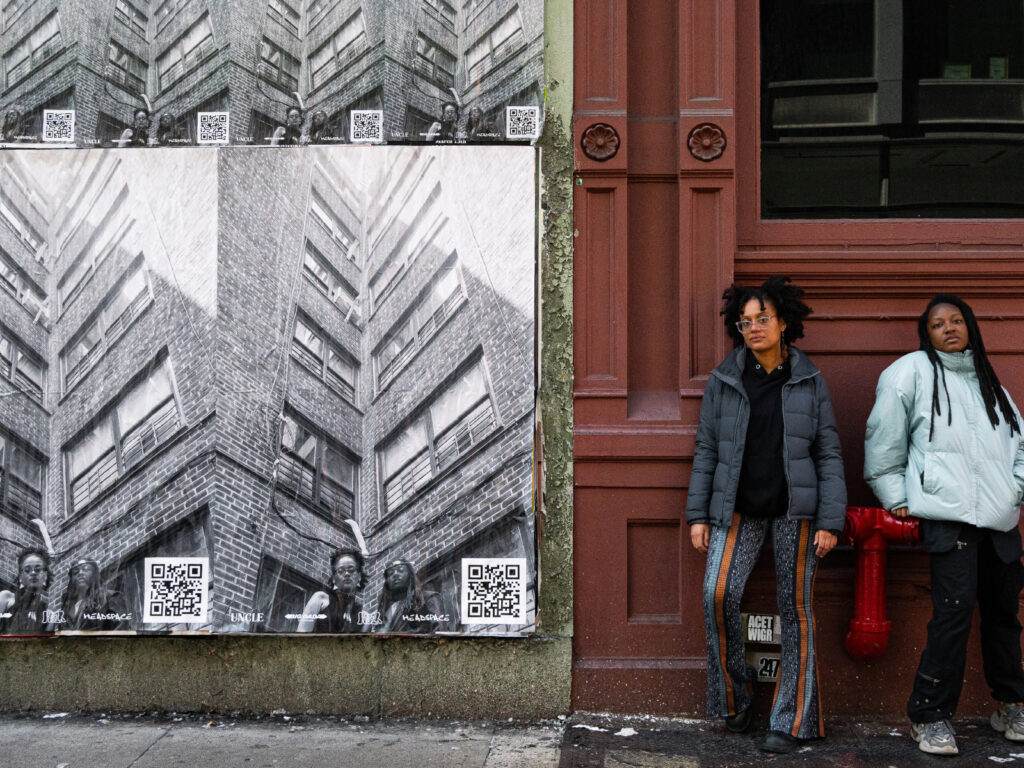
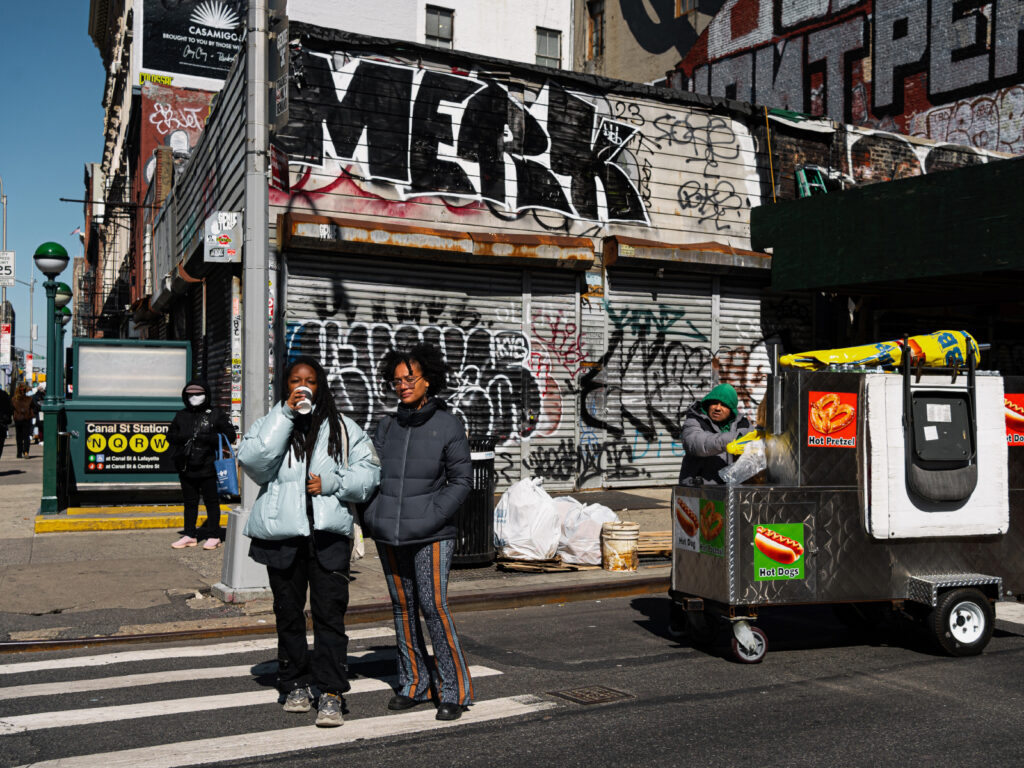
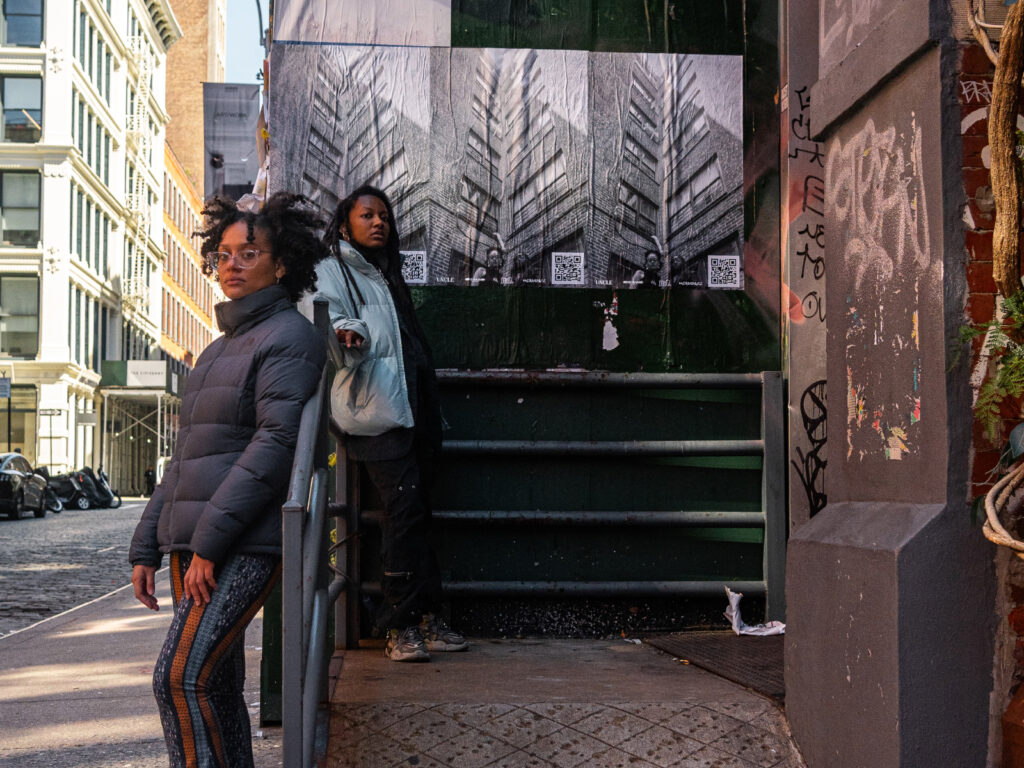
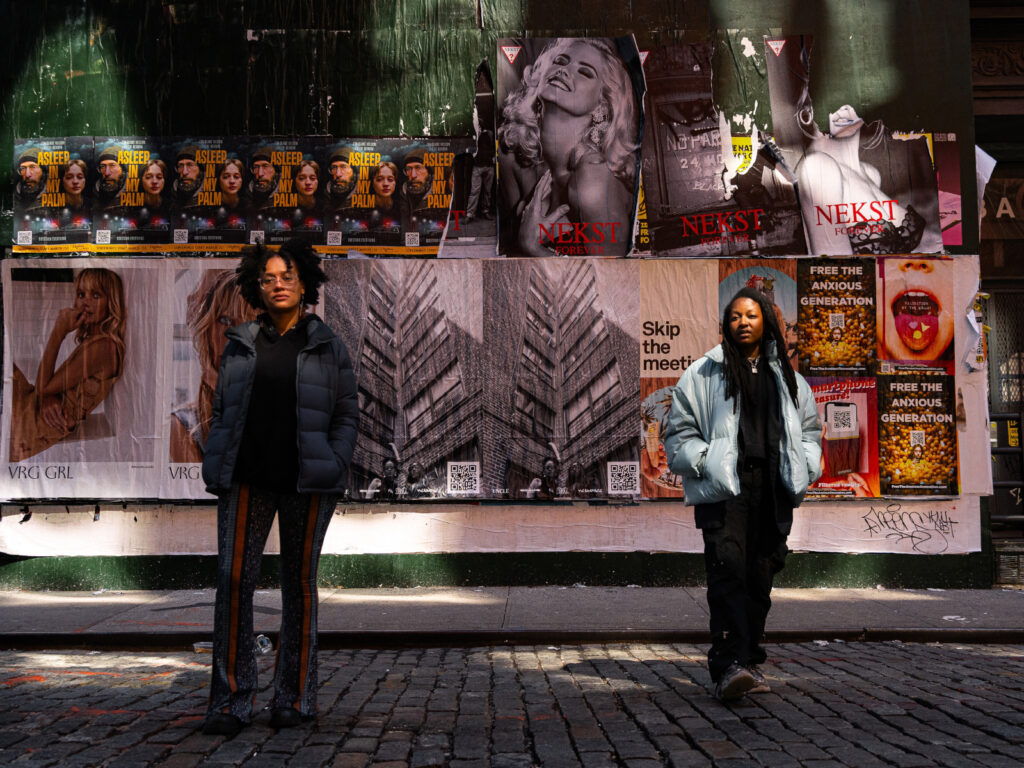
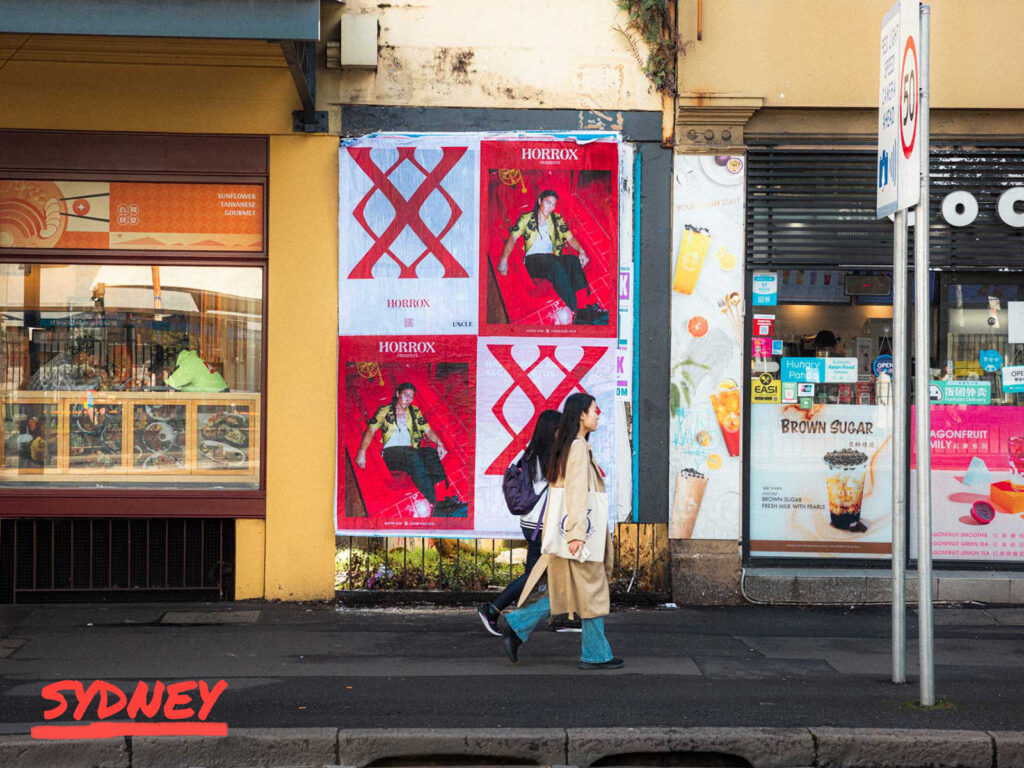
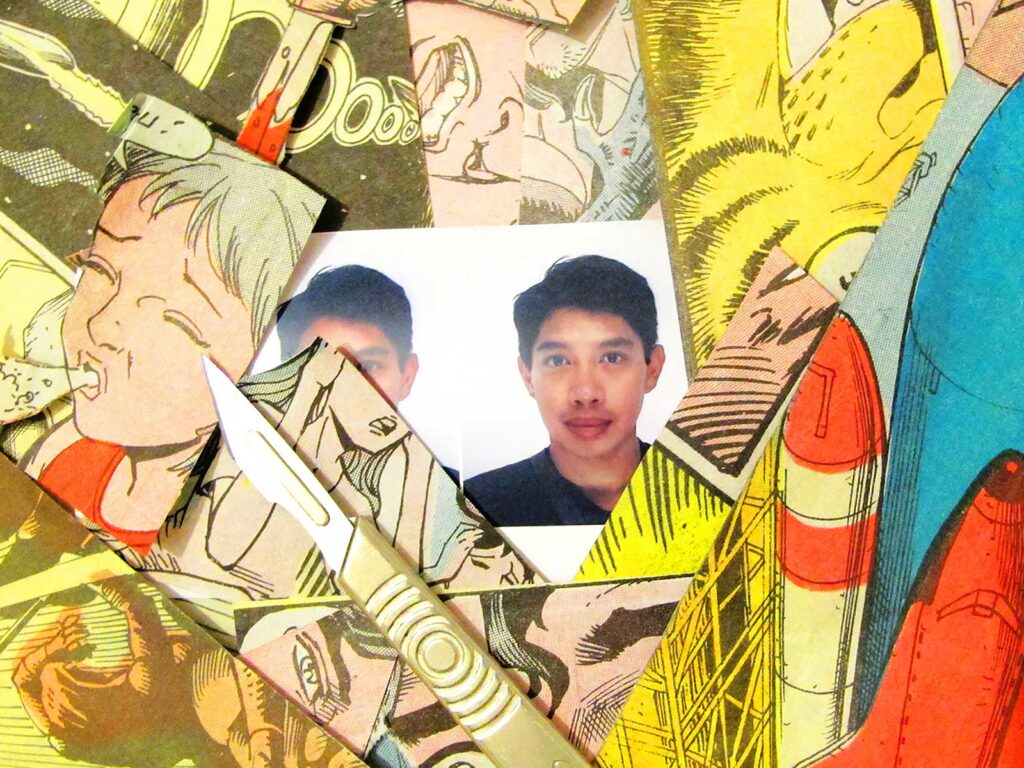
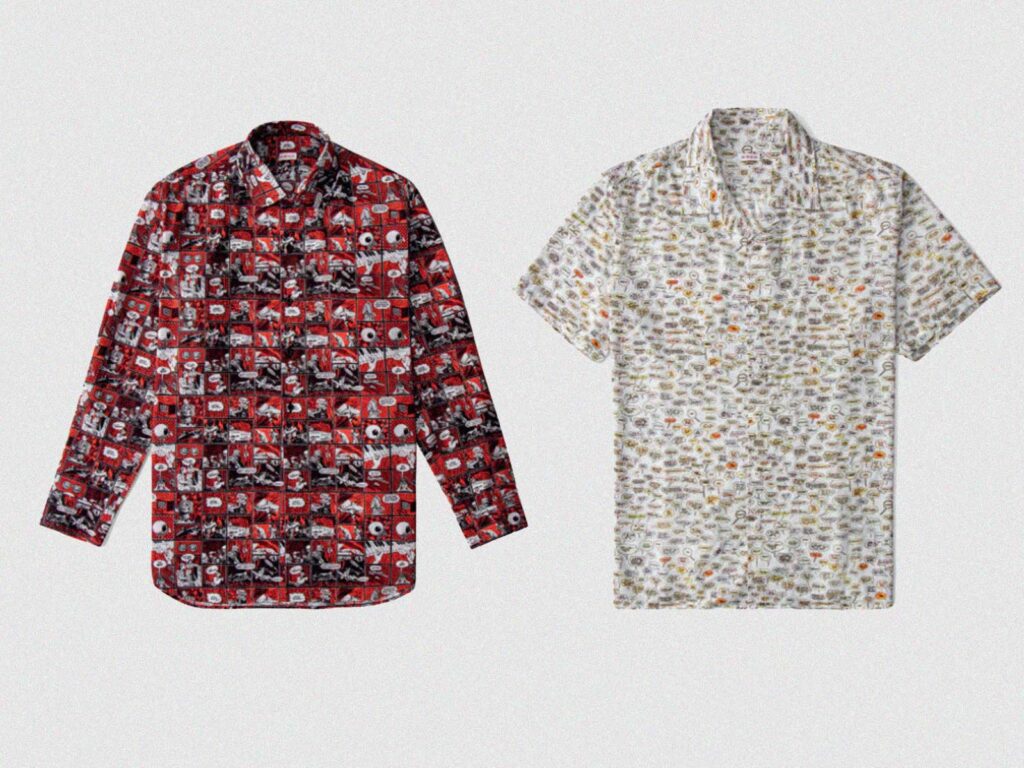
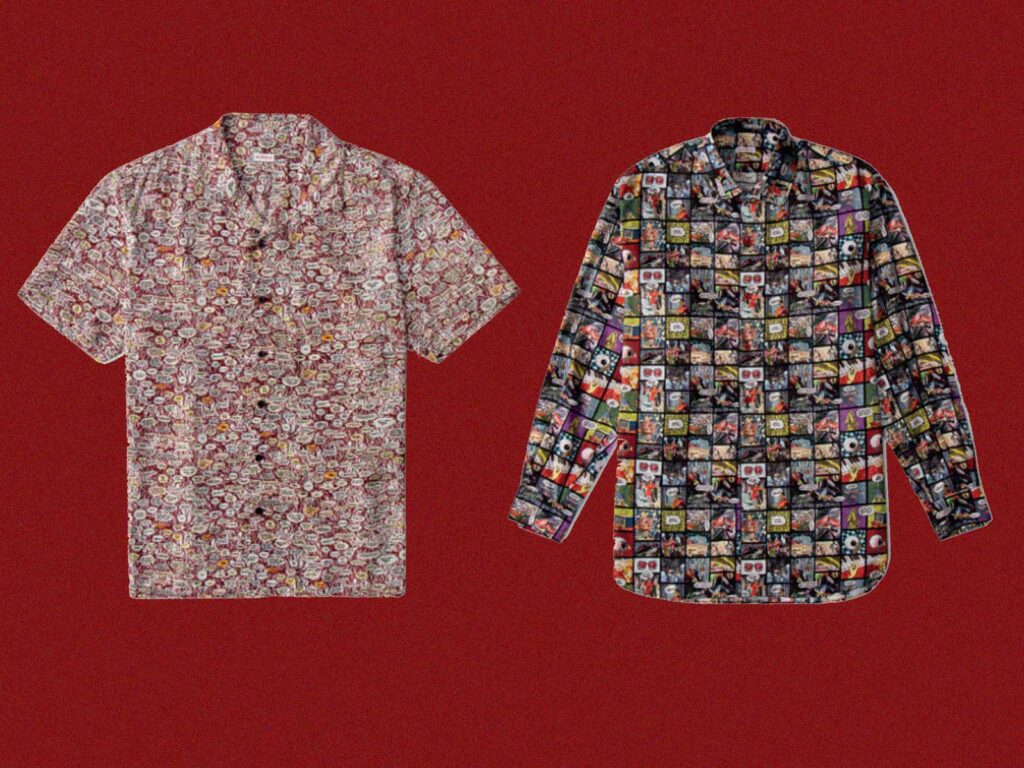
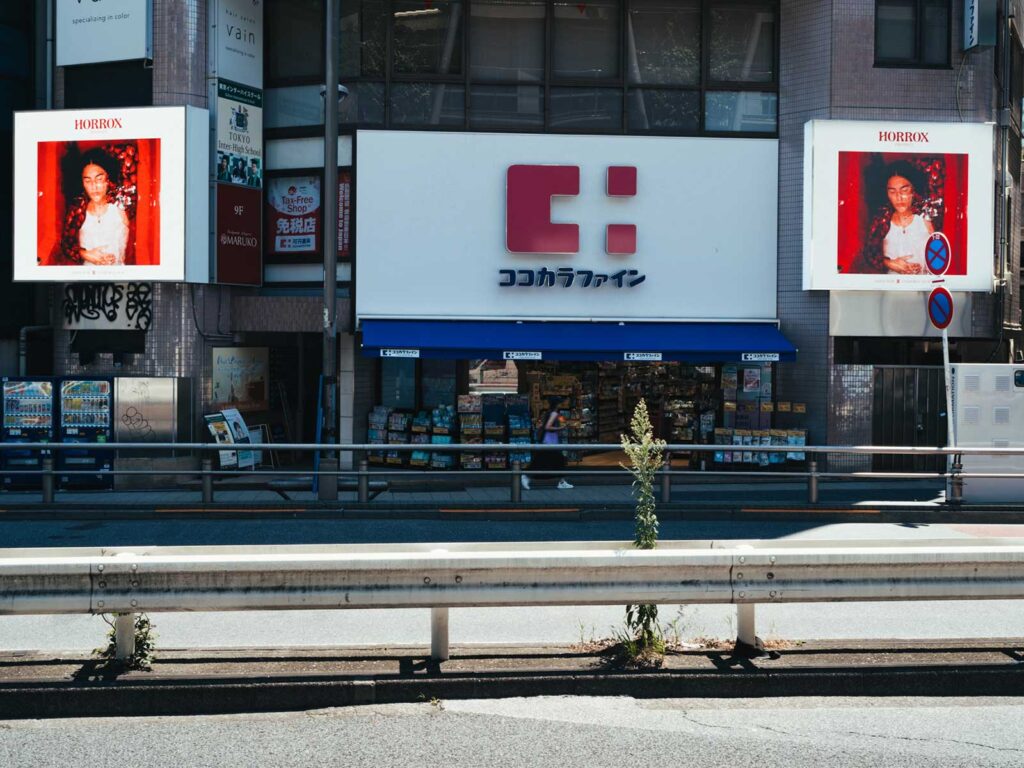
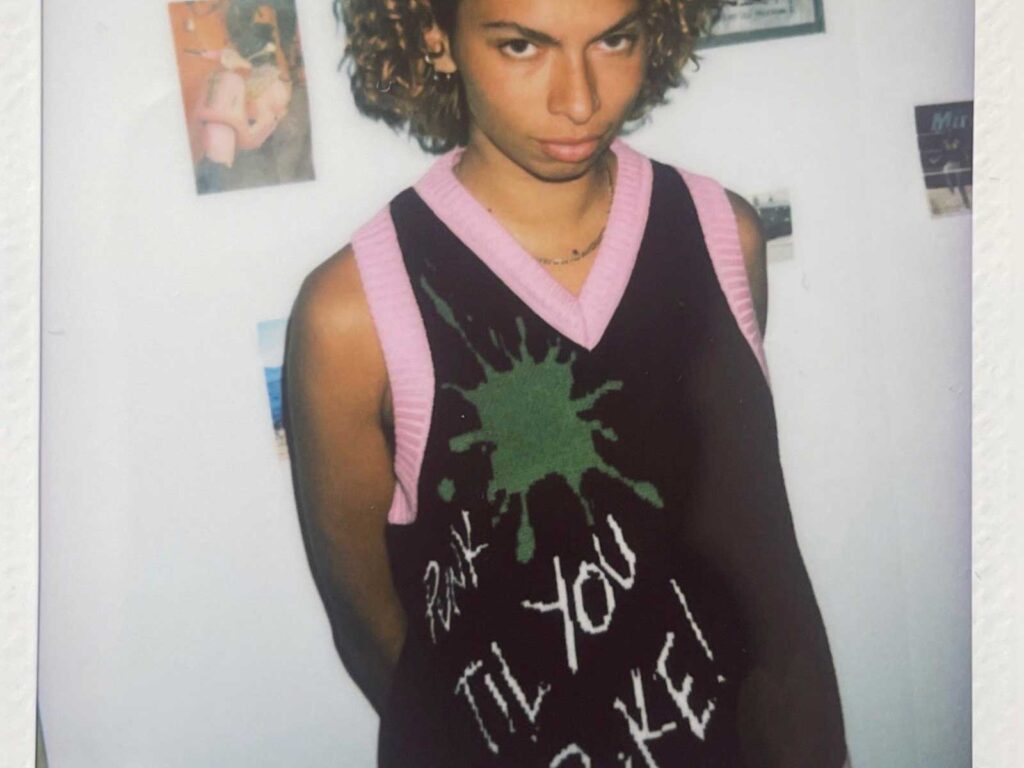
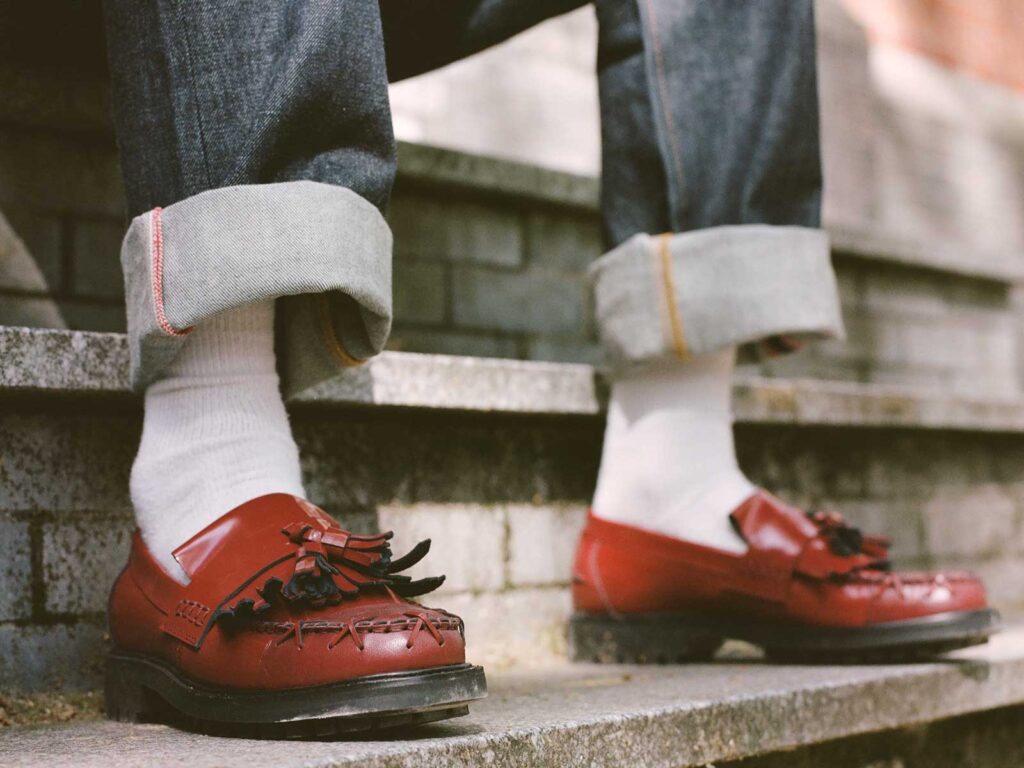
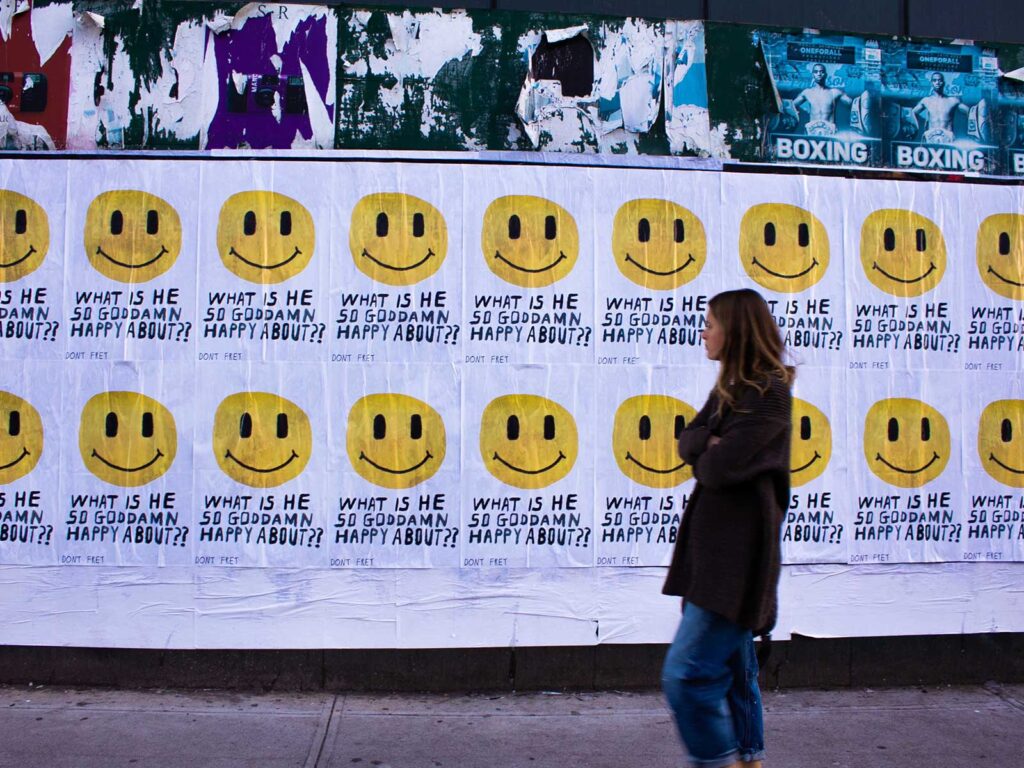
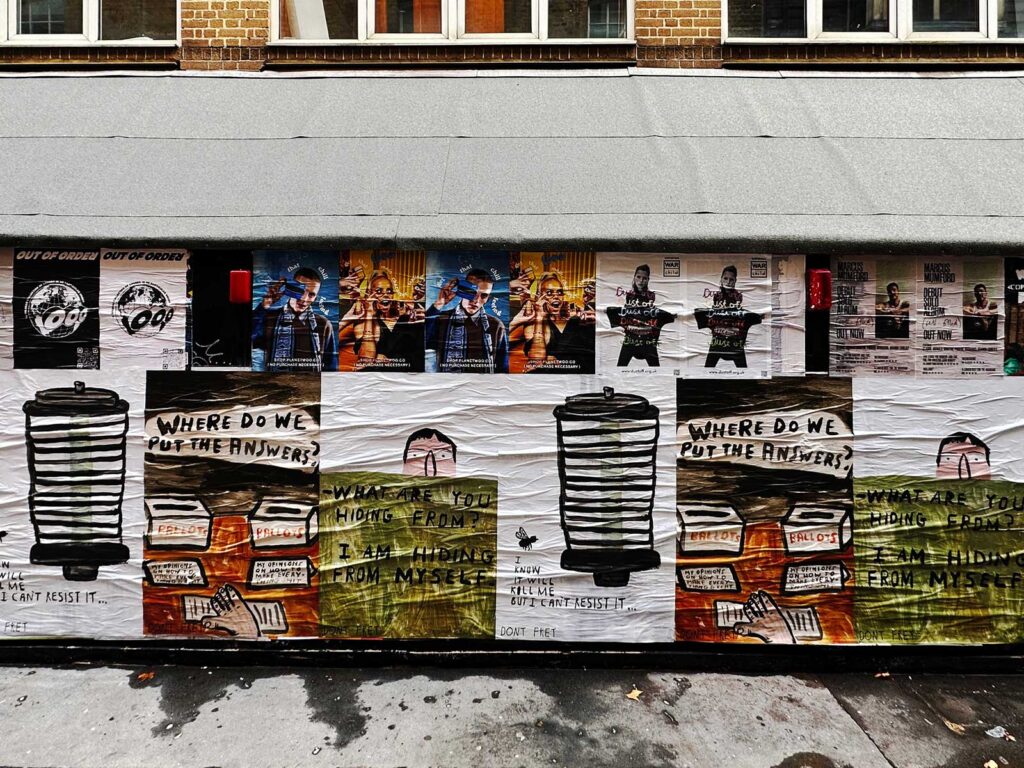
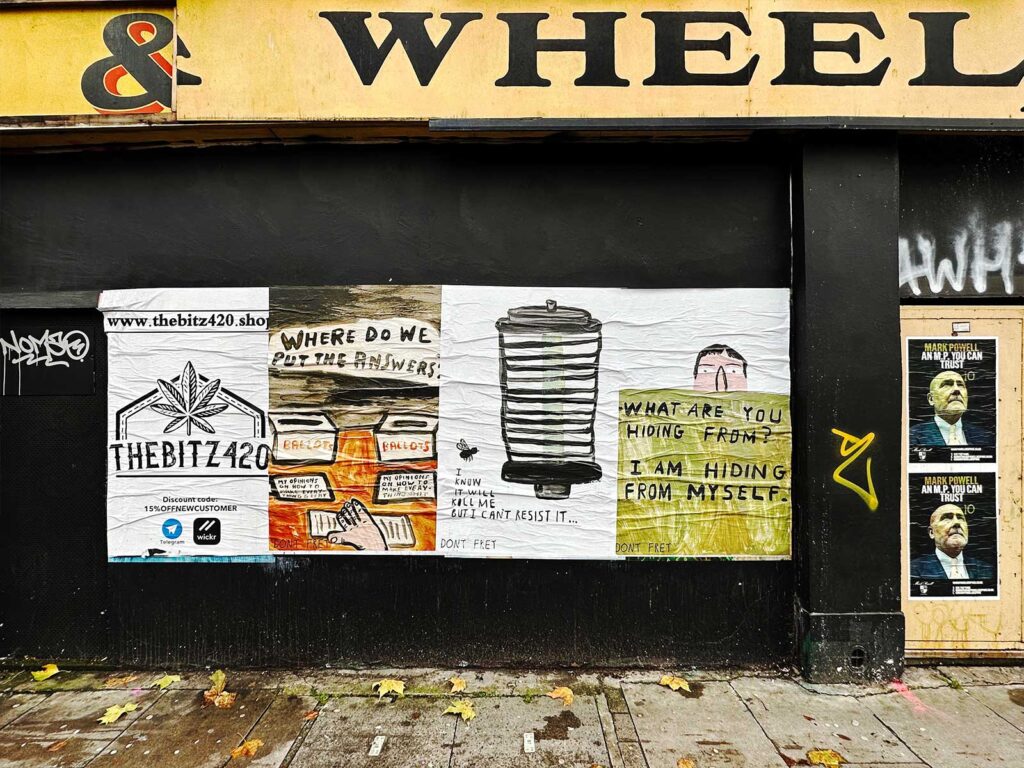
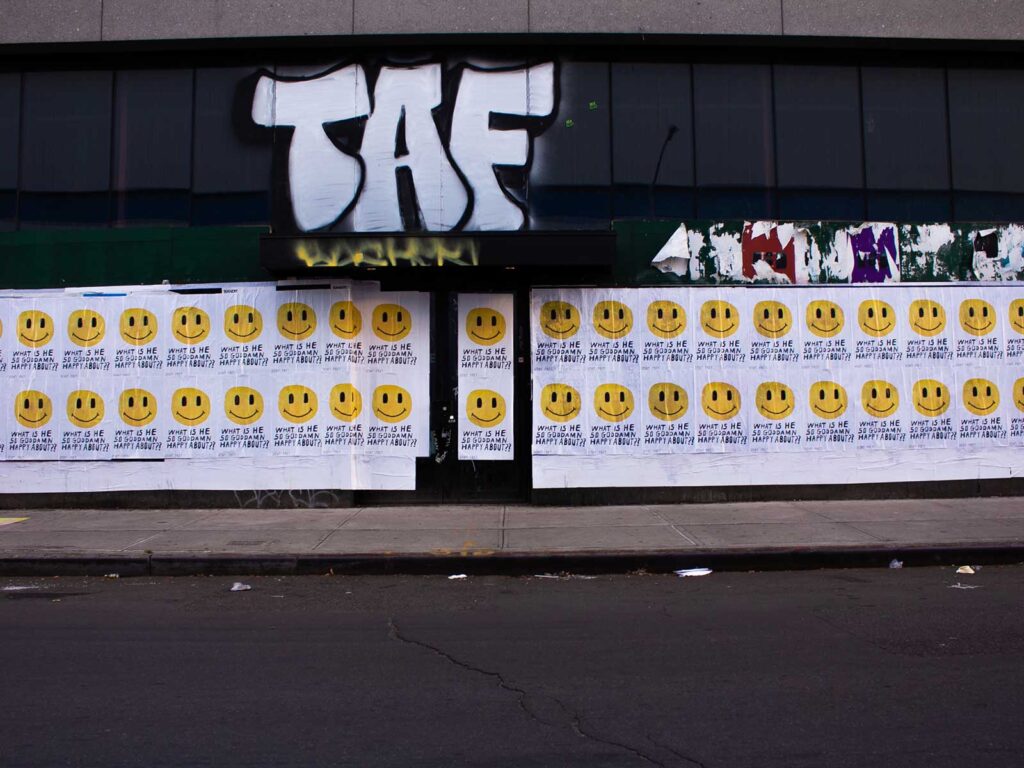
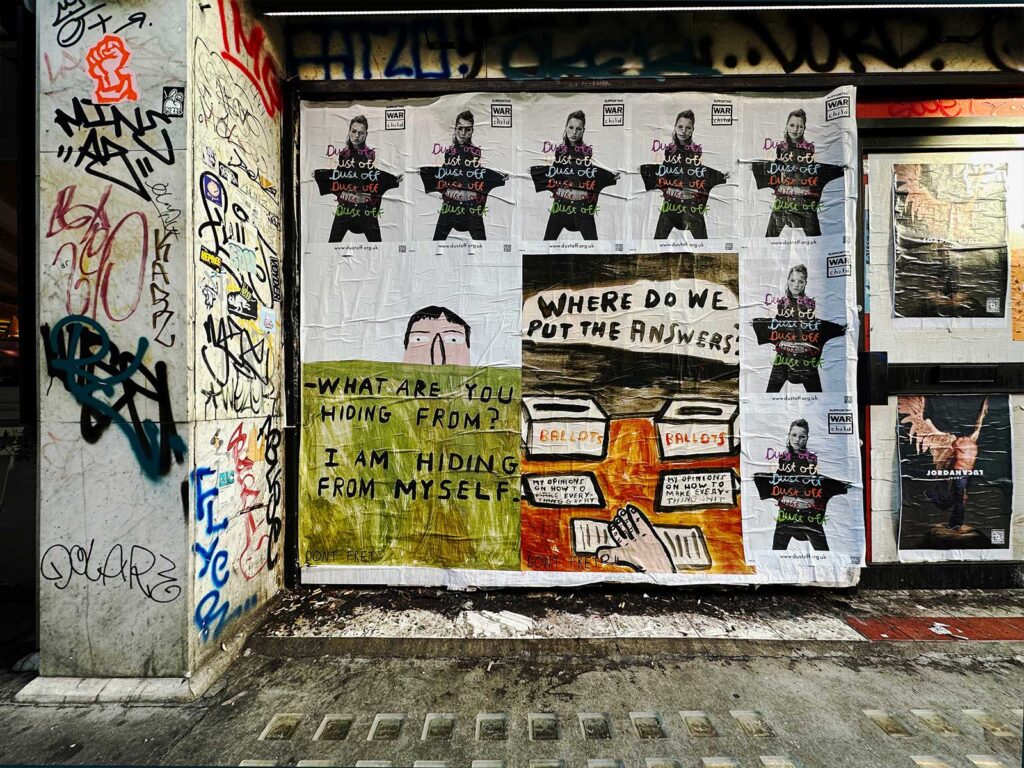
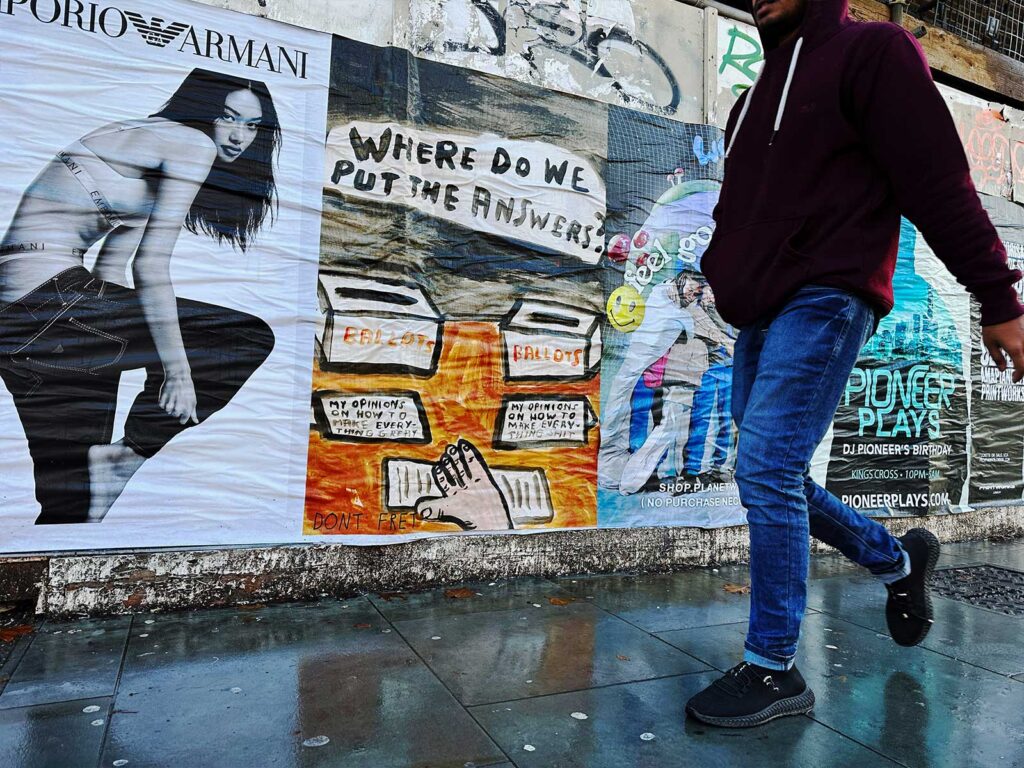
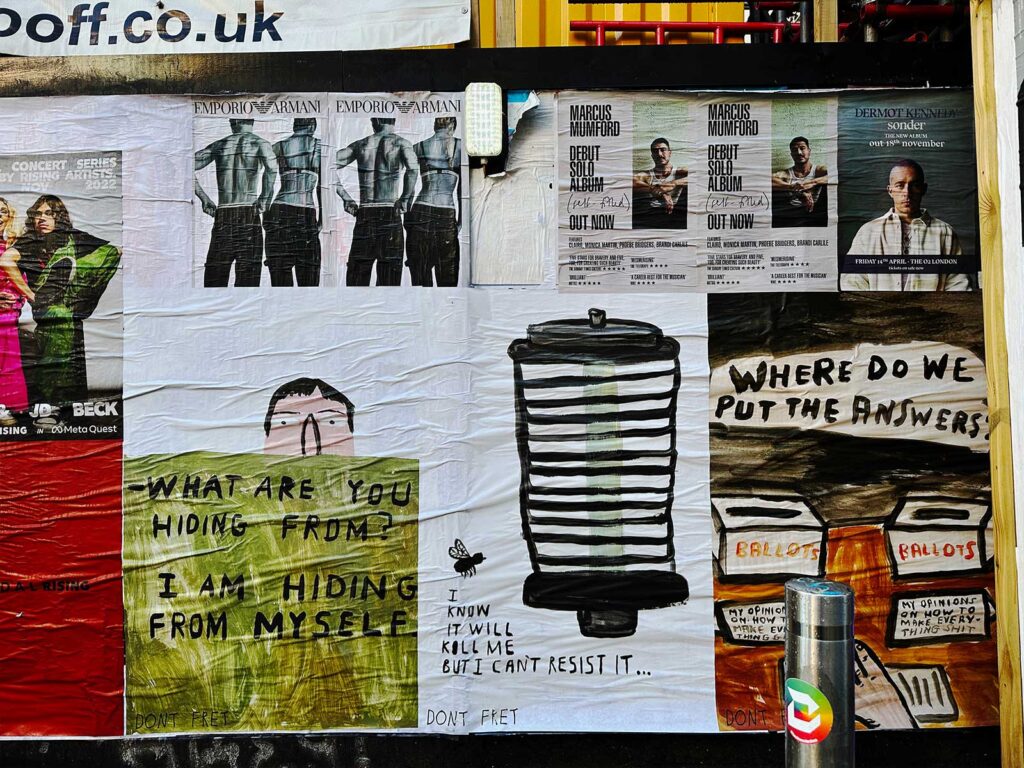
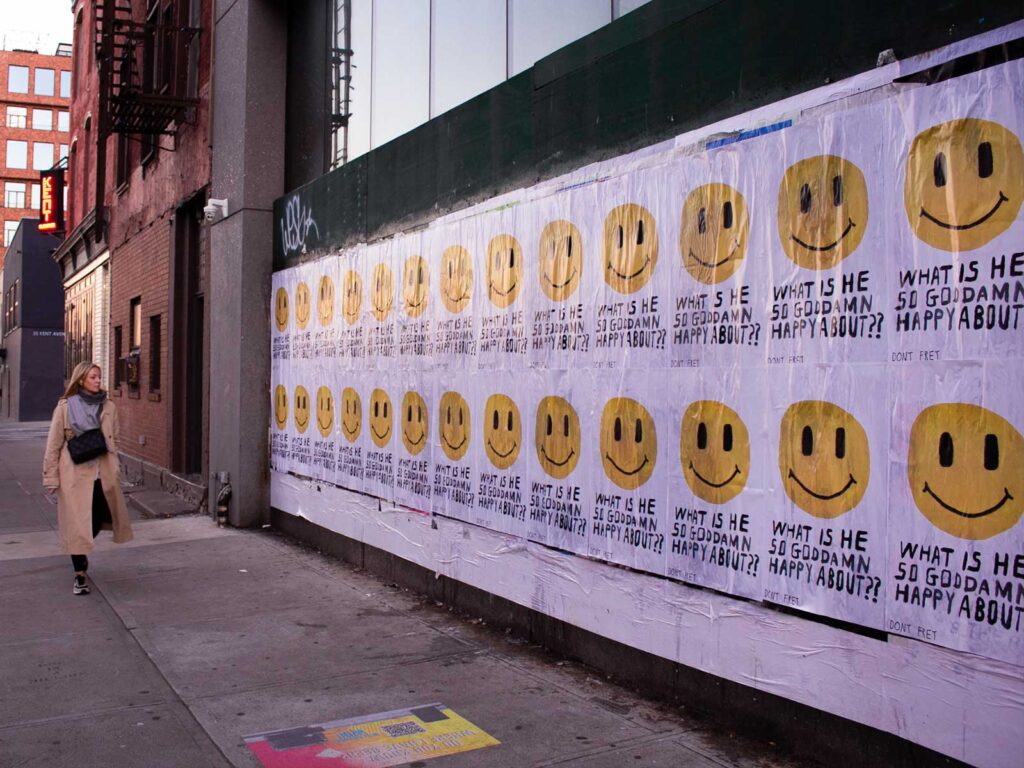
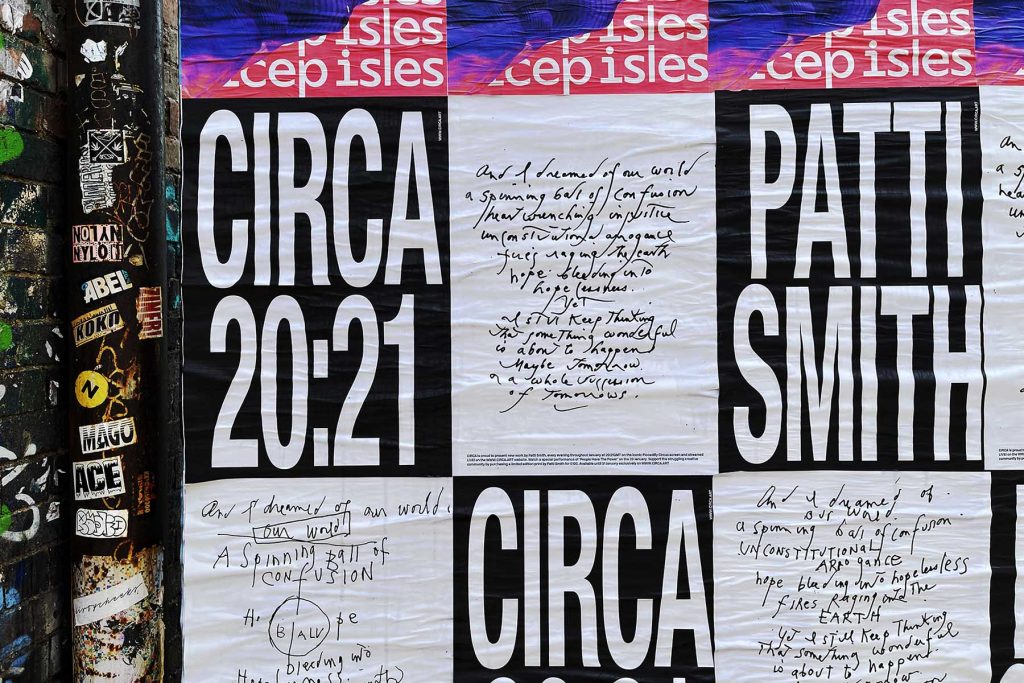
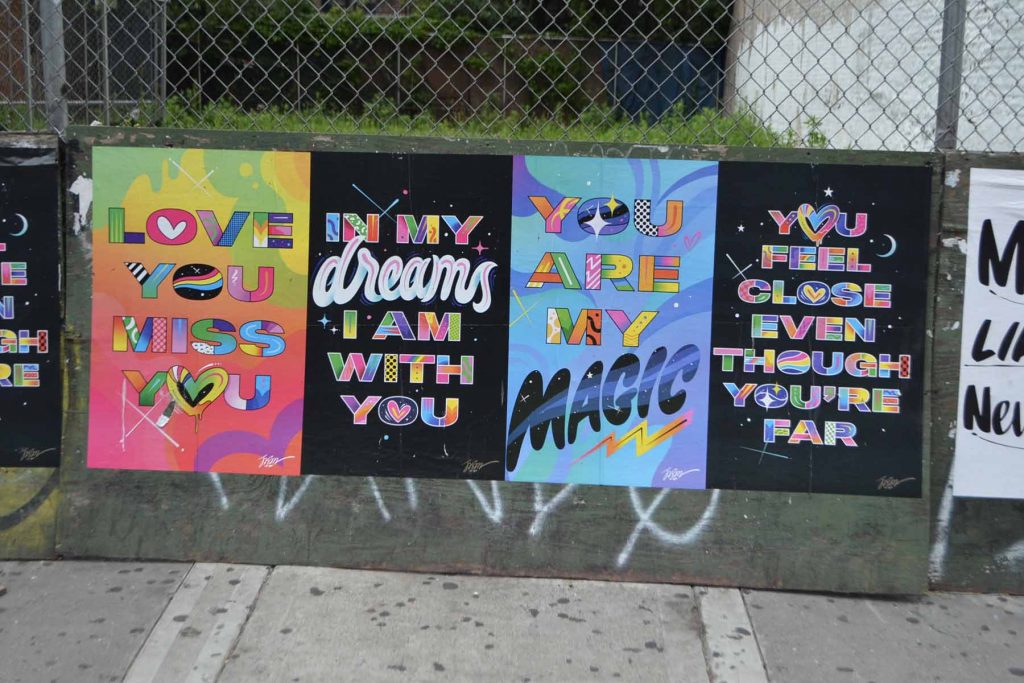
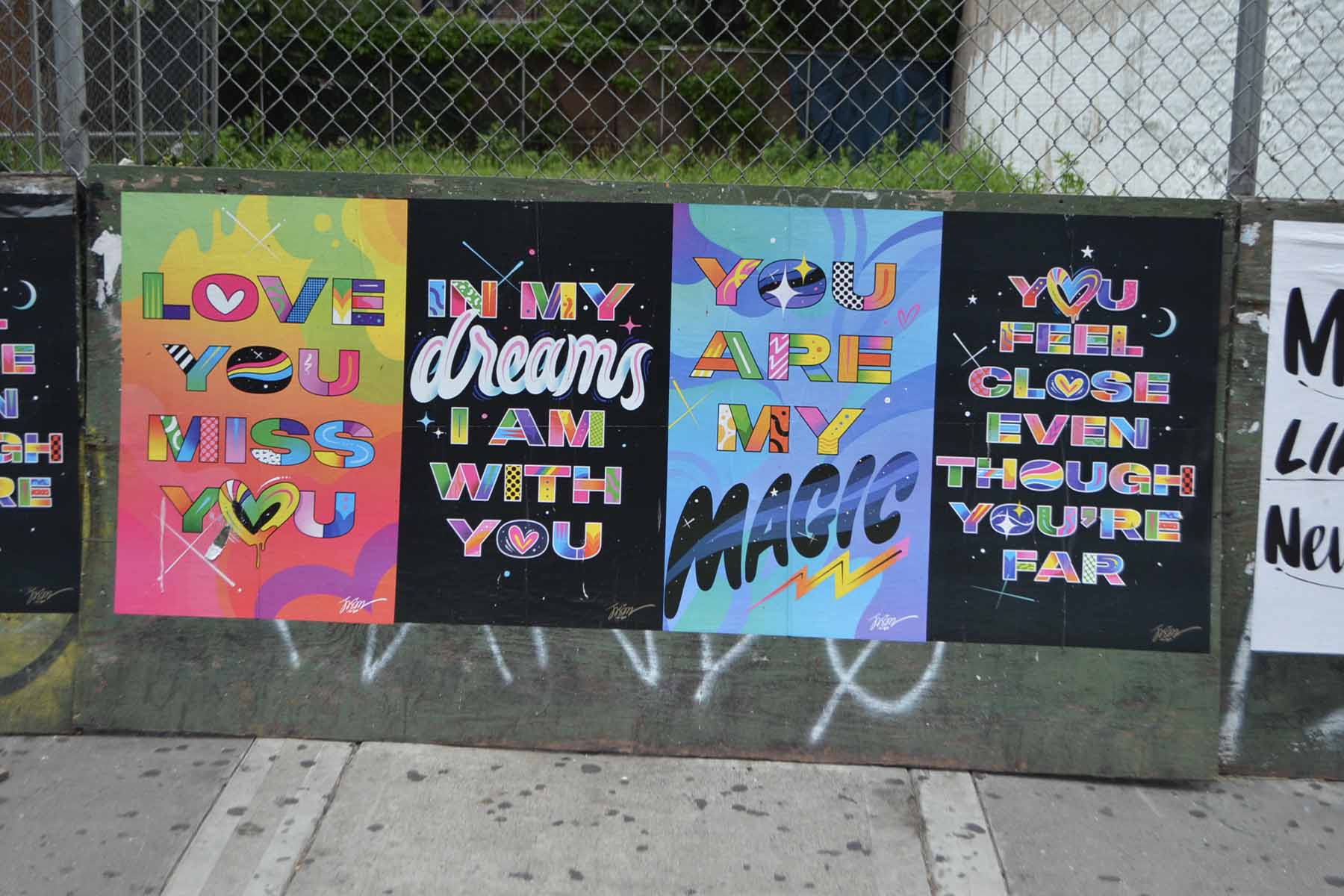
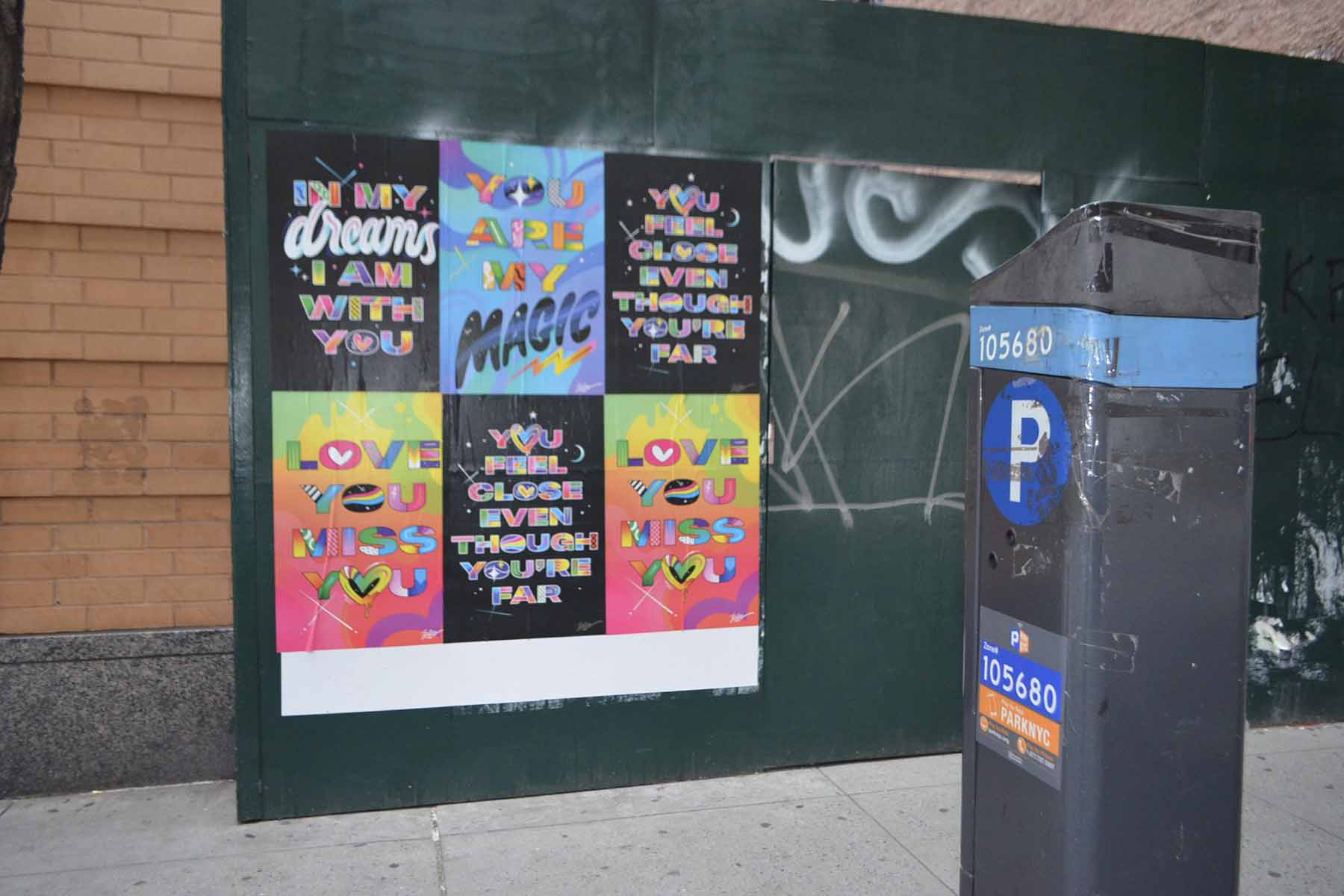
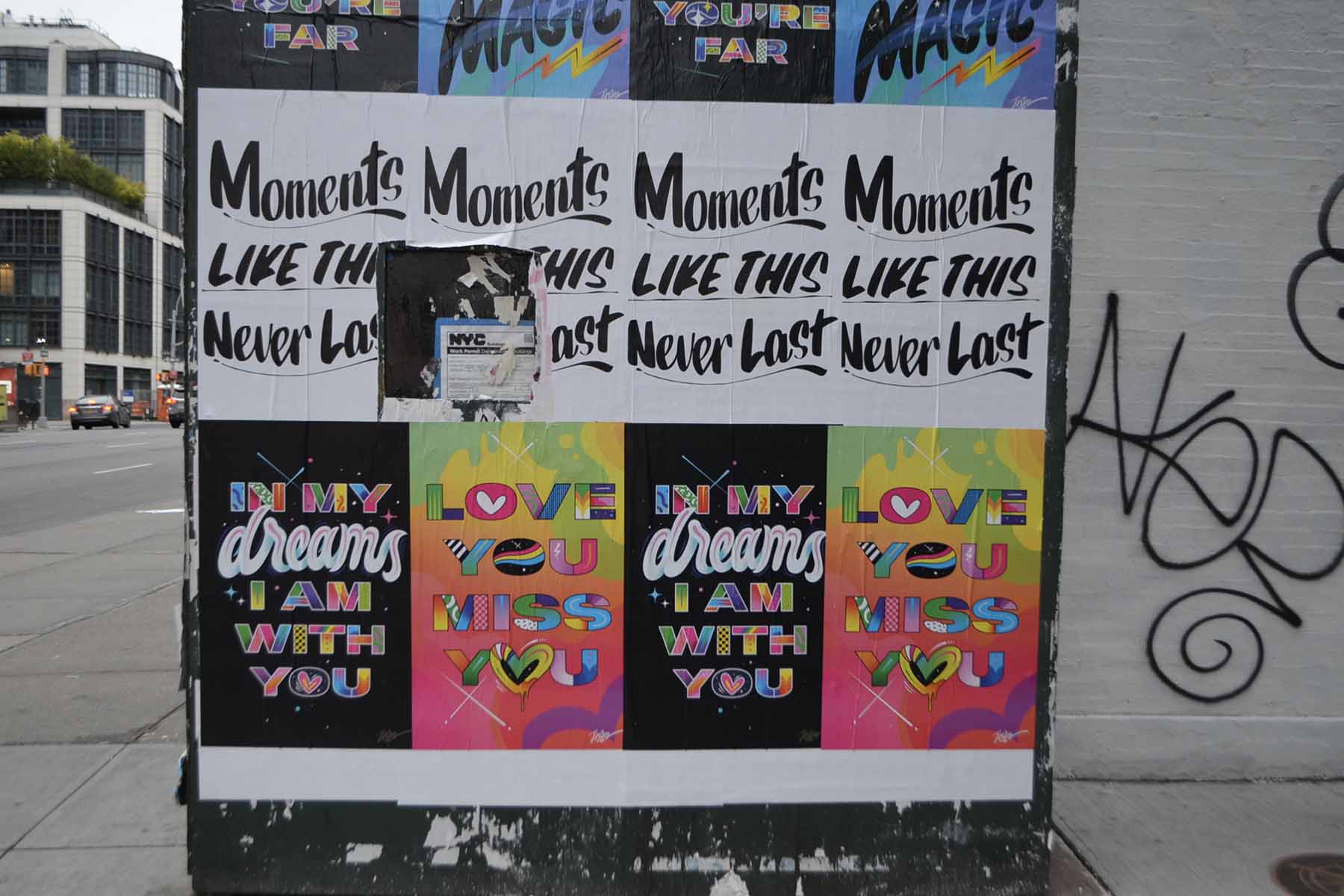
Once again, ME+EM hit New York hard to paste its new summer collection across the city, boldly showcasing its motto, “Intelligent style, now and forever”.
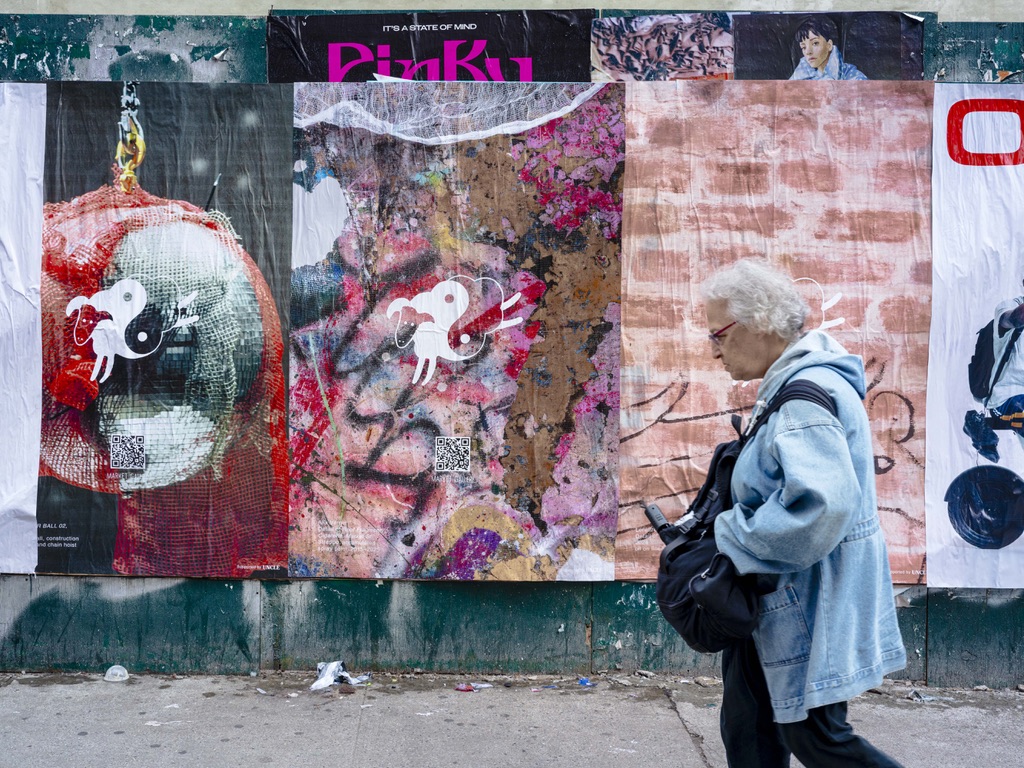
UNCLE supported the brand by deploying 72″ x 48″ wildposting formats in the heart of Manhattan, turning busy streets into a striking visual statement. ME+EM successfully magnified the brand’s chic essence, capturing the best of the streets.
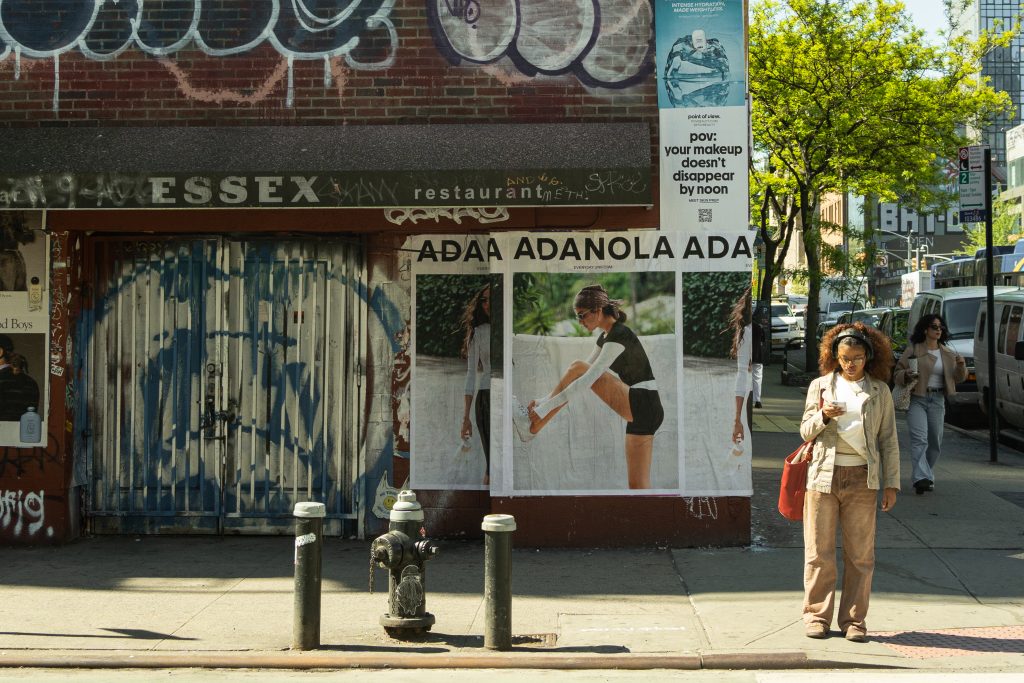
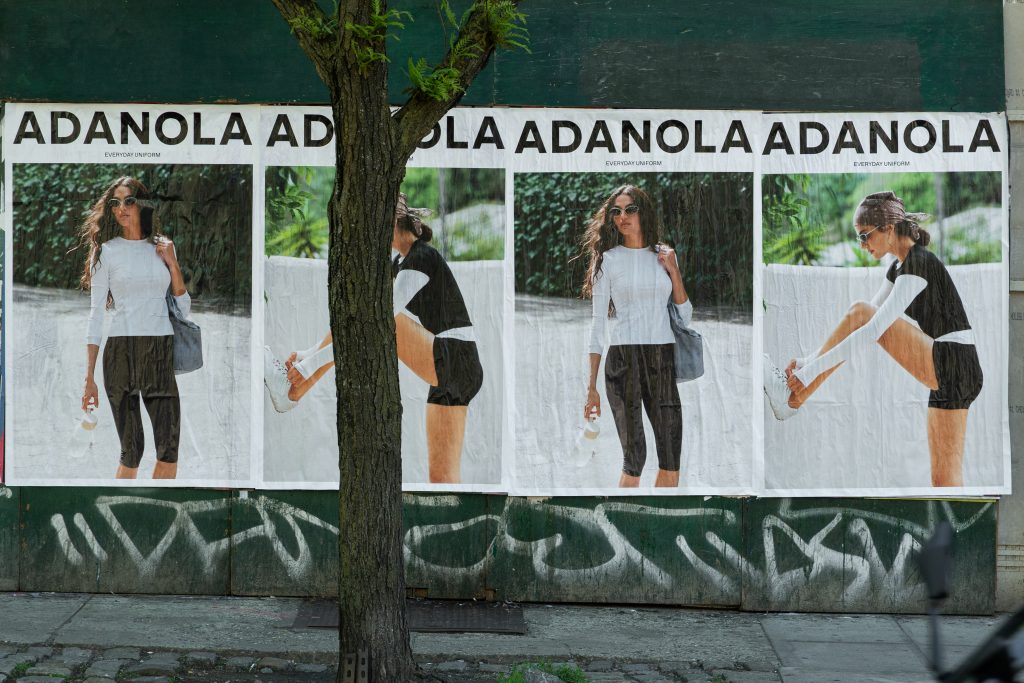
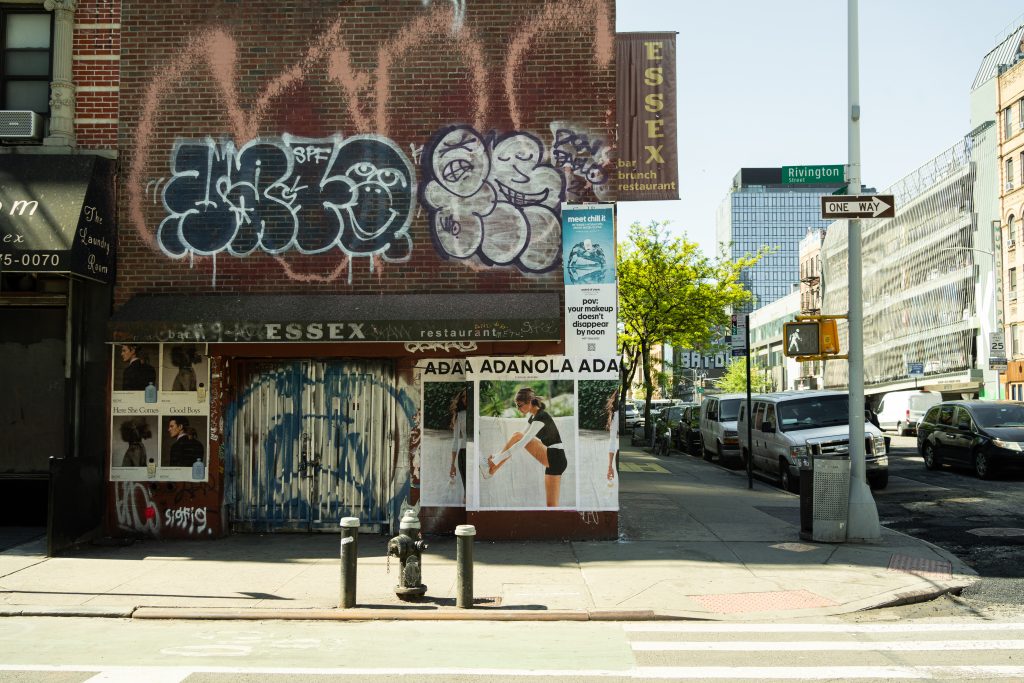
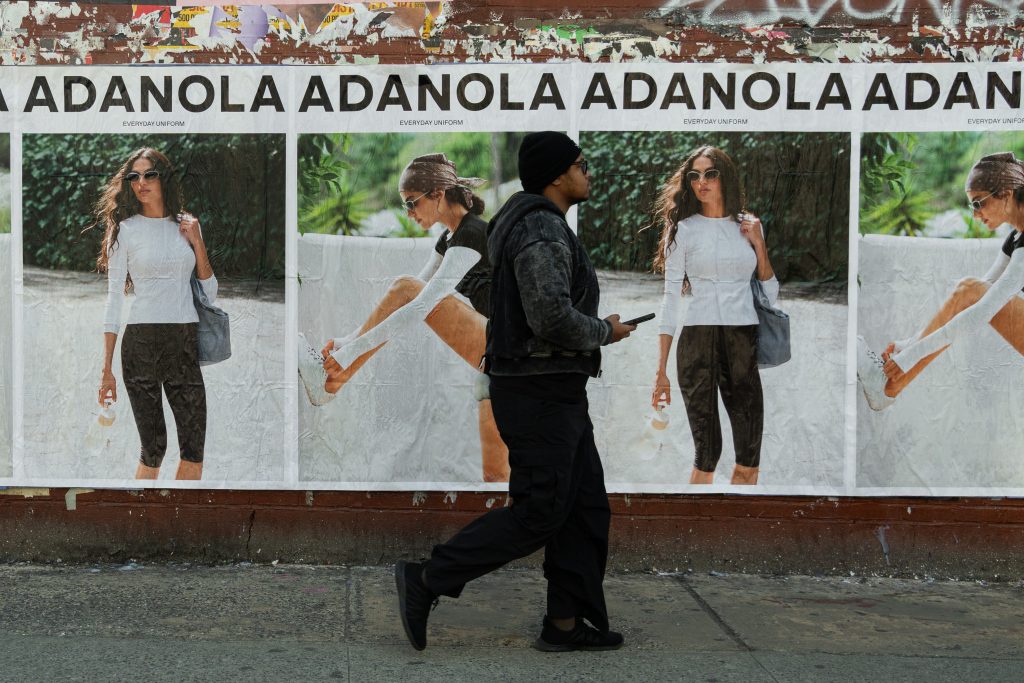
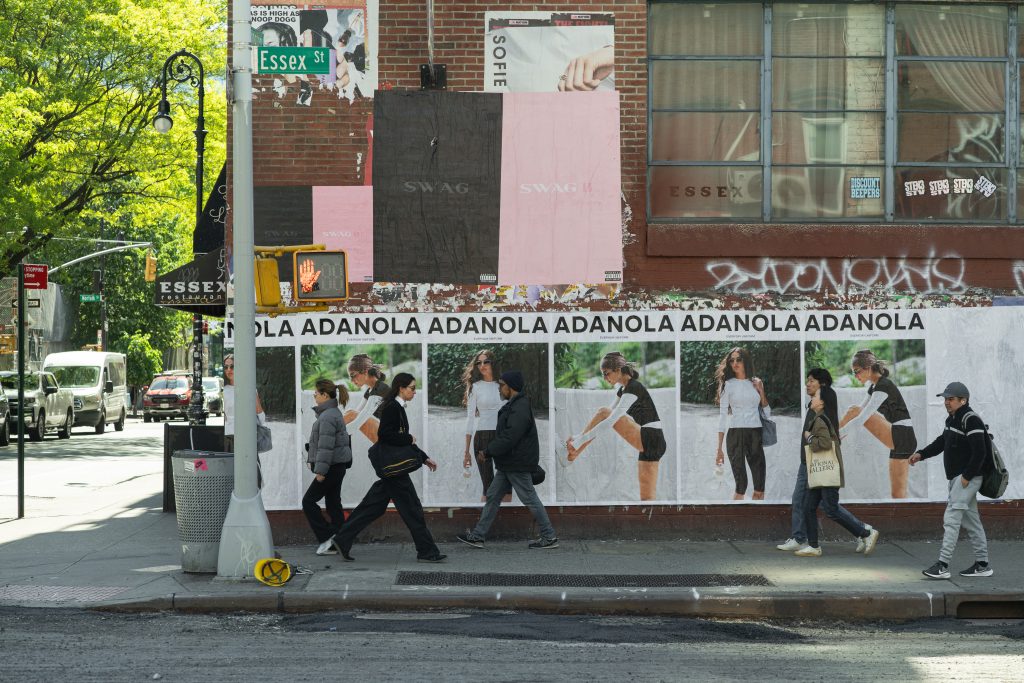
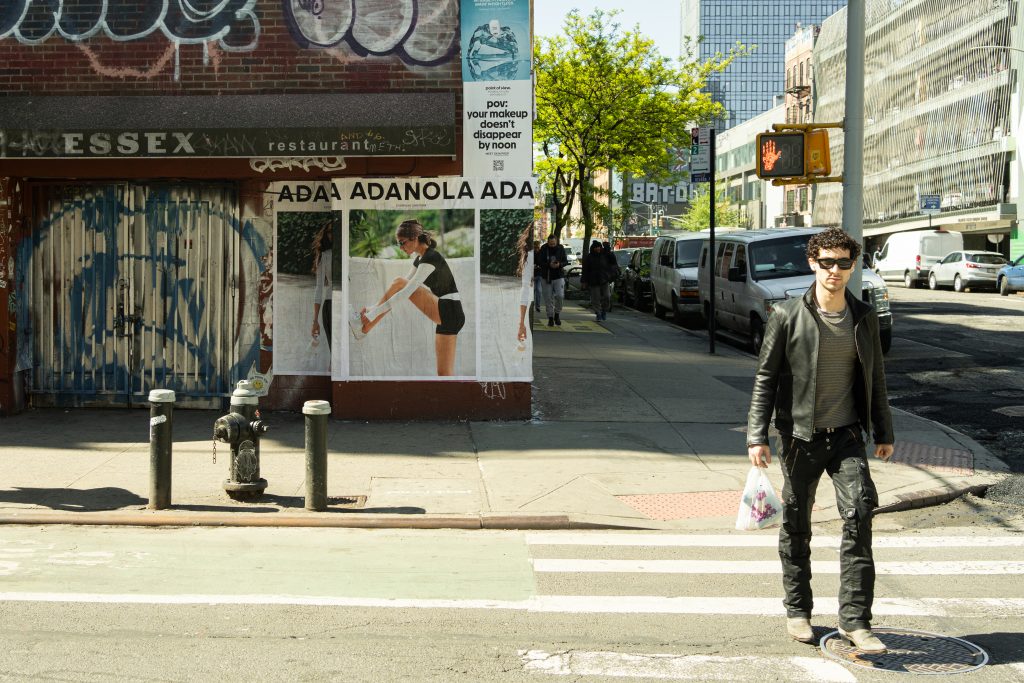
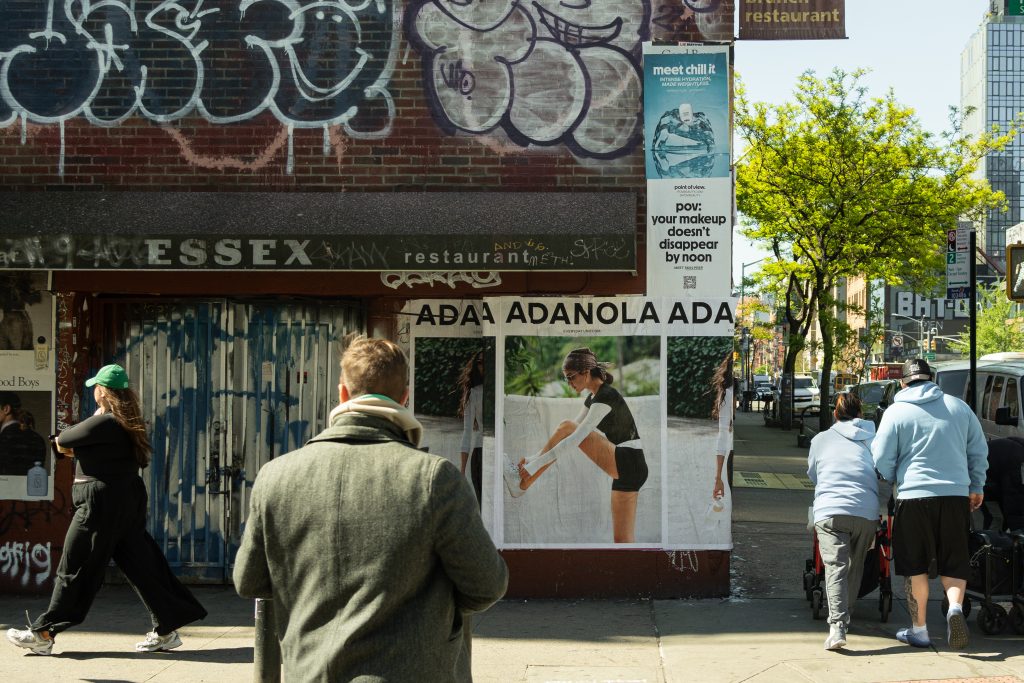
Coffee in hand, leggings on, city conquered. Adanola joined UNCLE for a high-impact takeover of the New York streets. This campaign commanded the city’s attention, promoting the latest collection with a singular ‘everyday uniform’.
Raw 72″ x 48″ flyposting saturated Manhattan’s most iconic locations. The display brought a sense of effortless poise to the rugged city walls. The brand’s lifestyle felt truly contagious, proving that comfort remains the ultimate luxury.
Limitations have been acknowledged to assist creativity, almost to the verge of cliché. But such sentiments resonate because, at one point, or in some circumstances, they are true. Sometimes the best camera is the one in your hand.
The New York loft jazz scene of the 1970s offers an example. As the formal jazz economy stopped making enough room for serious avant-garde players – clubs, labels, studios and the wider commercial circuit no longer reliably sustaining that work – musicians began building their own spaces instead, using lofts, apartments, factories and warehouses across Lower Manhattan.
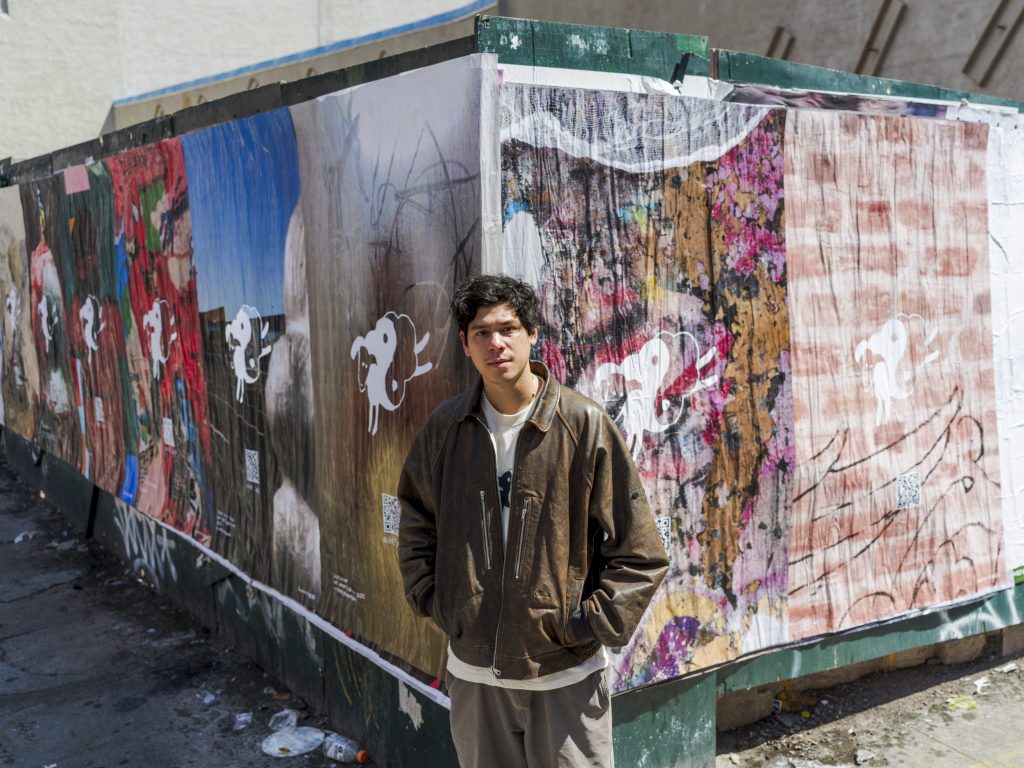
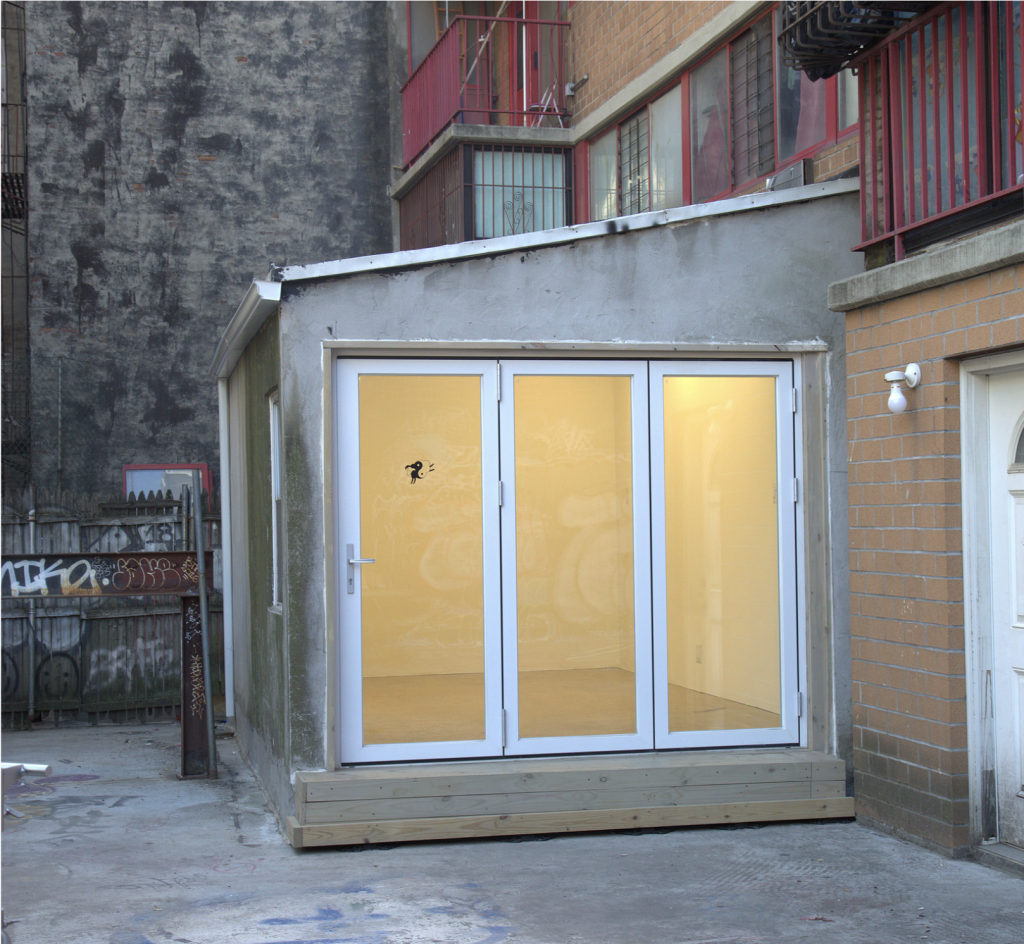
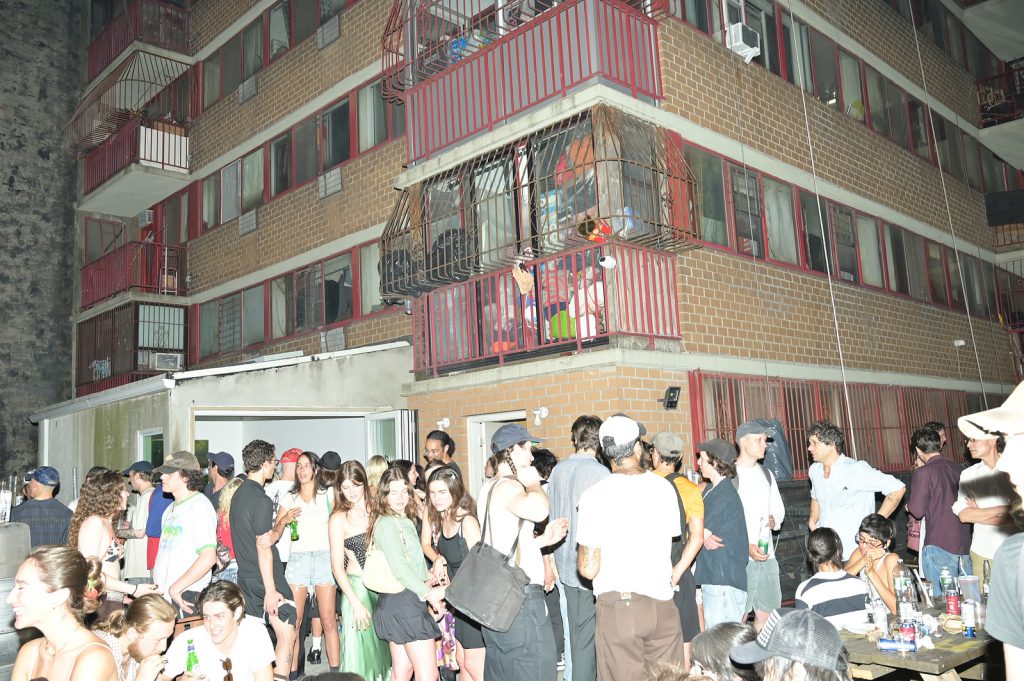
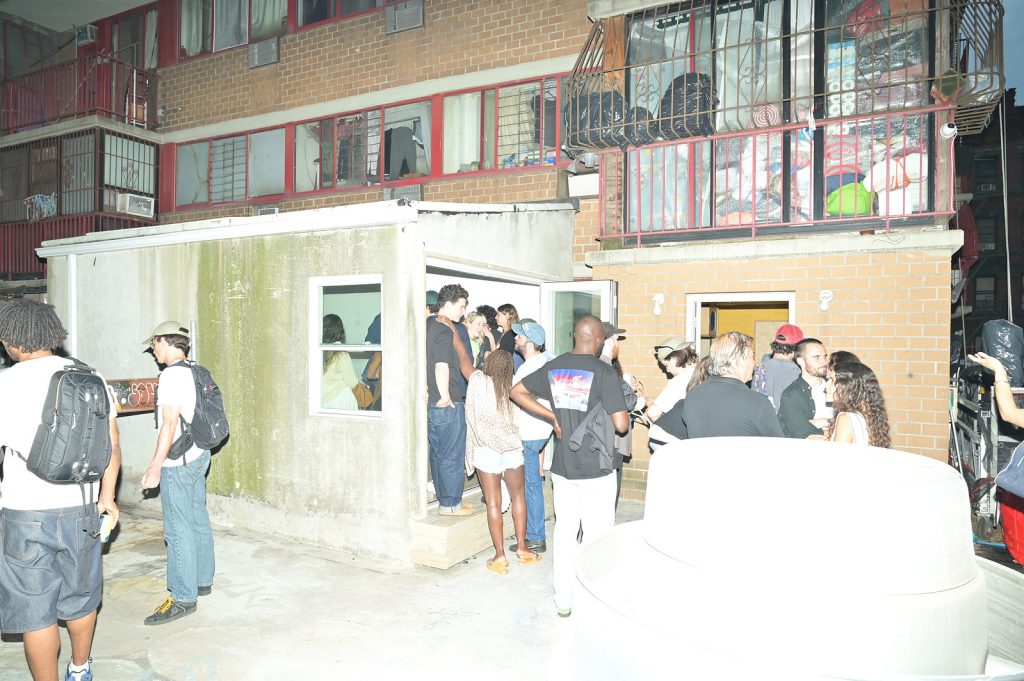
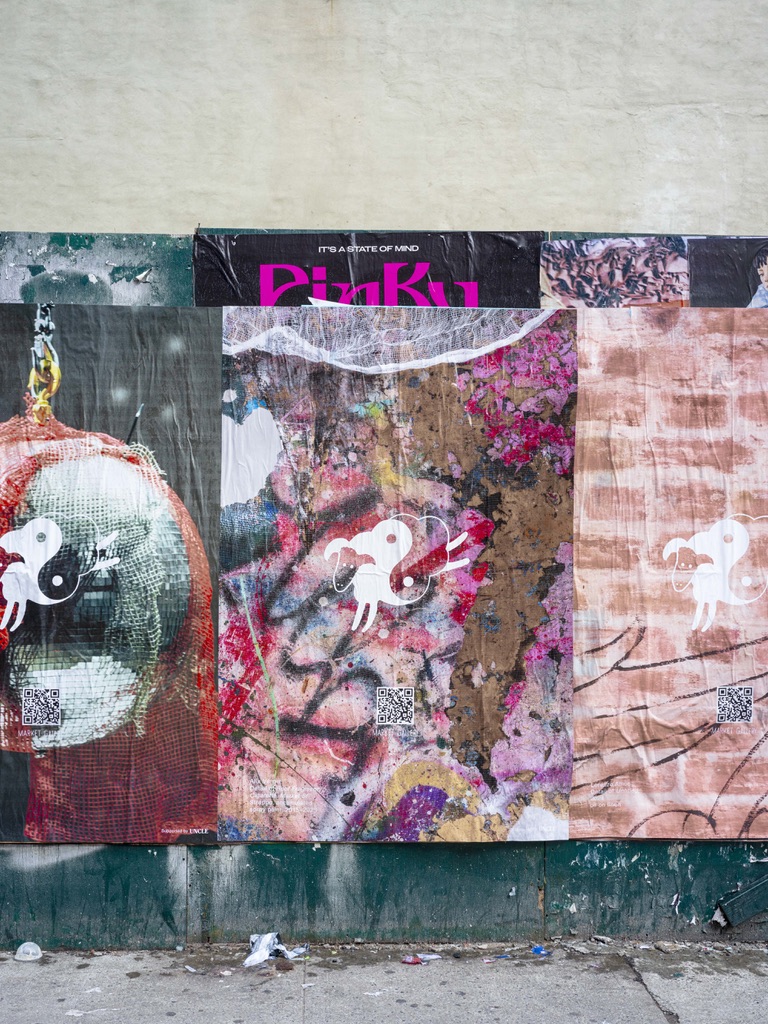
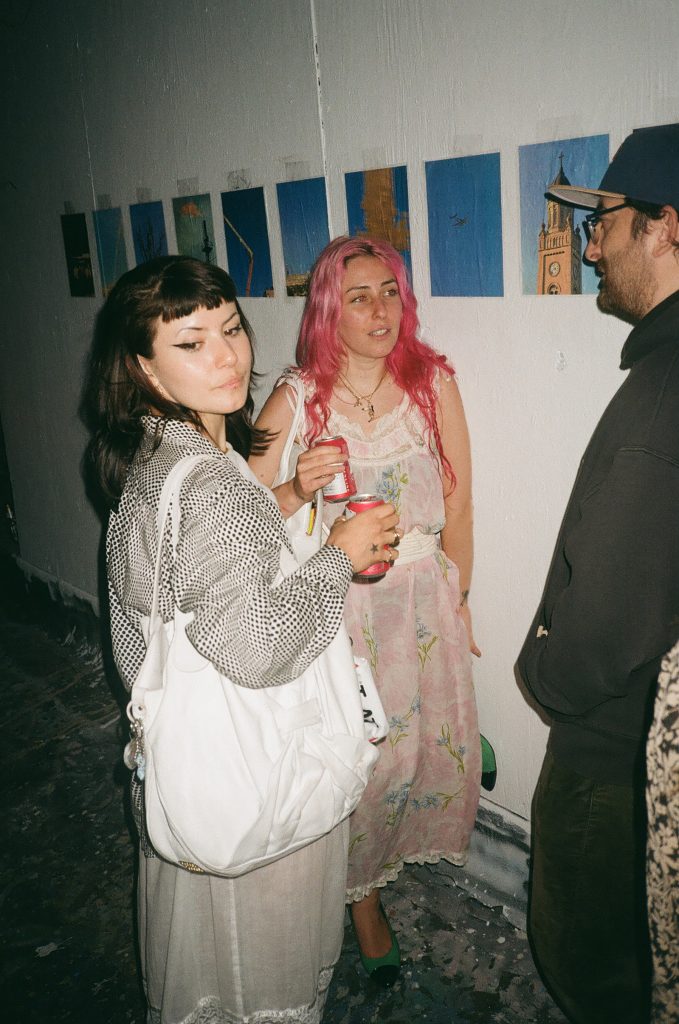
There is something of that lineage in Market Gallery, the Chinatown project founded by Adam Zhu. “Market Gallery is a gallery staged in a shed on my rooftop,” he says. Accessed by walking through his apartment and onto the roof, the space sits above Market Street and has become one of the more distinctive small galleries in downtown New York. That unusual route is part of the point.
“It’s not like I’ve had the doors open to what you might consider the establishment of the art world,” he says. “There’s a difficult space for the middle ground right now. You have your blue-chip galleries and your small galleries, and creating space for artists to express themselves without the pressures of the market is not so easy to come by.”
New York City might feel endless, but despite having a similar-sized population, it actually covers half the size of London. Different cities, different densities, but close enough to make the pressure on space in New York easy to feel. Zhu feels it too. “Space is hard to come by in Manhattan,” he says, “so I knew I needed to take advantage of it.”
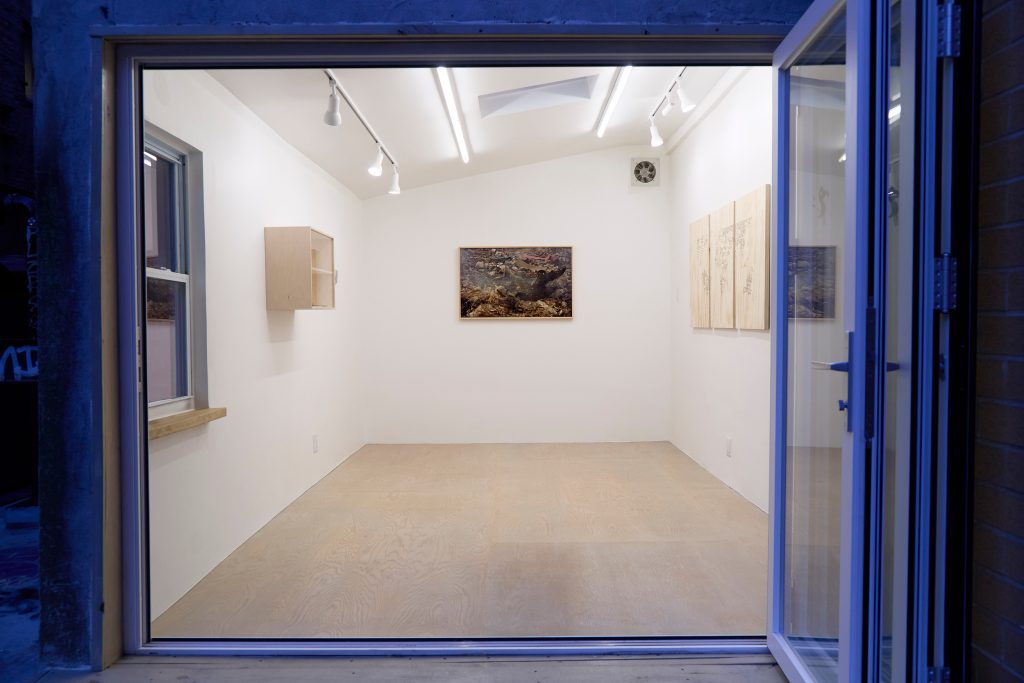
That sense of resourcefulness runs through the whole project, but so does the quality that comes from that intimacy. The shed is not being presented as some charmingly ramshackle anti-space. Zhu renovated it properly: white walls, wood floor, a real gallery built from what was available rather than delayed until something bigger or more official came along. Artists including Andrew Kass, Rachel Simon, Lorenzo Amos and Marcus Jahmal have all helped define what the space can do, often whilst Adam is grilling food for guests nearby.
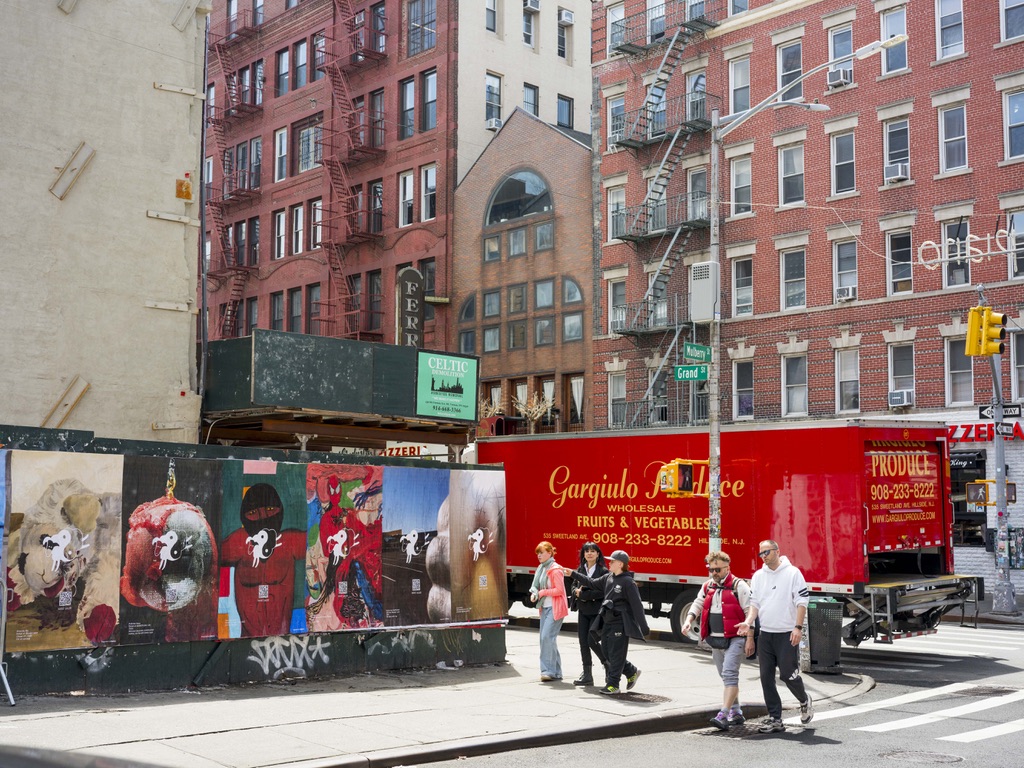
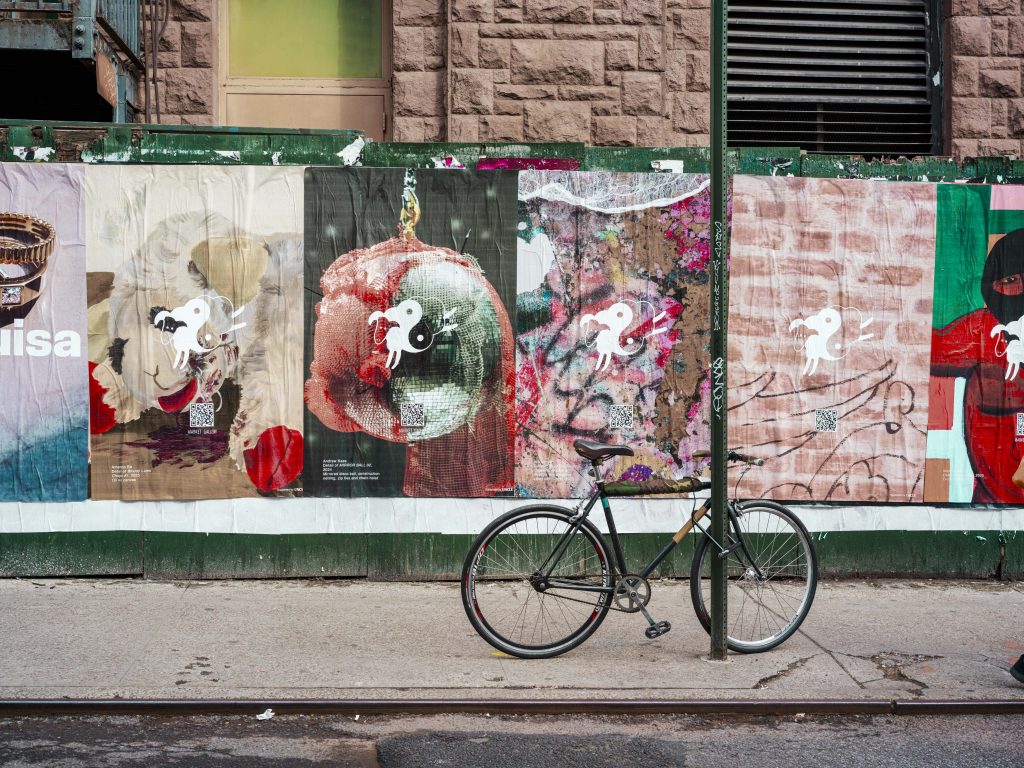
Market Gallery may be hidden above the street, but it has always been shaped by the city below it – by Chinatown, by New York, by the pressures of downtown life, and by an art world in which visibility is never evenly distributed. With UNCLE, work exhibited in the rooftop shed now comes back down onto the street, extending the gallery’s reach without losing the spirit that made it worth paying attention to in the first place.
Because sometimes the best gallery is the shed on your rooftop.
FIRST OFF, COULD YOU INTRODUCE MARKET GALLERY TO SOMEBODY WHO’S NEVER COME ACROSS IT BEFORE?
Adam: It’s an apartment gallery where you have to walk through my apartment to a back roof area, where there’s a shed that we’ve converted into a gallery. The space is in Chinatown and has been a creative space in my home for the last ten-plus years. In summer 2024, I decided to renovate it into a gallery. It was previously a studio, a music studio, storage — it was used for many different things over the years — and kind of got rotted out and fell apart. The recent version is the most elaborate one, where it feels like a gallery: white walls, wood floor.
HOW DID MARKET GALLERY ACTUALLY COME TO BE? WAS THERE A PARTICULAR POINT WHERE YOUR APARTMENT, THE SHED, AND YOUR WIDER CREATIVE WORLD CLICKED INTO SOMETHING THAT FELT LIKE A GALLERY RATHER THAN JUST YOUR OWN SPACE?
Adam: It kind of snowballed. It’s always been a creative space, my house, and the question of what to do with that space started more as: I have to renovate the shed or demolish it, because it’s falling apart and in disuse. My friends who were using it were in a jazz band called Onyx Collective, and they had stopped using it because they had other studio space, but also because it had become quite mouldy and the floor had caved in. I hadn’t personally used it in quite a while and came to this realisation: if I fix this up, what do I do with this space?
I’d always curated shows, and it actually isn’t the first time I’d done something like an art show using my space out there. It kind of became okay, maybe we can have gallery shows out there. It really started as something I thought could be cool for 20 people to 50 people — my friends, basically.
Once I was investing in the construction, it wasn’t until it was nearing completion that I was like, oh — this is real. For me, it was the fact that I have this beautiful space now — and space is hard to come by in Manhattan — so I knew I needed to take advantage of it. Creatively, I was at a crossroads, and I thought this was a great platform for my friends, my community, but also an extension of my practice — something to keep me creatively stimulated, working with artists.
RESOURCEFULNESS FEELS LIKE A RUNNING THEME HERE. MARKET GALLERY CAME OUT OF MAKING SOMETHING SERIOUS AND THOUGHTFUL FROM A RELATIVELY SMALL, UNCONVENTIONAL SPACE. IN NEW YORK, IS THERE PRESSURE TO MAKE EVERY BIT OF SPACE COUNT? HOW MUCH HAS THAT SHAPED THE WAY YOU THINK ABOUT BUILDING A GALLERY?
Adam: I think growing up, even the curations I’ve been a part of, a lot of the shows I’ve been a part of have been on the fringe of DIY or using space in unconventional ways. One of the first group shows I was in was in an abandoned building.
That sensibility of always being like, okay, I have access to this space — how do I use it? — is always how I’ve gone about doing stuff in the creative world. It’s not like I’ve had the doors open to what you might consider the establishment of the art world. This has always been my way of doing things, and it’s how me and my friends do things too: if we have access to a raw space, or a studio, or something, that’s when the ball gets rolling on, okay, let’s do something with this space.
I think that’s a huge part of being a New Yorker and being young and creative when you don’t necessarily have access to real gallery space. My outlook on starting this was definitely from that perspective — how can I do something in the spirit of what we’ve always done, which is just use space, but maybe elevate it a bit and give a real gallery setting within the context of something that is more on the fringe of what that traditionally means, and without the barriers that we typically see in trying to enter those spaces in the art world.
ONE OF THE STRIKING THINGS ABOUT MARKET GALLERY IS THAT IT DOESN’T FEEL OVER-PROFESSIONALISED OR OVER-SANITISED. IT ALMOST FEELS LIKE BEING INVITED INTO SOMEONE’S LIVING ROOM. HOW IMPORTANT IS THAT INTIMACY TO WHAT YOU DO?
Adam: It’s basically integral to it. I always find it important to distinguish that it feels different from your typical small Chinatown gallery, because by nature the experience becomes quite a large part of what the gallery is. You have to go through my apartment, and you end up on my roof area. The gallery itself is quite small, but there’s quite a bit of space to mingle outside, so in that sense it feels more like a happening in a different way than other galleries, where you see the art and mingle under bright lights and end up on the sidewalk.
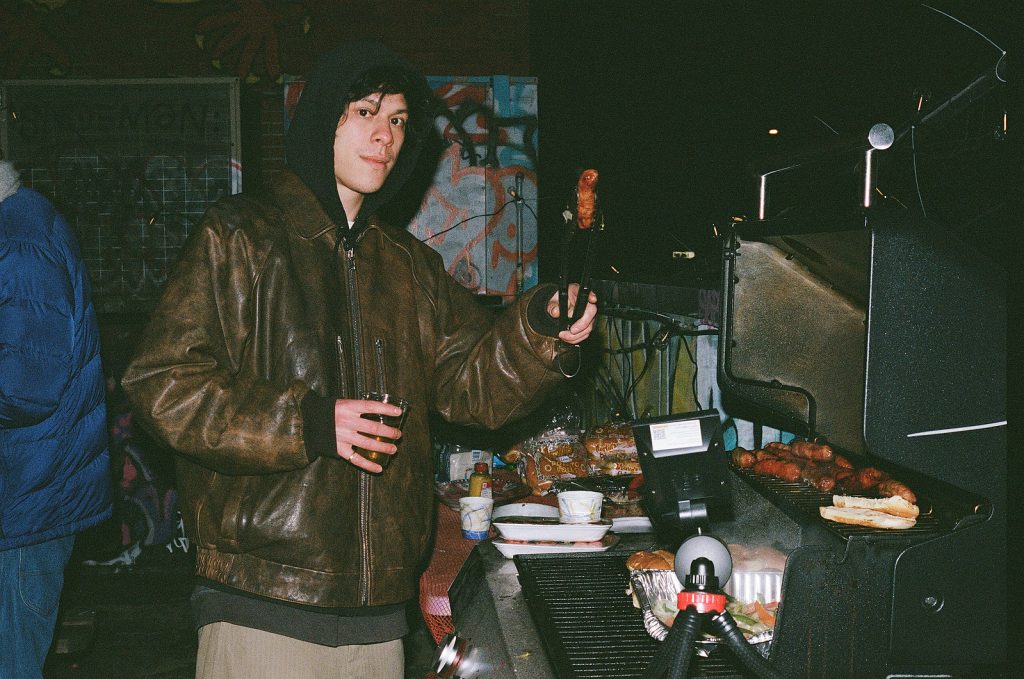
In this circumstance, you’re in my space. I’m normally cooking or grilling. It has a completely different energy than a lot of stuff I’ve been to, and I think that’s why people have gravitated to it in the way they have, and artists have as well, because it has this element of community and authenticity that is just palpable in the setting itself.
YOU’VE WORKED WITH ARTISTS THROUGH EXHIBITIONS AND RESIDENCIES. ARE THERE ANY PARTICULAR COLLABORATIONS OR SHOWS THAT FEEL ESPECIALLY IMPORTANT IN THE STORY OF MARKET GALLERY SO FAR?
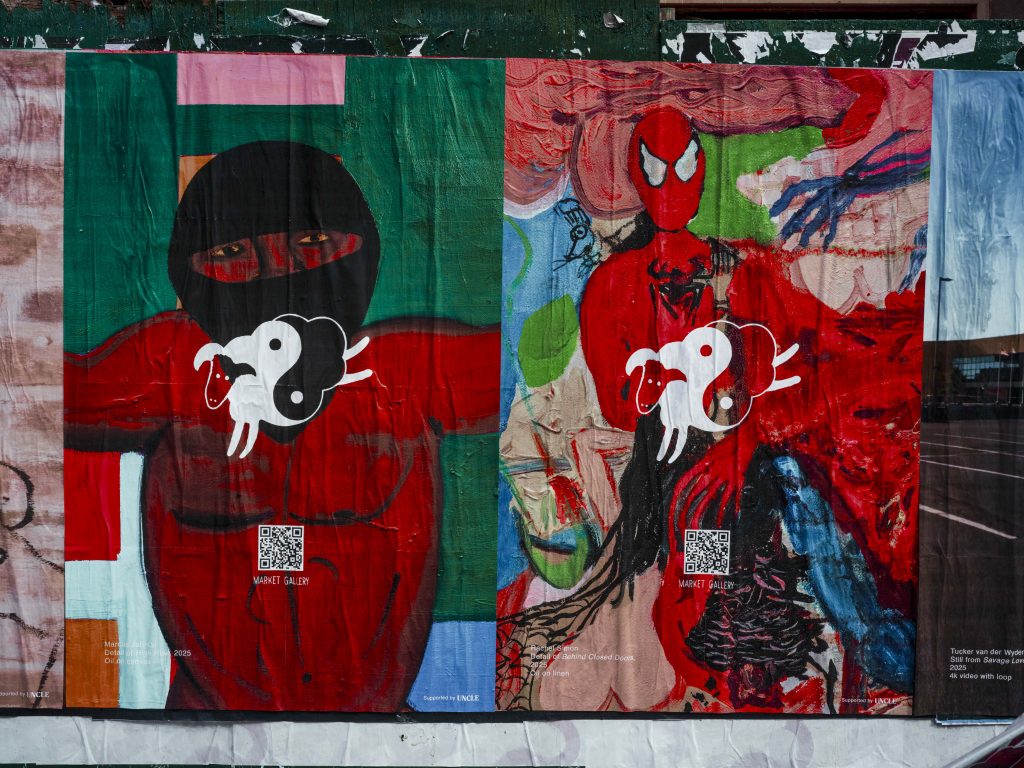
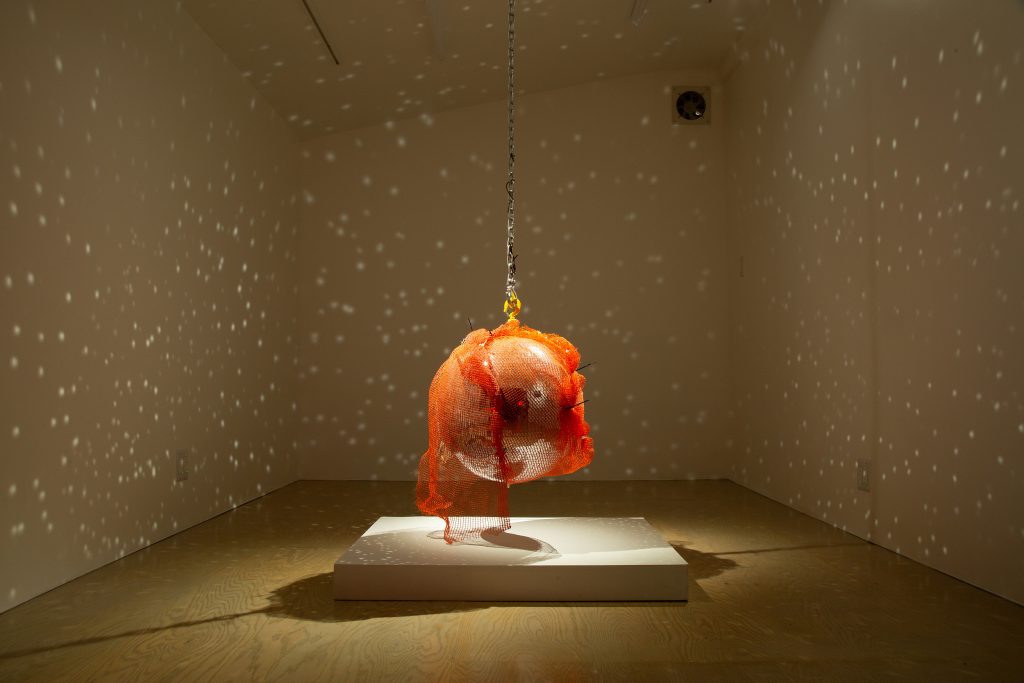
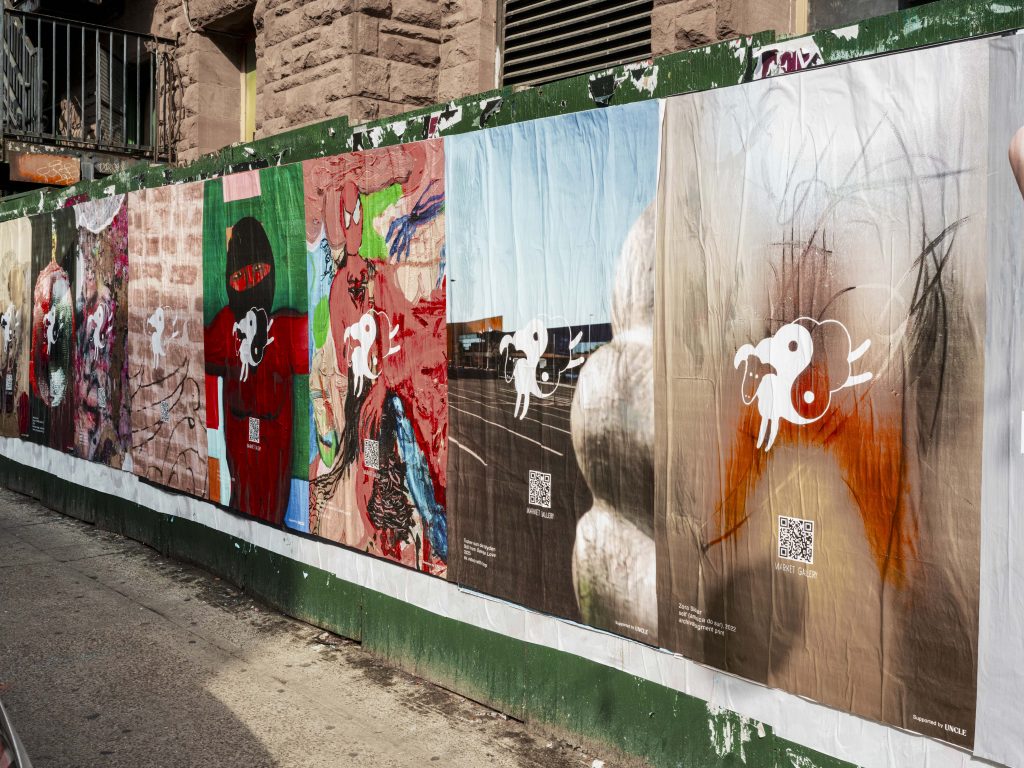
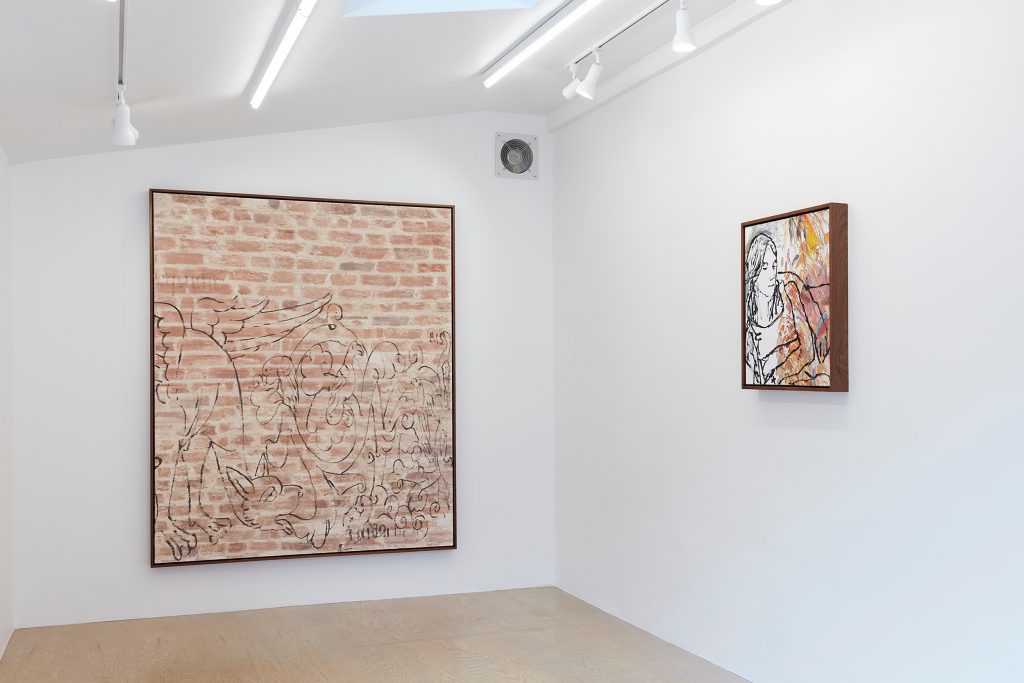
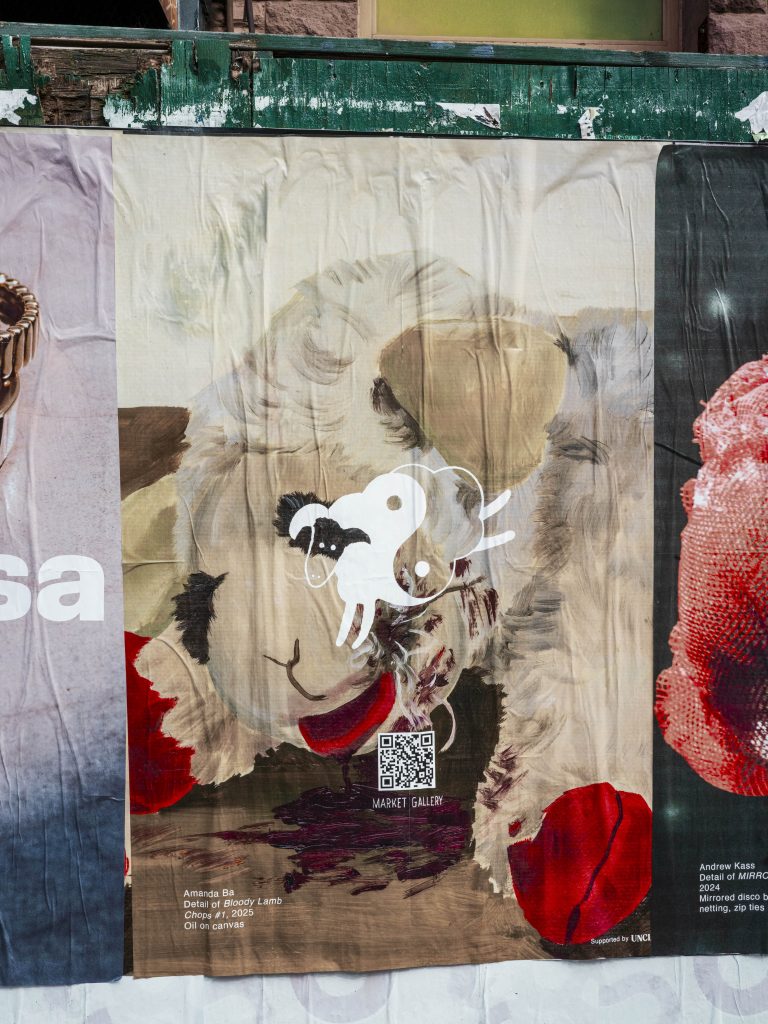
Adam: Every single artist that I’ve included on the posters is an artist that we’ve done solo shows with. Although I’ve curated two other big group shows under Market Gallery, these artists are integral to the narrative because we’ve done solo shows. I could go through each one of them and their importance.
Andrew Kass was the first artist to exhibit there, but he also did the renovation that turned the shed into the gallery, so he’s actually the contractor as well as an artist. Zora Sicher is a very close friend and collaborator over the years — hers was the first winter show, and it showed me that despite the weather we could still make it work out there. We had soup and a fire going.
Every single artist has been important, and they’ve all shown me how they can utilise the space differently. Tucker did a video installation where there was a screen in the back wall that was completely seamless, so there was video and sound. Marcus Jahmal was the first to exhibit sculpture. Amanda Ba kind of reflected the ethos of the space because she showed paintings that were more personal and stylistically different than what she exhibits with bigger galleries.
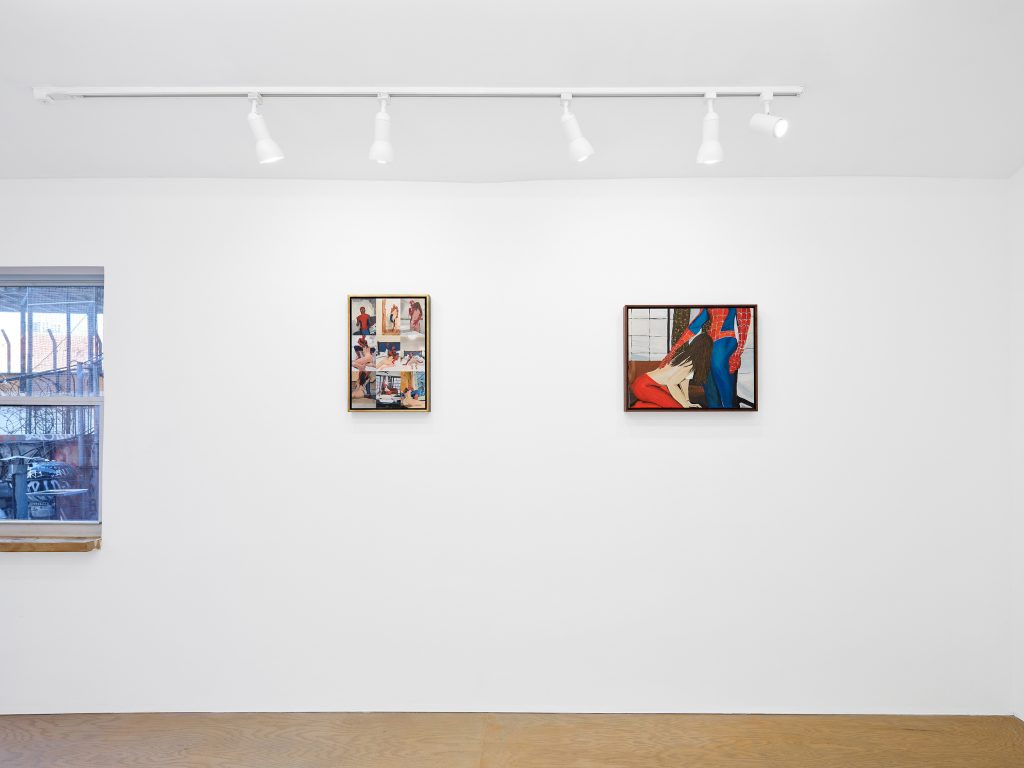
Then somebody like Alix Vernet — the source material of her work was the actual rooftop floor. After ten years of living there, the floor was caked with tags and layers of paint, and she used resin to actually lift up those layers. That was a milestone in terms of interaction with the space. Rachel Simon, who does the Spider-Man drawings and paintings, was another where I was closely involved in every aspect of the creation of that. Lorenzo is on such a meteoric rise, and is able to link his paintings to a New York lineage. Every single artist has been dear to the narrative of the space, and all of them have shown me what the possibilities are.
I’ve only done solo shows at the shed — the group shows have always been somewhere else — so the chance to work so closely and in-depth with each person has been the best experience of all of this.
IS THERE A PARTICULAR ETHOS OR INSTINCT YOU LOOK FOR IN THE ARTISTS YOU WORK WITH? NOT NECESSARILY IN TERMS OF MEDIUM OR STYLE…
Adam: Beyond my taste in artwork, of course, I’m inviting you into my home, into my space, so there’s something really personal about that. A few things have to align — not only my taste in the work, but also an organic connection. Every single person I work with, I have a personal connection with, which is of course strengthened through the show and working together, but always it’s personal.
I think that’s the through-line: there’s an organicness and a sense of a real relationship between the gallery and the artist. When people ask me, “How’s it going? Collectors, this and that,” the best litmus test of what’s working is my relationship with the artist. The other stuff is not really my forte, though I’m learning. But as an artist, the greatest metric to me of the growth of the gallery is my relationship with artists, and the artists that I respect and admire gravitating towards wanting to work with Market Gallery.
CHINATOWN FEELS CENTRAL TO THE IDENTITY OF THE PROJECT. HOW HAS BEING BASED THERE SHAPED THE ENERGY OF MARKET GALLERY? MORE BROADLY, WHAT DOES CHINATOWN MEAN TO YOU IN 2026? IT’S SUCH A MYTHOLOGISED PART OF NEW YORK, BUT ALSO A REAL NEIGHBOURHOOD UNDER PRESSURE — WHAT KEEPS IT CREATIVELY ALIVE FOR YOU?
Adam: I’ve been living in Chinatown since 2015, but I grew up in the East Village, the Lower East Side, so Chinatown has been part of my life my whole life. Being half Chinese and speaking the language and spending time here has been integral to my identity.
In the ten years I’ve lived in Chinatown, it’s changed quite drastically. My building is almost entirely Chinese still, and the fabric just a few blocks away is now what people call Dimes Square. Obviously, gentrification is felt in the area and has made its way down towards my street, which is Market Street. But there still is a real Chinese community here. The community towards my area of East Broadway is more Fujianese — it’s less touristy. It’s not like Mott Street or west of here. The area here is a deeply rooted community. It’s not just Chinese restaurants — it’s a real community of people that live here.
FROM YOUR PERSPECTIVE, WHAT ARE THE BIGGEST CHALLENGES IN THE CITY’S ART WORLD RIGHT NOW?
Adam: I still consider myself to be an art world outsider for the most part. I think there are a lot of barriers to what might be considered the art world here in New York, and I think Market Gallery is born out of trying to erase some of those barriers between the artists and the gallery.
In the art world at large, there’s a lot of talk about challenges, sales, all these things, and a big need for decentralisation from the establishment. There’s a difficult space for the middle ground right now — you have your blue-chip galleries and your small galleries — and creating space for artists to express themselves without the pressures of the market is not so easy to come by. That’s pretty central to the mission of Market Gallery.
AND ON THE FLIP SIDE, WHAT ARE NEW YORK’S STRENGTHS AT THE MOMENT? WHAT STILL MAKES IT WORTH MAKING WORK THERE?
Adam: New York is historically and currently one of the most special places creatively. What makes New York uniquely special is how interconnected and interactive it is — how you walk out your front door and you’re exposed to all different cultures, walks of life, and the melting pot that it is. It creates a less insular environment and allows for expression and creativity.
One of the biggest threats to that is gentrification and rising prices for everything. Artists can’t survive, really, and even big establishments are struggling, so you can only imagine how artists are doing. That’s kind of the struggle of creating in New York — how much you might have to compromise to have success commercially. But what’s great about New York is the sense of community and the creative spirit, and the resourcefulness — within those constraints, the creativity that comes from that is also incredibly special.
HOW DOES IT FEEL TO HAVE THE WORK OUT OF THE GALLERY AND ON THE STREET WITH THIS COLLAB?
Adam: It’s really special, and I think it reflects the ethos of the gallery very well, because the way we go about things is not like a traditional gallery. It aligns super well with the way that we have this adjacency to the street, and even street and graffiti culture, which has been part of my space since I moved there.
There’s something guerrilla about the way we do things in the first place, so this street-level visibility — especially considering we are invisible at street level, we’re not a storefront gallery — is always a special opportunity to take. Being a New Yorker, and with a lot of the artists I’ve shown being New Yorkers, that presence streetside is always something striking. It would be unconventional for a typical gallery, but it aligns well with what we’re doing at Market.
WHAT’S THE LONG-TERM VISION FOR MARKET GALLERY?
Adam: It’s a difficult one. I’ve actually been struggling with this question myself, because as it grows, I’m not sure it can, in five years, exist purely in my space or in the shed. That being said, I don’t necessarily see myself opening up a typical brick-and-mortar gallery, but you never know — maybe that is the path.
Or maybe it is continuing to grow the different aspects of it: the branding aspect, the print aspect, the remote ways of doing shows abroad or in different spaces. I’m always eager about growth outside of my apartment, and what that might look like in five years is very unclear, but I’m open to wherever this project takes me, because it’s become my sole focus basically. What’s clear is that it needs to grow past the confinement of my apartment, which it has already, but in what capacity is still unclear.
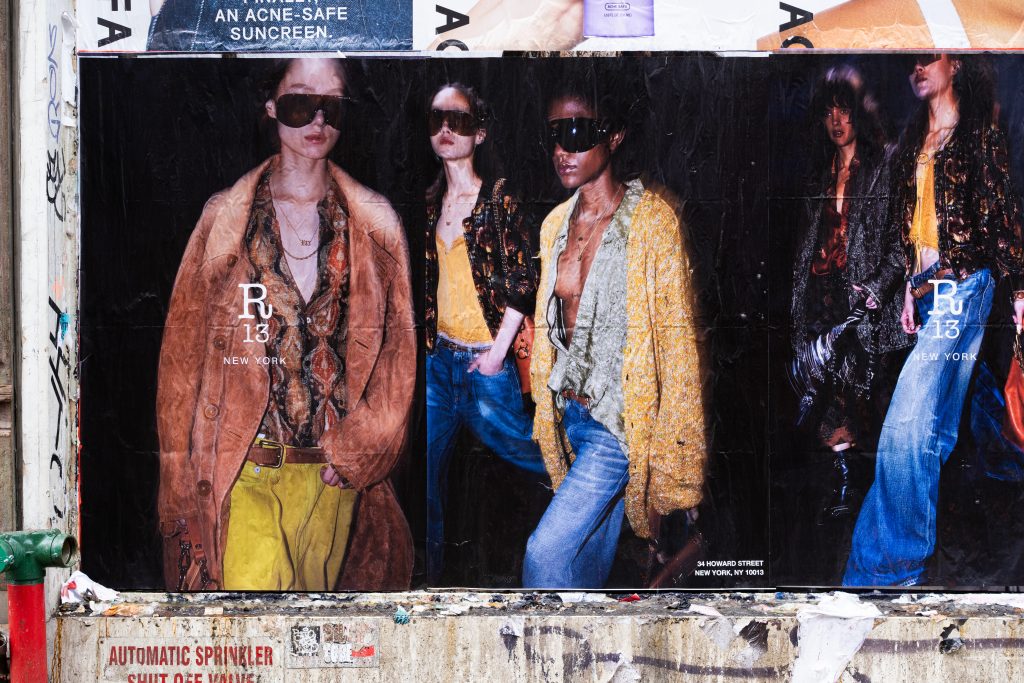
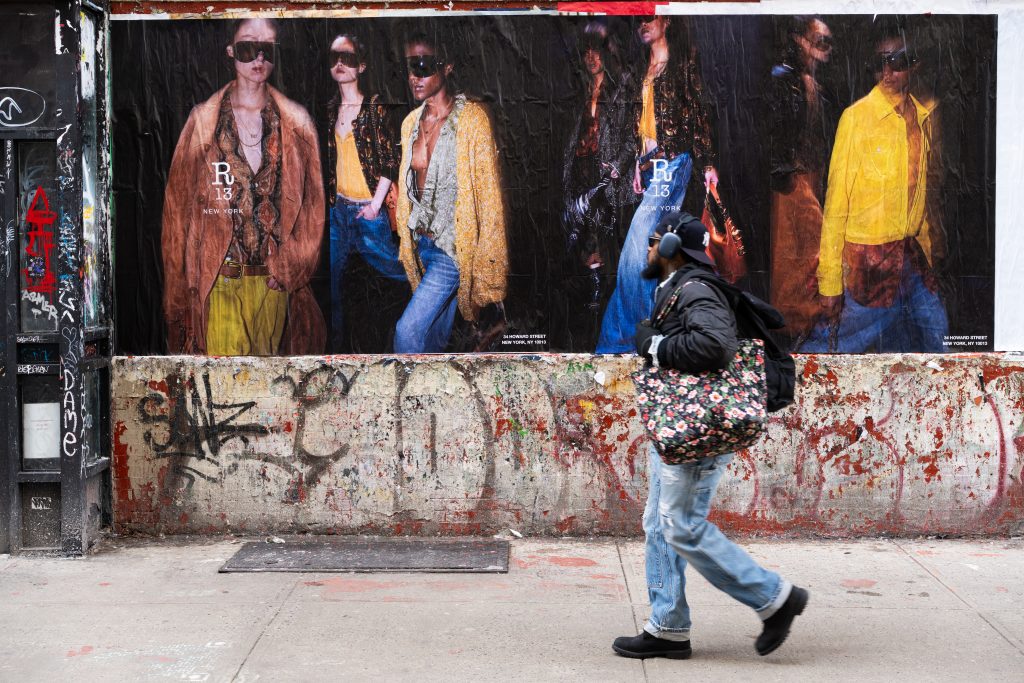
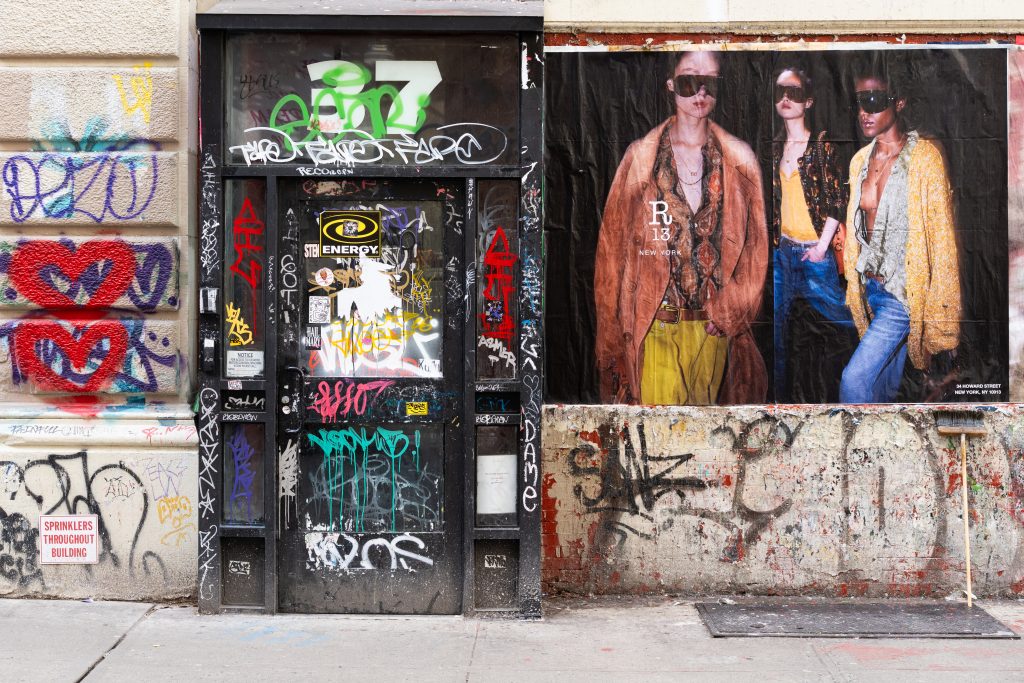
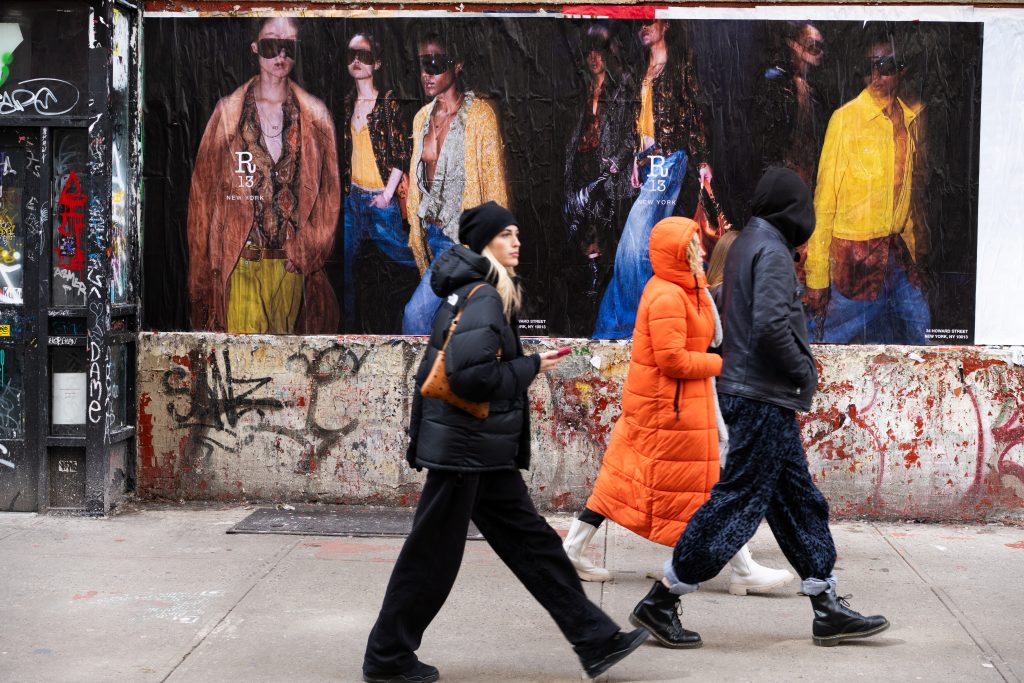
For the R13 Pre-Spring 2026 launch, we went back to where it all started: the street. In a massive collaboration with R13, UNCLE flooded the New York landscape with a guerrilla campaign that defined “larger than life.”
Spanning 72” x 48” across every high-traffic artery from Lower Manhattan to the heart of Brooklyn, the visuals captured the grit and soul of the new collection. It was proof that while the city changed, R13 still ran the streets.
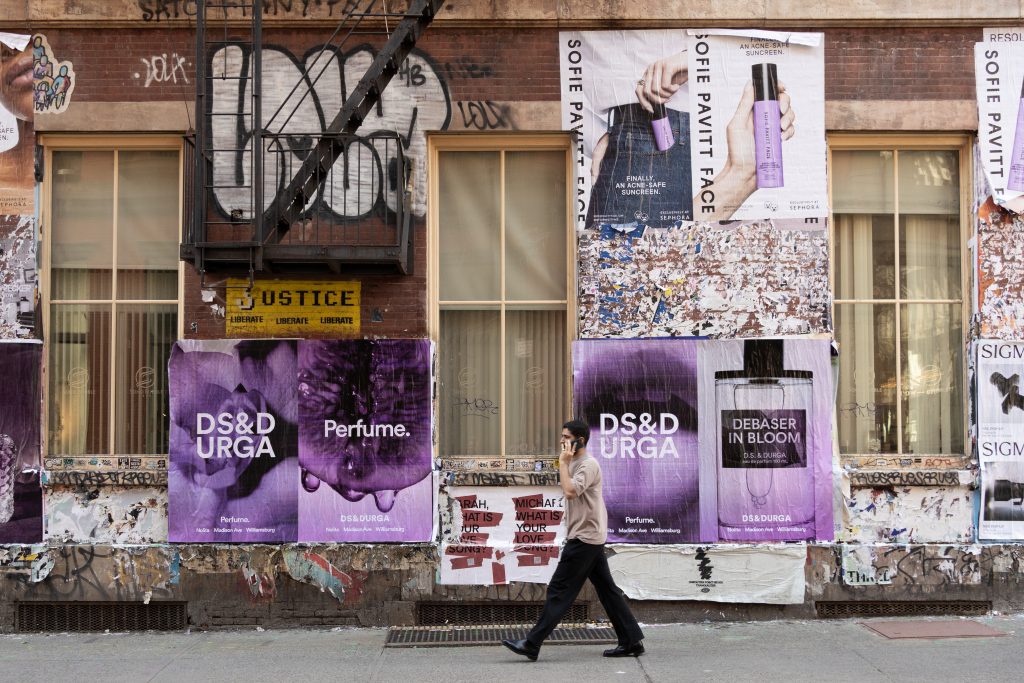
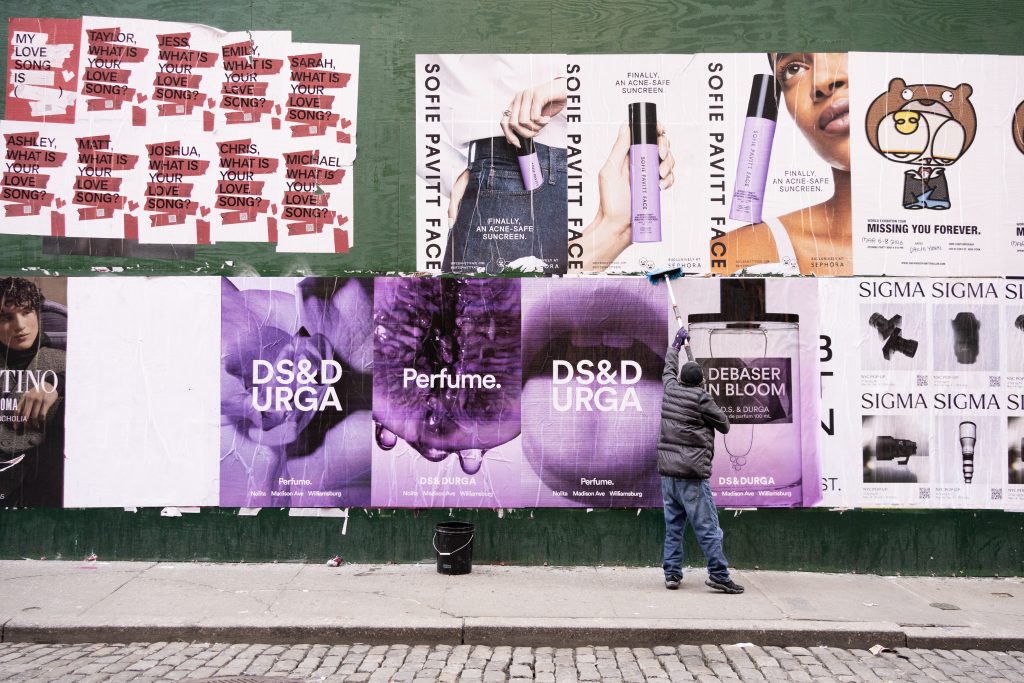
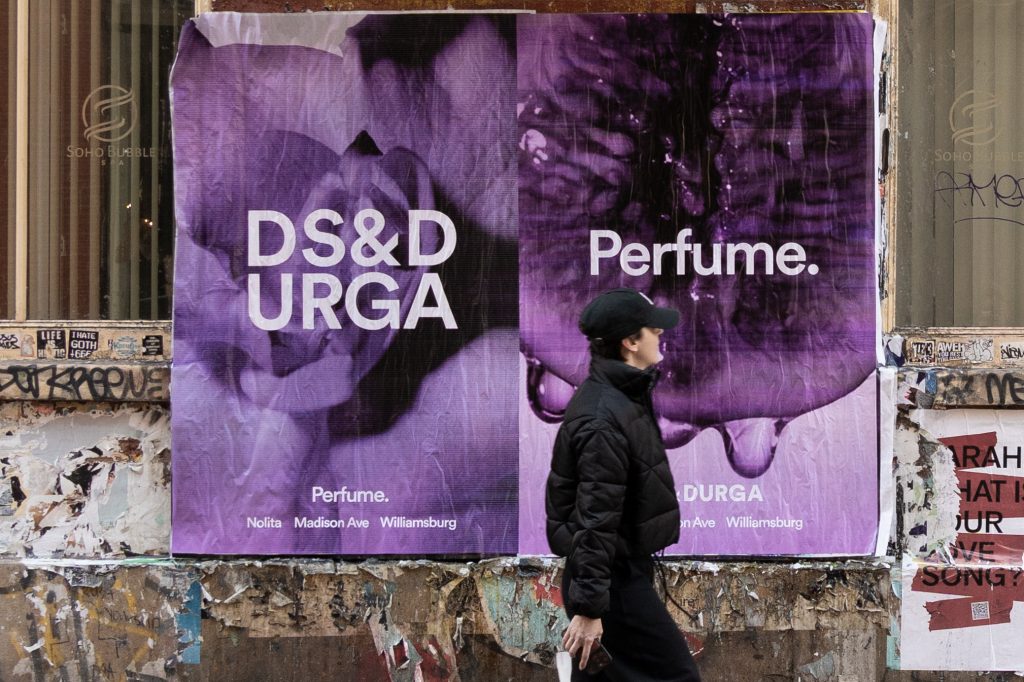
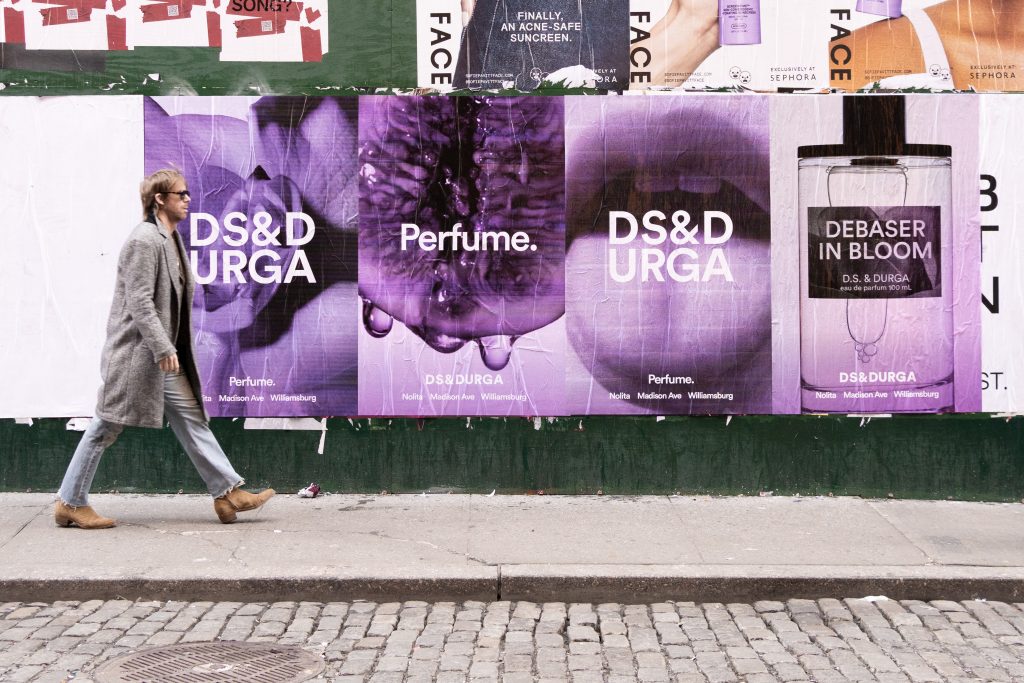
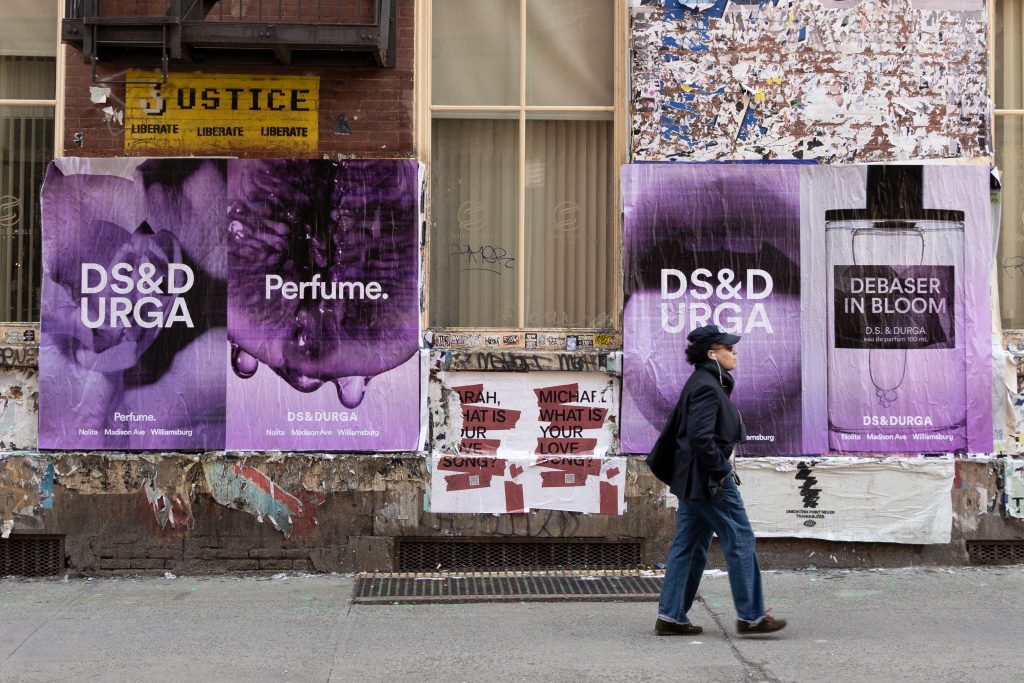
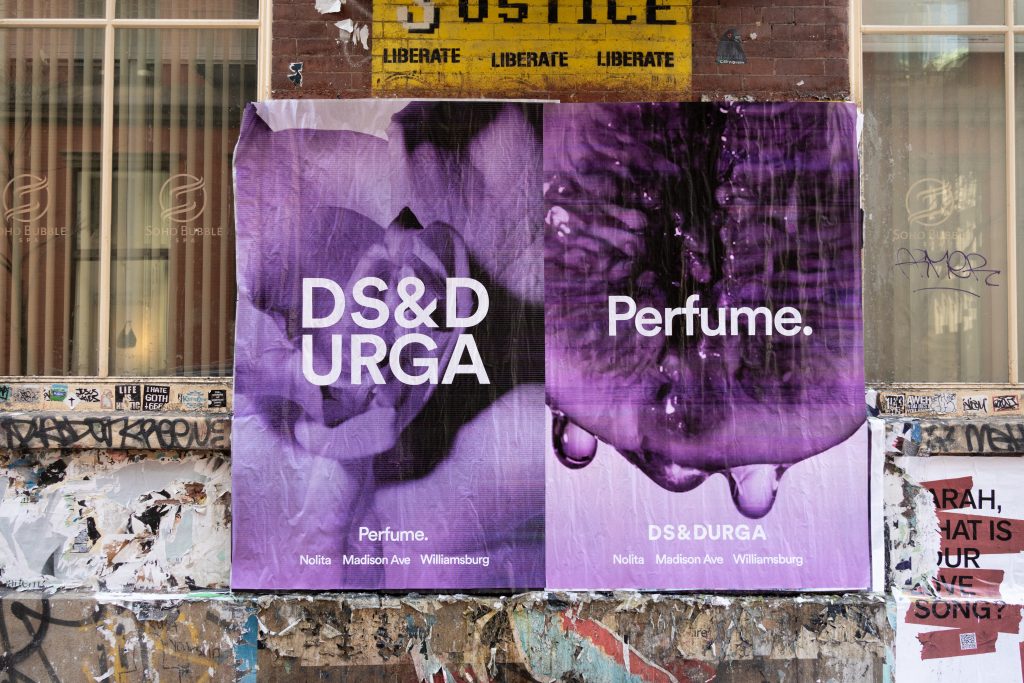
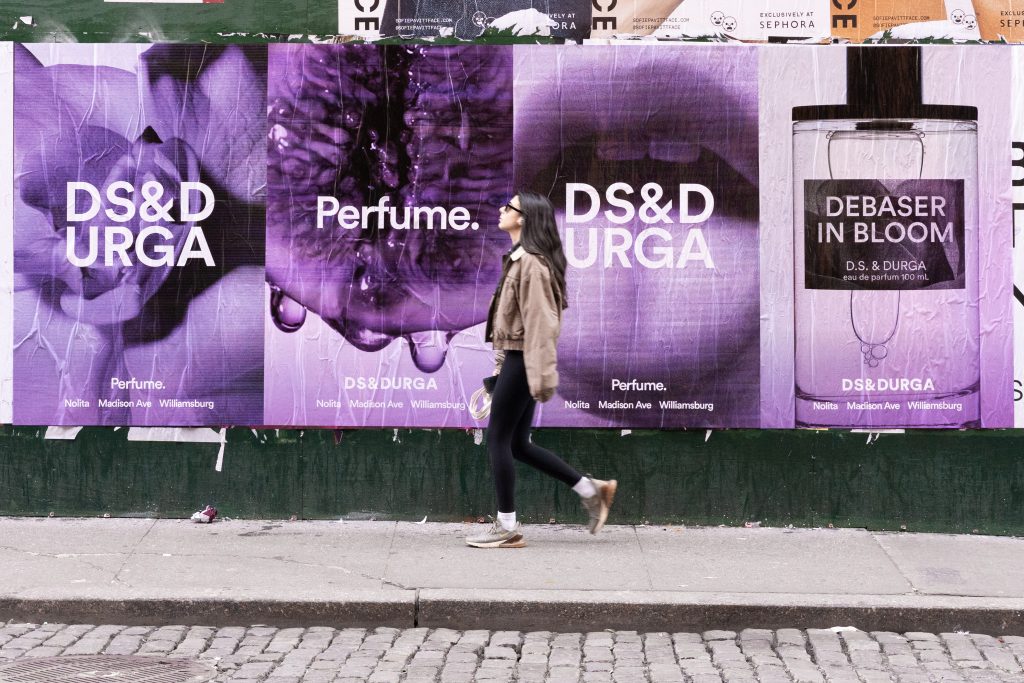
Same song. Different mix. For NYC Fragrance Week, D.S. & DURGA took their 2015 cult classic out of the bottle and onto the streets.
Debaser in Bloom turns up the volume—“hot, humid, sexy” fig collides with white gardenia and the metallic bite of cassette nostalgia. No boutiques, no restraint. With UNCLE, the launch hit the streets in a surge of XL flyposting and B2 blocks, flooding New York in full force.
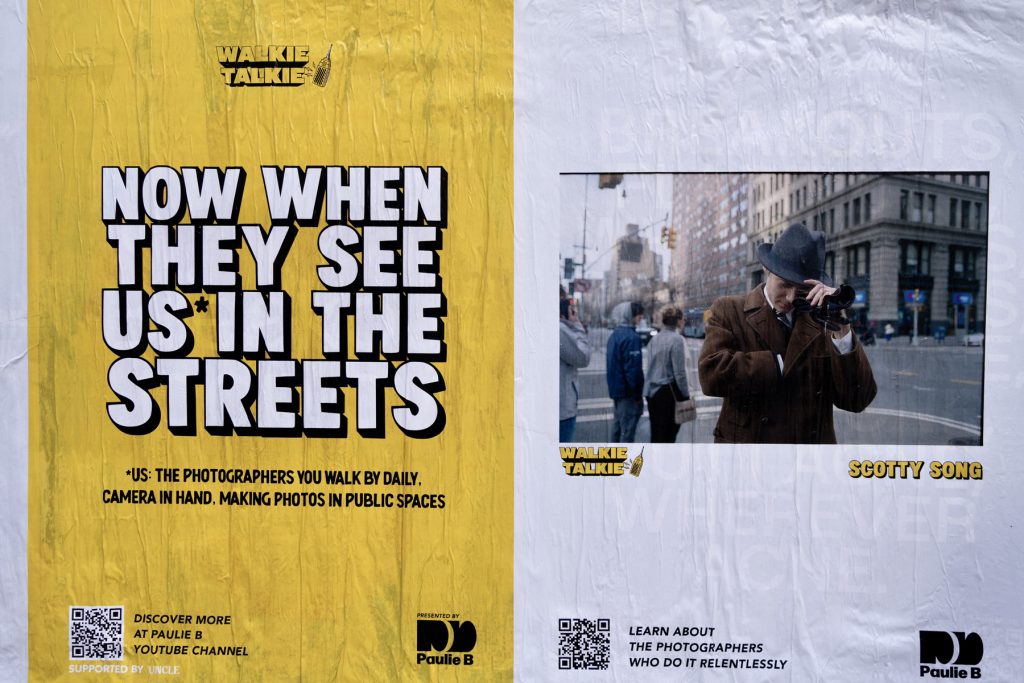
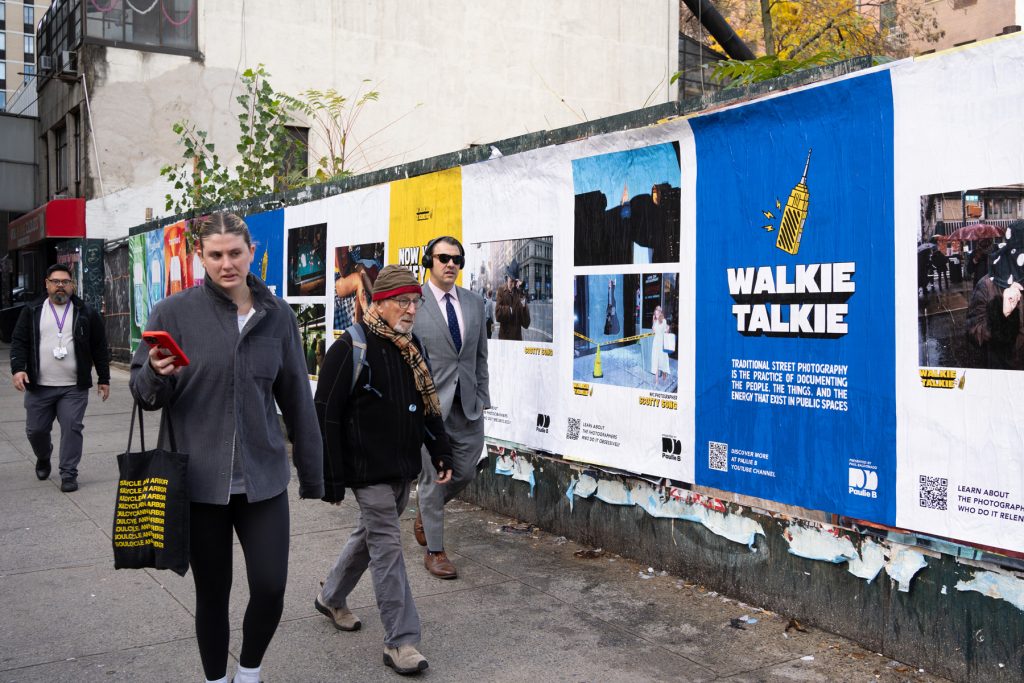
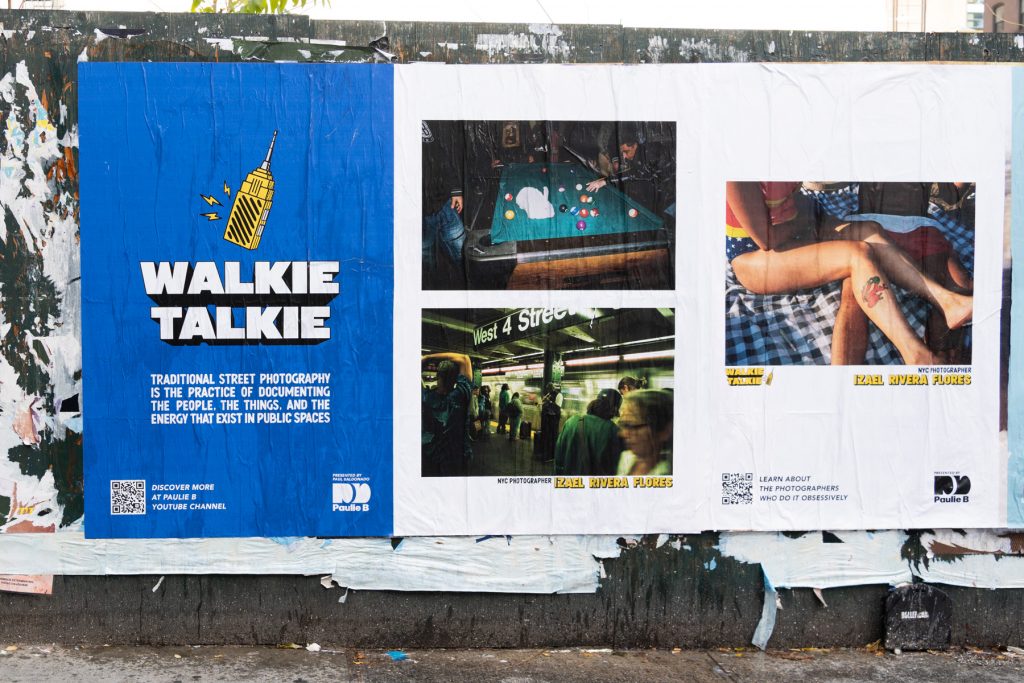
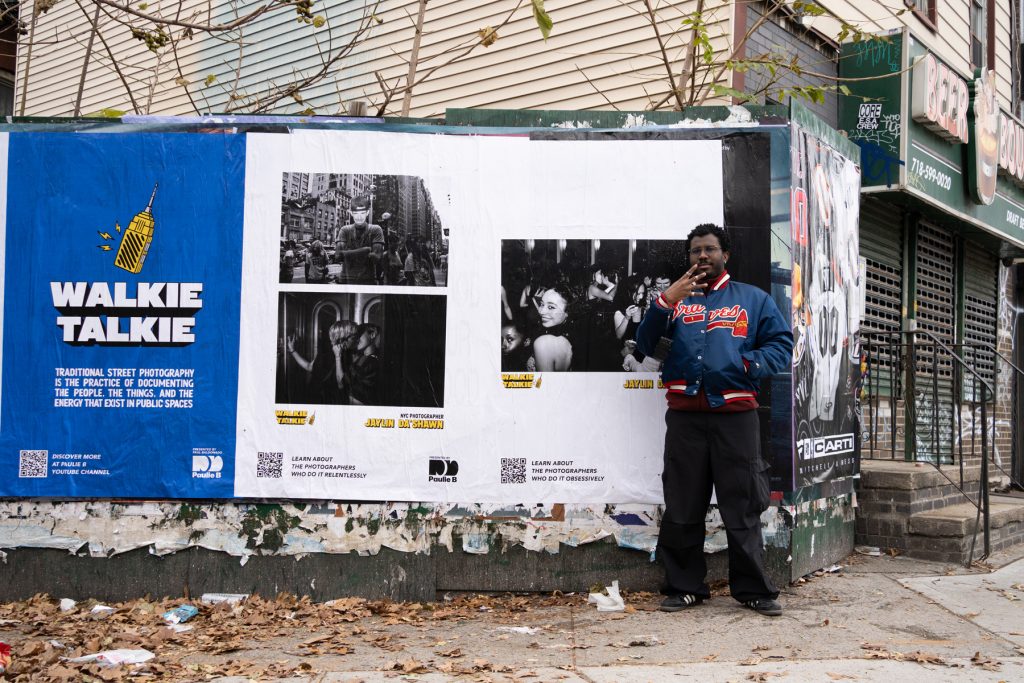
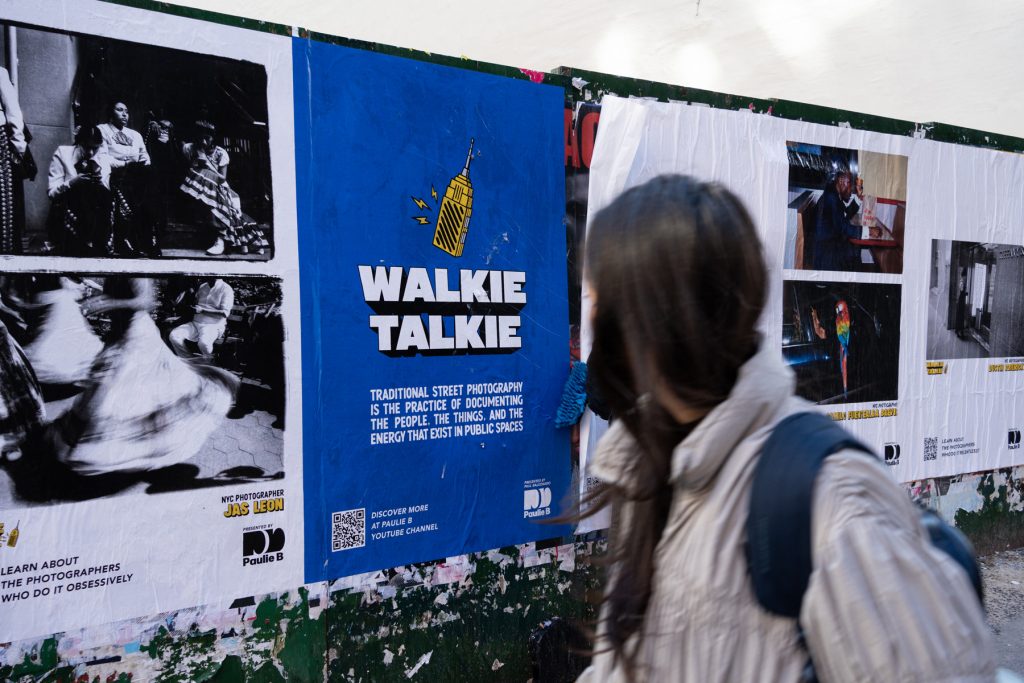
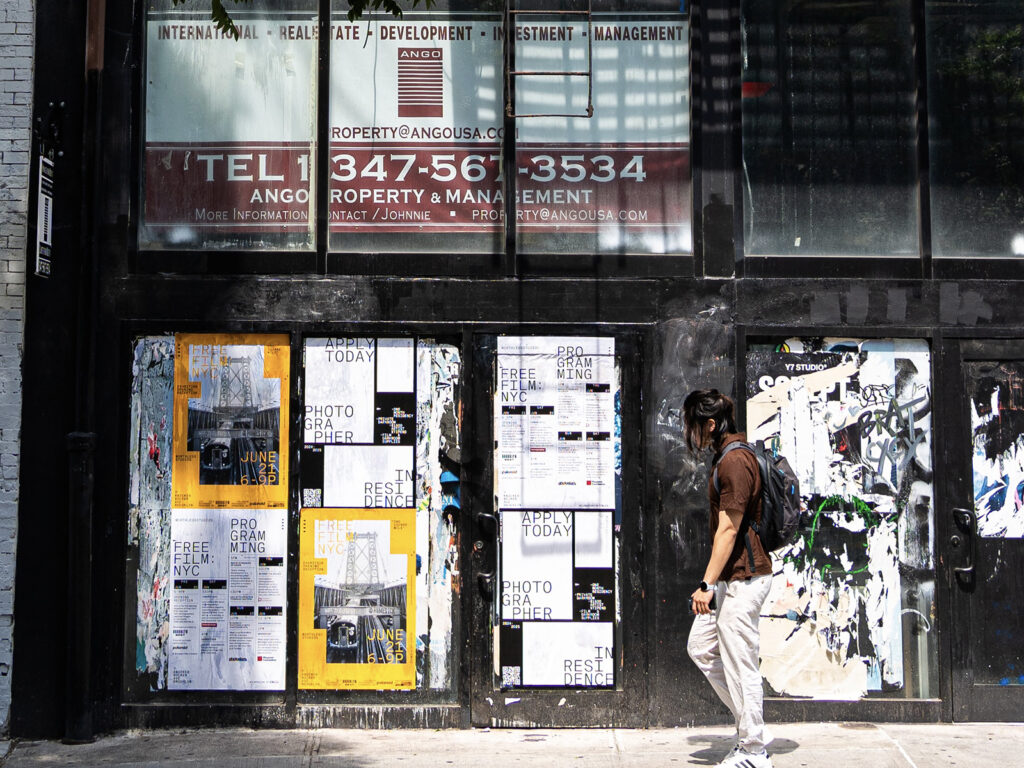
While the photographers, tempo and locations change from episode to episode, this is the one line you’ll always hear in Walkie Talkie — the street-photography YouTube series founded byPaulie B, real name Paul Baldonado.
Born and raised in Washington D.C., Paulie grew up as the kid who excelled in art class — always drawing, always seeing visually. He started taking photos in the Tumblr era, borrowing his sister’s DSLR before falling deeper into photography during a nine-to-five job in his twenties. After moving to Chicago, he made a rule for himself: take one picture every day for a year. That discipline — paired with the city’s architecture and rhythm — shaped his eye. But it was New York’s unrelenting pace that really pulled him in. The move in 2019 gave him what he calls “the energy my shutter finger was searching for.”
What makes Walkie Talkie unique isn’t just what comes out of it, but the honesty with which it’s shown. There are no guarantees of “the shot.” Some days yield nothing, some days give everything — but the cameras keep rolling. As Paulie puts it, “this is what it’s really like being a street photographer in New York and having conversations with this community that I have.”
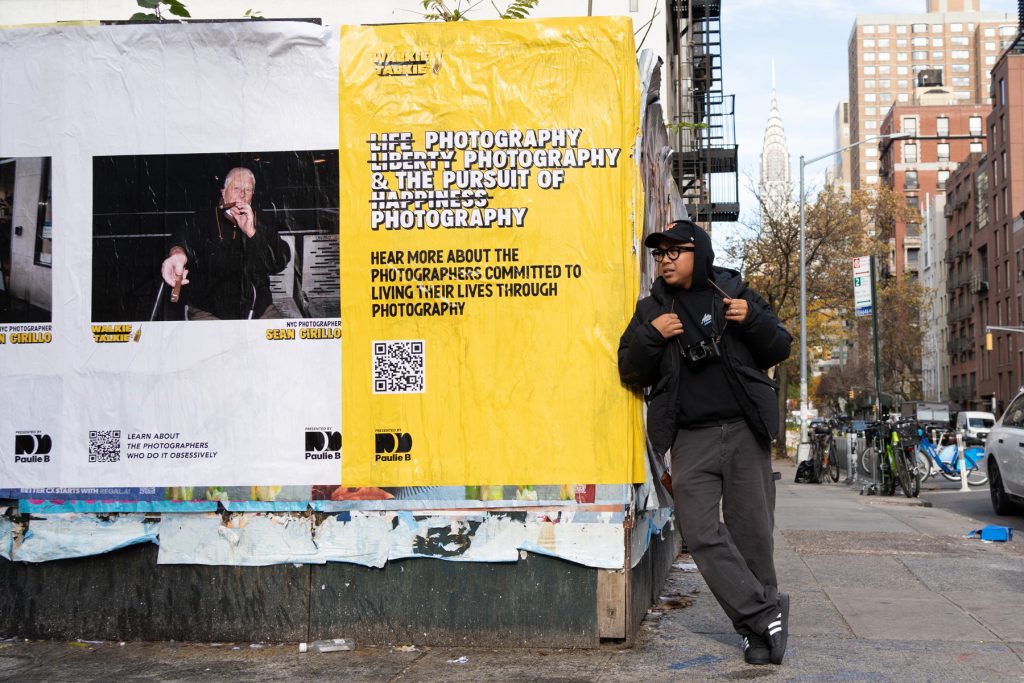
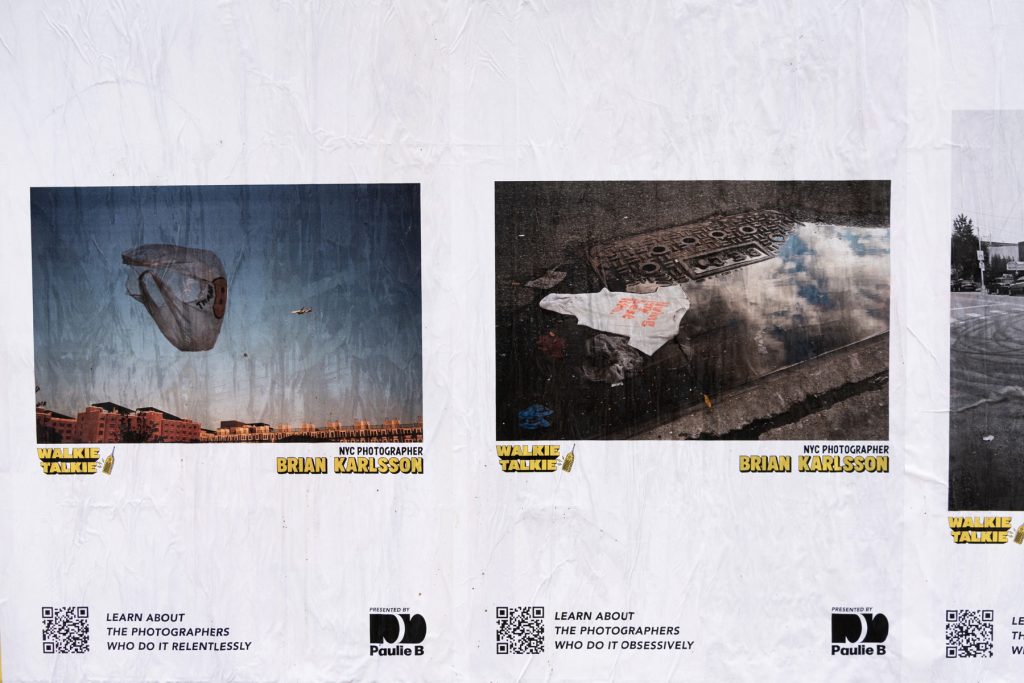
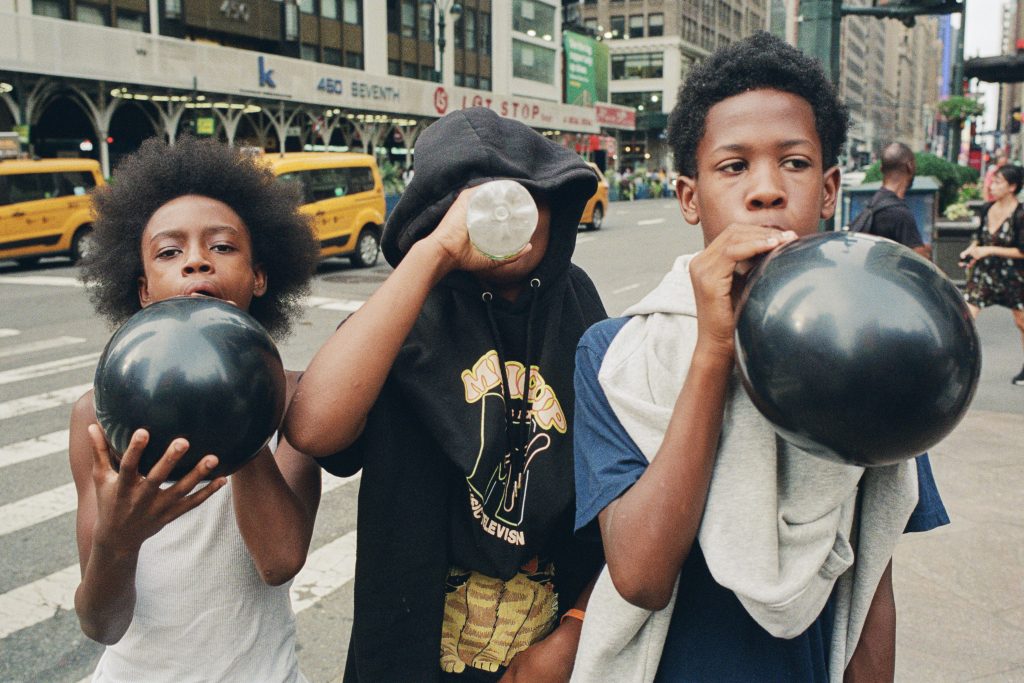
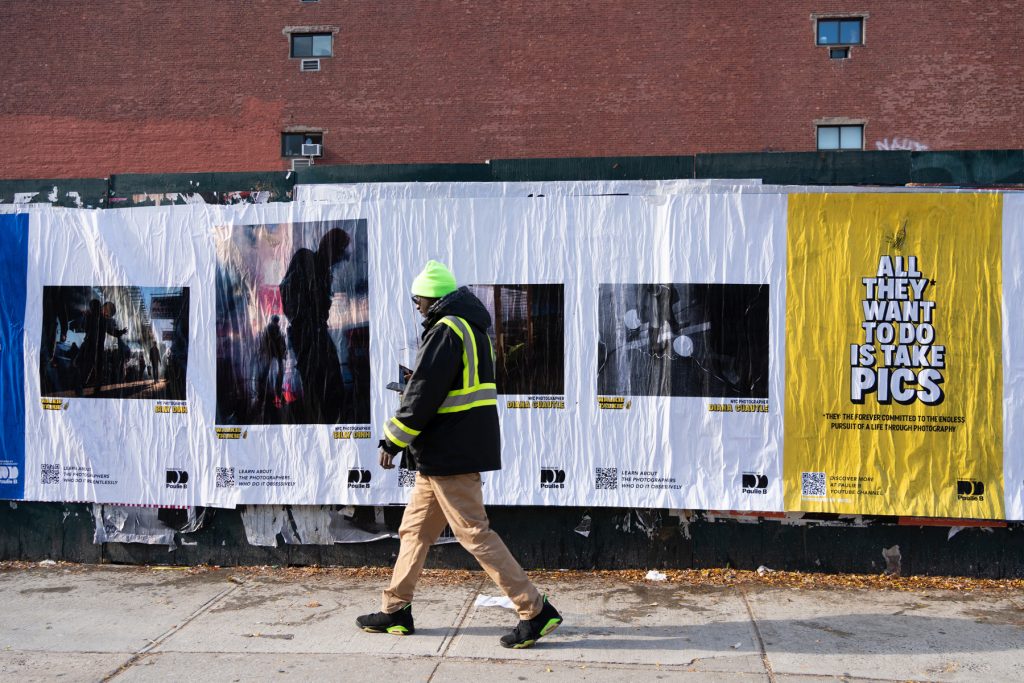
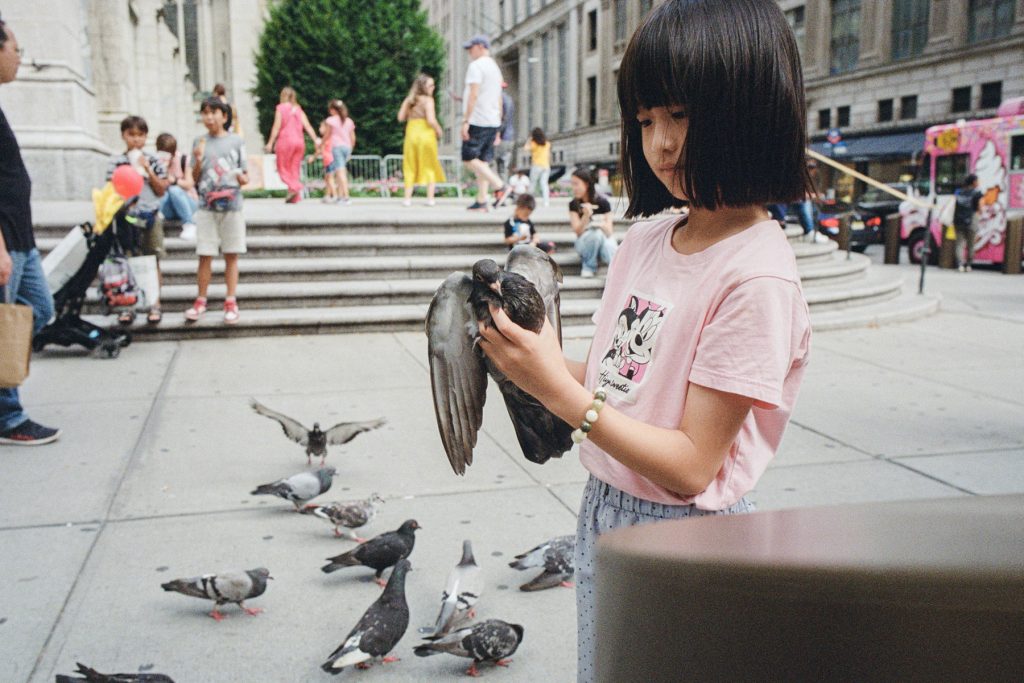
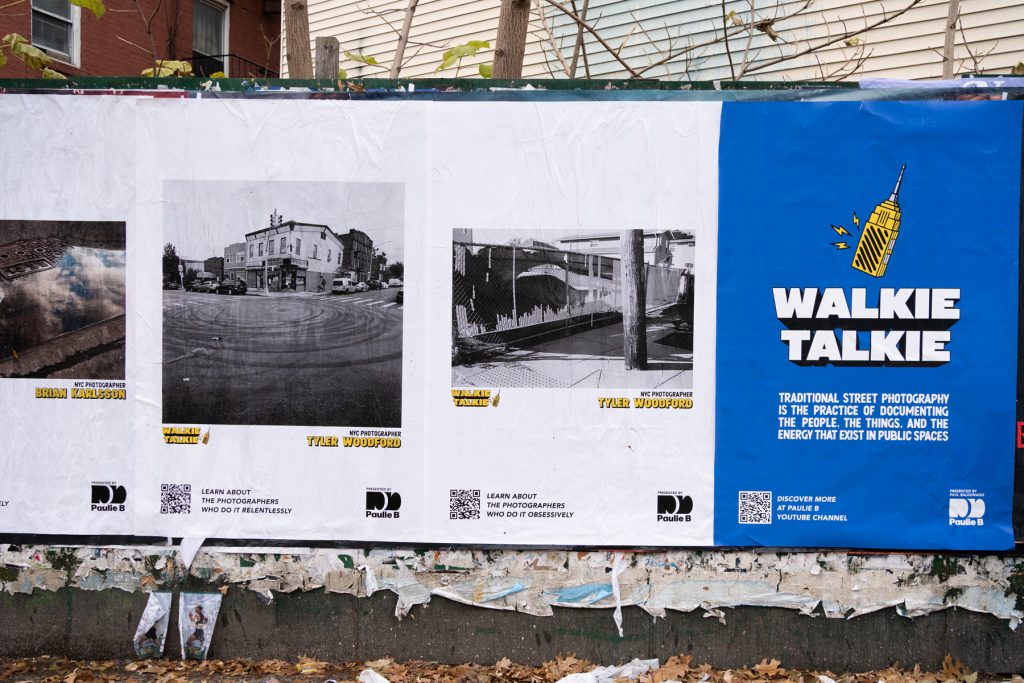
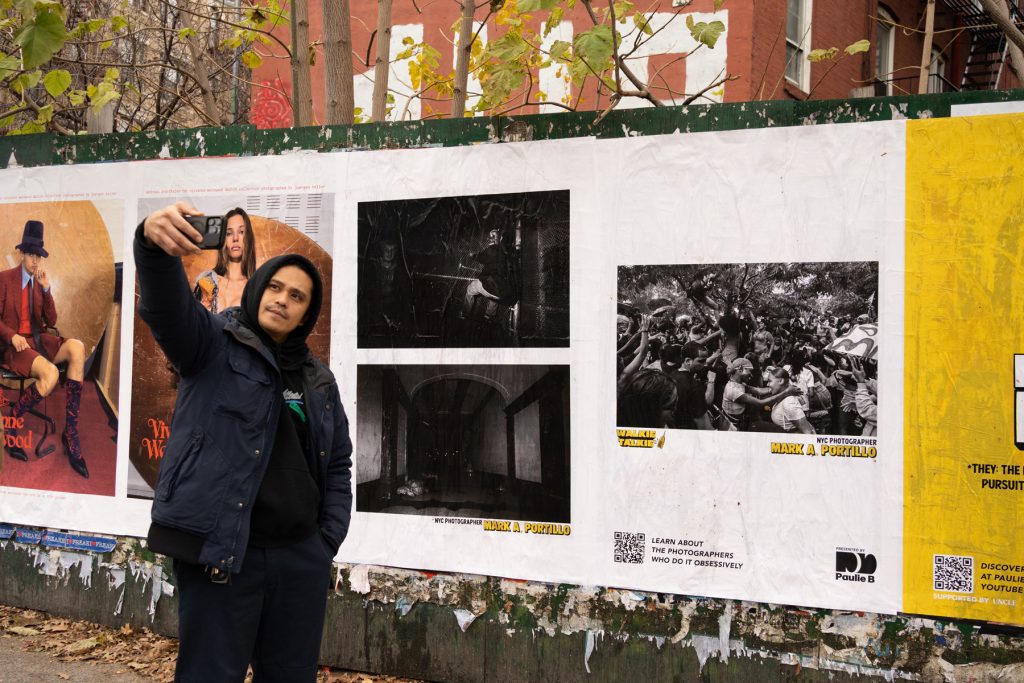
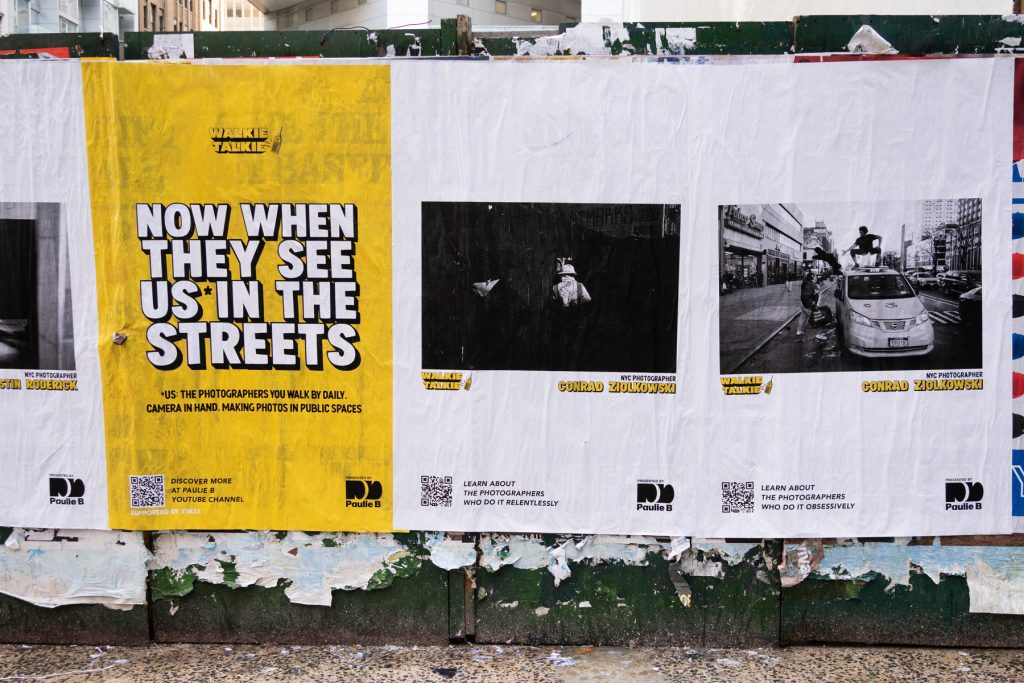
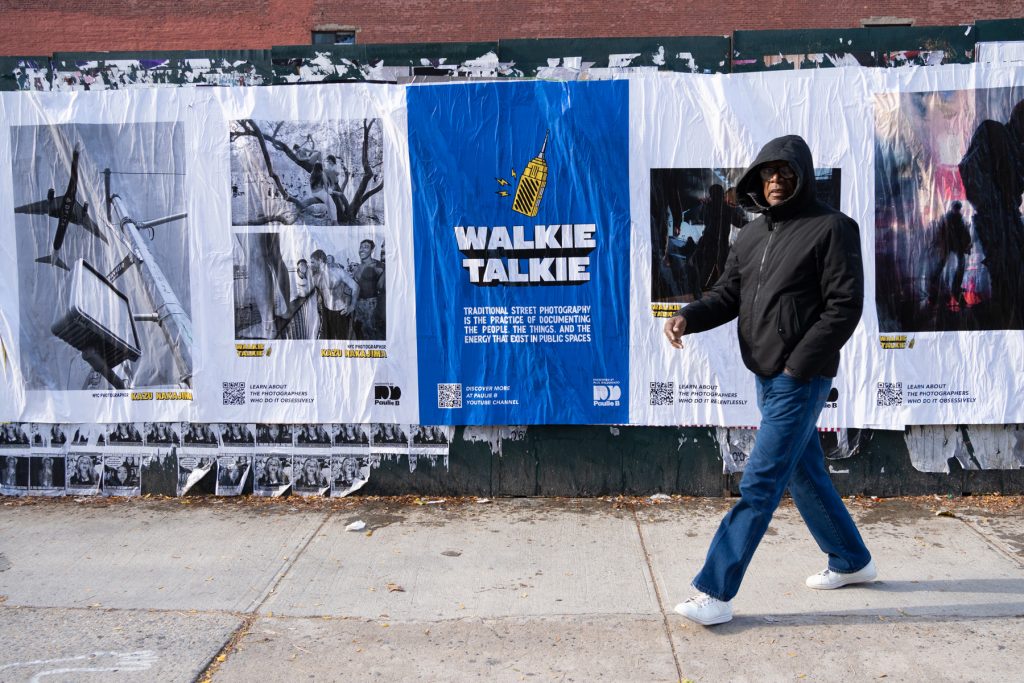
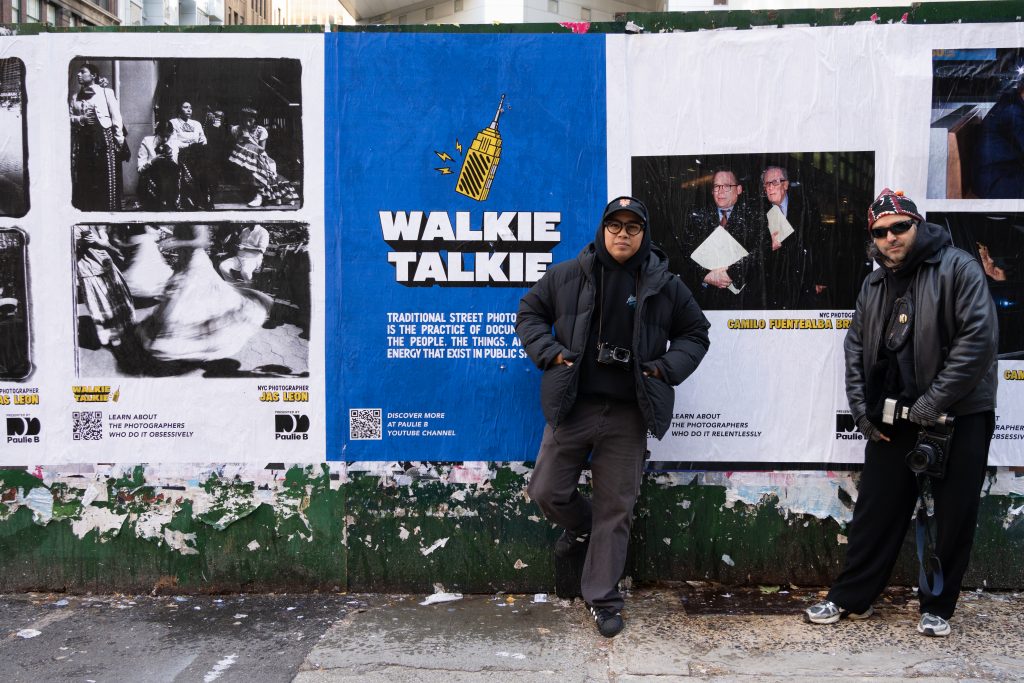
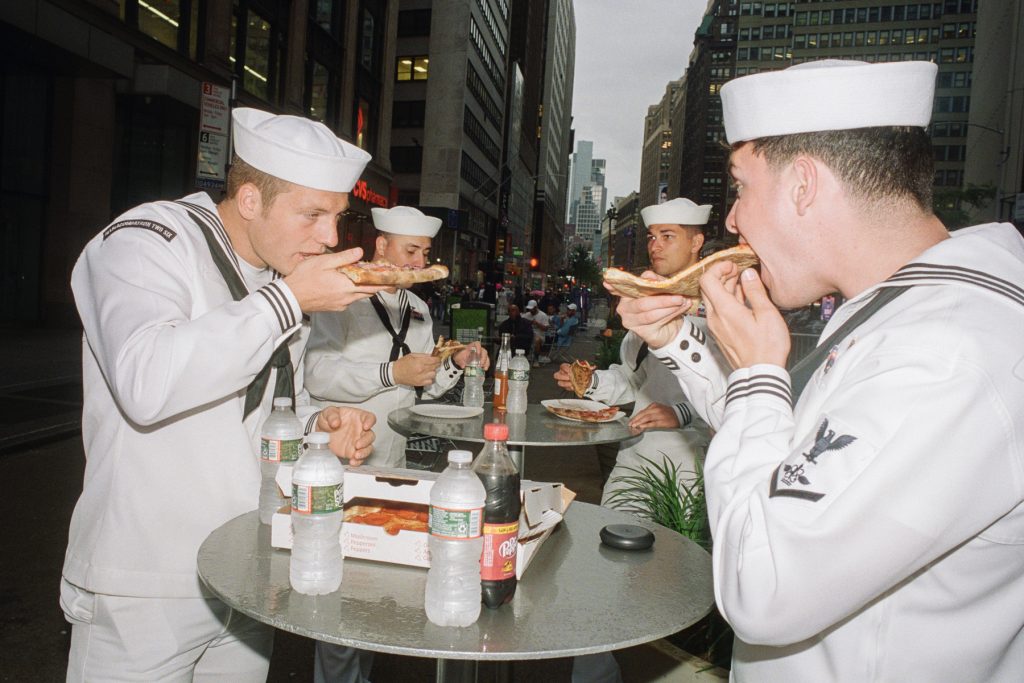
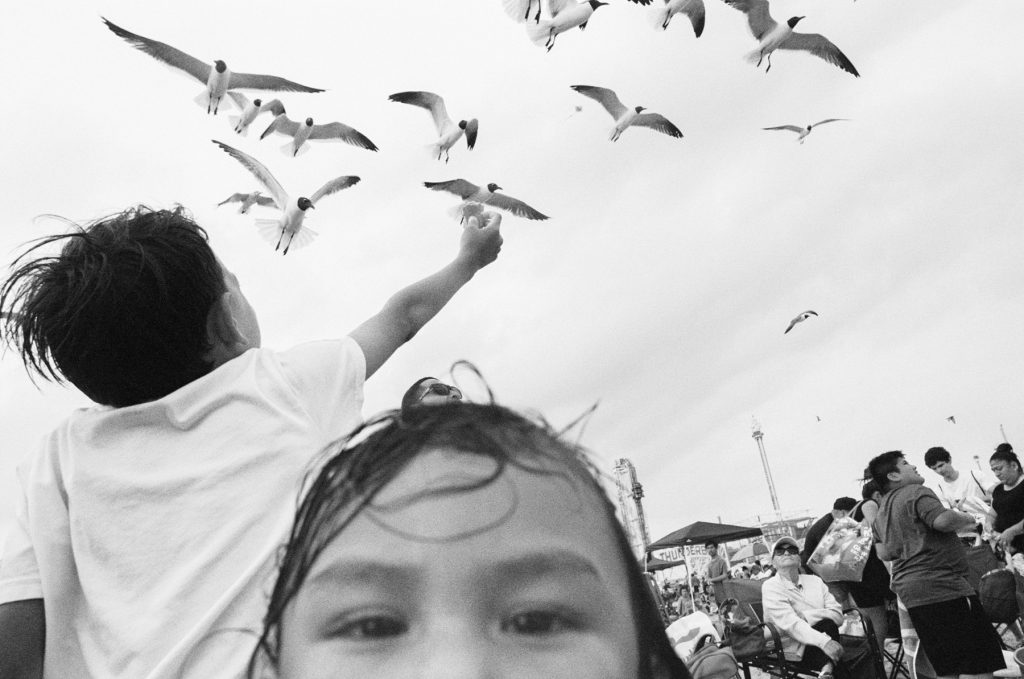
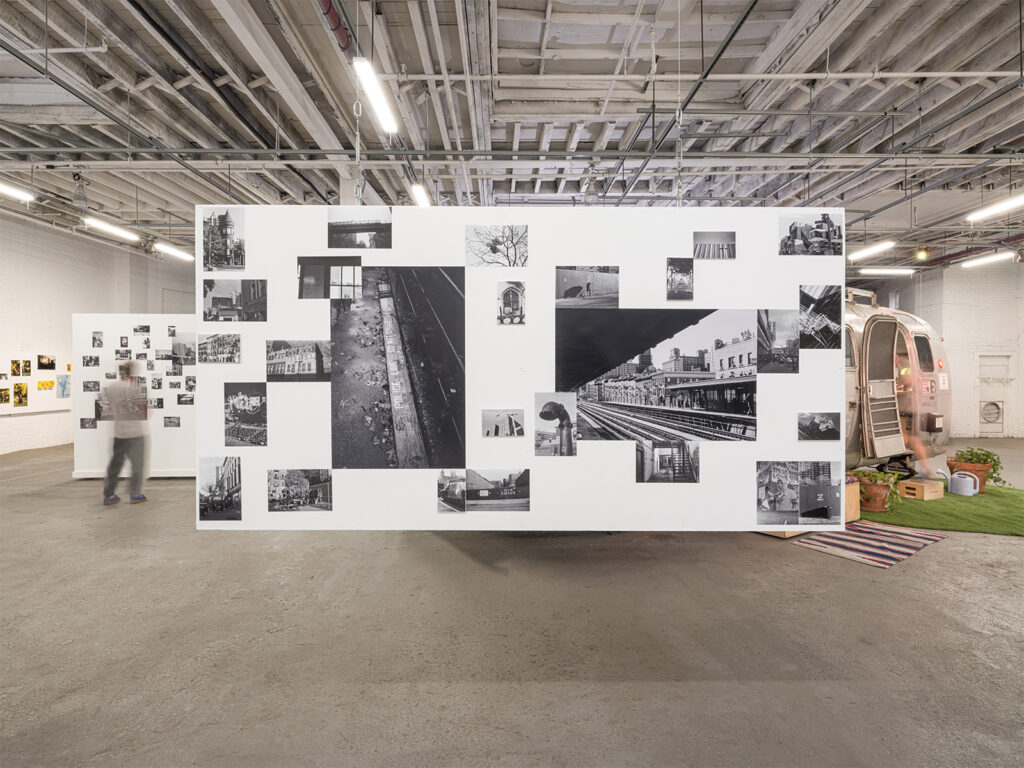
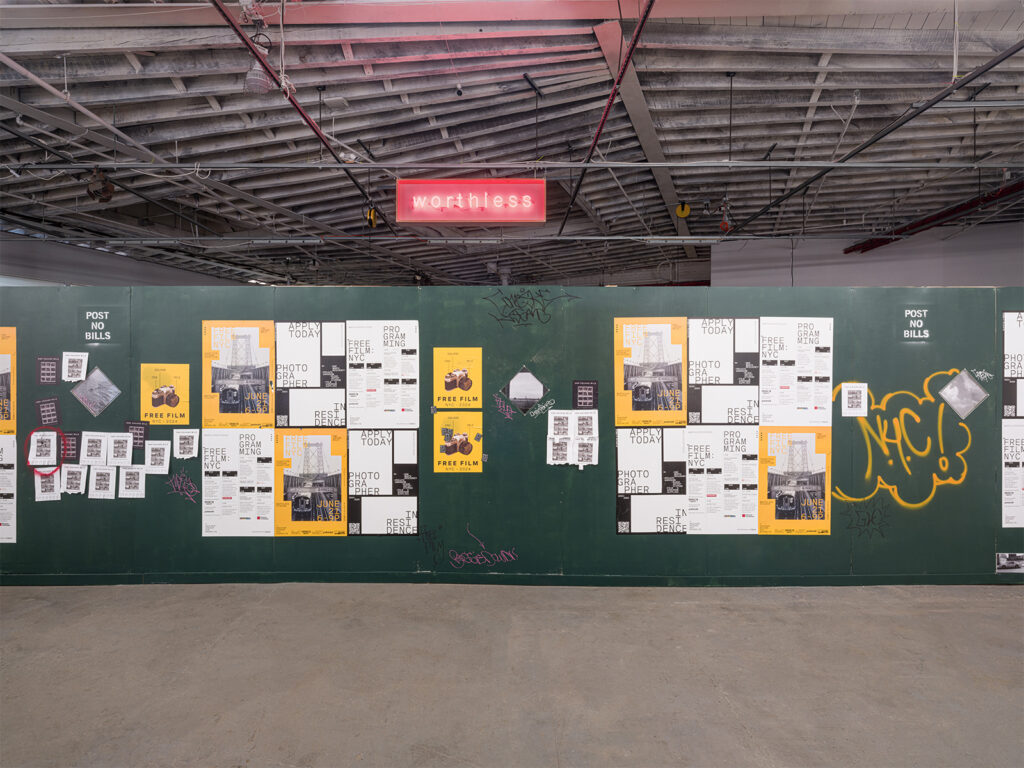
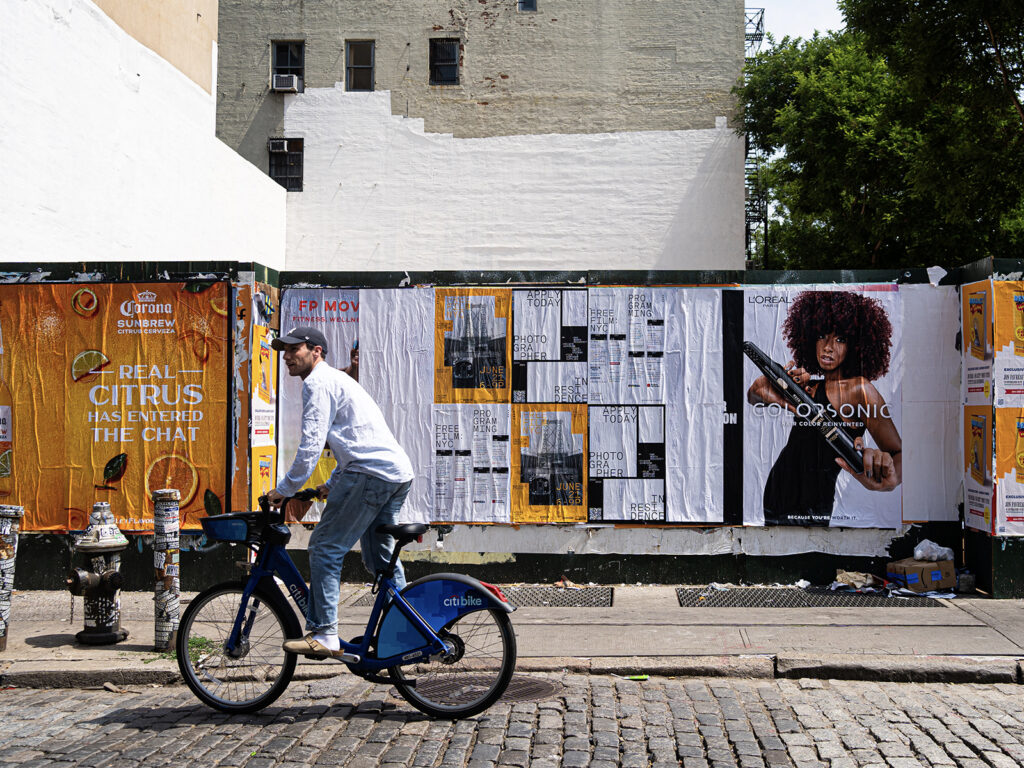
Through a new collaboration with UNCLE, that same community is taking over the streets once again — or more precisely, the walls. As Paulie rolls out a rebrand for the channel alongside a new run of videos, work from Walkie Talkie-featured photographers has been wildposted across New York.
Across its run, Walkie Talkie has featured a wide cross-section of photographers shaping the medium today — from Trevor Wisecup to Martha Cooper, to Jas Leon, Mark A. Portillo and Kazu Nakajima who all feature in the wildposting campaign. Each brings their own rhythm, philosophy and city soundtrack to the frame, turning the series into an evolving record of street photography’s present moment.
For Paulie, that moment has come full circle. The work born on the streets finds its way back there, free of galleries and glass. It’s an affirmation of what Walkie Talkie has always stood for: photographers who keep shooting, and keep showing up on the street.
In conversation with UNCLE, Paulie B reflects on the making of Walkie Talkie, the philosophy behind it, and why, even after all these years, the answer to that familiar question still feels the same.
WERE THERE ANY EARLY INFLUENCES — PHOTOGRAPHERS, ARTISTS, OR EVEN FILMS — THAT SHAPED HOW YOU SEE THE WORLD THROUGH A LENS?
One of the first big influences for me was actually a film — the Vivian Maier documentary. I remember watching it and thinking, oh, this is something that’s been done before — people have been out there, documenting life, photographing strangers, just observing the world as it is. It gave me a sense of history, that what I was doing was part of a much bigger story.
From there, I started digging deeper, meeting other photographers, and learning about figures like Fan Ho and Gary Winogrand. Early on I was really into Fan Ho — the way he used light and geometry, how every shot felt so deliberate. But over time, Winogrand became the main influence for me. He’s been a constant ever since I discovered him.
At first, it was about the images themselves, but now it’s more about his philosophy — his attitude towards taking pictures. He just wanted to be outside shooting, every day, without overthinking it. There’s a relentlessness in that approach that I really connect with. Winogrand talked about how you should risk failure every time you take a photo, and that stuck with me. Most of what I shoot doesn’t work out — there’s a lot of “crap,” as he would say — but that’s part of it. You’re supposed to put yourself in a position to fail a little bit every time, because that’s how you grow. That mindset really shaped how I see photography, and it’s what keeps me out there walking and shooting every day.
LET’S TALK ABOUT WALKIE TALKIE. HOW DID THE IDEA FIRST COME ABOUT, AND WHAT MADE YOU WANT TO BRING STREET PHOTOGRAPHY TO YOUTUBE?
Street photography videos already existed on YouTube, but Walkie Talkie really came out of what was already happening in my life. I’d spend miles and miles walking every day through New York City with other photographers, having conversations — sometimes about photography, sometimes about life in general. I thought, it would be interesting if people could listen in on that. It’s kind of like a podcast, but visual, and grounded in the streets.
For me, New York has always felt like the mecca of street photography, but the stuff I saw online didn’t reflect what I was actually seeing and experiencing here in real life. The culture, the people, the rhythm — it was all different. So I wanted to bring that authenticity online. This is what it’s really like being a street photographer in New York and having conversations with this community that I have. It’s my way of showing people the energy and honesty of what’s happening here every single day.
WHAT DOES THE ACT OF WALKING MEAN TO YOU IN RELATION TO YOUR WORK? THERE’S SOMETHING MEDITATIVE ABOUT YOUR VIDEOS — HOW DO WALKING AND SHOOTING CONNECT FOR YOU?
For me, walking is the whole thing. The way I practise street photography, it’s a game of effort. Most of what you shoot isn’t going to work out — that’s just how it is. So the more you walk, the more you see, the more chances you give yourself to make something.
If you take a hundred photos in an hour, ninety-nine might be bad. But if you walk for two or three hours, that’s a few hundred chances instead of a hundred. It’s not a perfect ratio, but the effort compounds. The more you put in, the more you get out. You have to be outside, you have to make yourself available, and you have to be willing to accept whatever comes your way. Some days nothing happens, some days you find magic — but you won’t know unless you keep walking.
DID YOU EXPECT IT TO GROW INTO SUCH A BIG, LONG-RUNNING SERIES, OR DID IT START AS MORE OF AN EXPERIMENT?
I had a feeling it would do well. Obviously I had doubts, but I also had this gut sense that it was going to connect with people. Like we talked about, New York is the mecca of street photography, and people everywhere are interested in what’s happening here — not just in photography, but across all creative practices. So giving them a peek behind that door felt like something that would resonate.
Early on, I was getting maybe a thousand views per Walkie Talkie, two thousand, three thousand — but I just knew. I had to keep that mindset, even through the ups and downs of YouTube. One thing I’ve learned from listening to successful people in other fields is that they all share this undenying thought that they’re going to make it. They don’t hope; they know. That really stuck with me.
So even when the numbers were low, I just kept telling myself, I know this is going to work. People probably think I’m raking it in, but I’m really not — I’m still convincing myself it’s going to work. But I have to keep that faith. You make a decision, and then you make it right. That’s the mindset. It’s all going to work out.
YOU’VE SAID BEFORE THAT YOU’RE AS INTERESTED IN THE PEOPLE BEHIND THE CAMERA AS THE IMAGES THEMSELVES. WHAT KIND OF CONVERSATIONS DO YOU TRY TO HAVE WHEN YOU’RE OUT FILMING?
I think Walkie Talkie really brings forward the person behind the camera more than anything. It shows the thought and the work that goes into taking a picture — because in some episodes, you’ll notice there aren’t that many photos being taken. That’s not because someone isn’t a good photographer; sometimes there’s just nothing happening. We don’t control that. We can’t control when good photos or interesting moments appear — we all just start walking, and whatever happens, happens.
What speaks to one photographer might not speak to another, and that’s part of what I love showing. It highlights how different people respond to the same city in completely different ways. It also shows how much work it actually takes — it can take days, even months, to get one photo you’re proud of. I’m only filming for a single day, so I hope Walkie Talkie helps people see that process — the mindset, the work ethic, and the thoughts behind taking pictures.
HOW DO YOU ACTUALLY FIND THE PHOTOGRAPHERS YOU WORK WITH — AND WHAT DO YOU LOOK FOR WHEN DECIDING WHO TO FEATURE NEXT?
There are a couple of ways I go about it. When I travel to a new city, I’ll usually reach out to photographers I already know there and ask them to name three people who really represent the community right now. I’ll do that with five or six people, and once I start seeing the same names come up, I know who to reach out to. That overlap usually tells me who’s active, respected, and pushing things forward. Here in New York, it’s a little different because I’m so embedded in the scene. I’m out on the streets a lot, watching who’s around, whose work keeps showing up, who’s putting in the effort day in and day out. Over time you develop a sense for who’s genuinely dedicated — the people who are doing it for the love of it, not just for likes or followers. I like to feature people who’ve been out there for at least a couple of years and still have that fire. Street photography can be really cyclical; a lot of people drift in and out. But the ones who stay consistent are the ones I want to spotlight.
THERE’S ALSO A BIT OF EMPHASIS ON THE GEAR PEOPLE USE — THE CAMERAS, THE LENSES, THE SETUPS. WHAT’S YOUR TAKE ON THAT SIDE OF IT? DO YOU BUY INTO THE IDEA THAT “THE BEST CAMERA IS THE ONE IN YOUR HAND”?
Honestly, I only started asking about gear because people in the comments got mad that I wasn’t. Personally, I don’t care that much. Most of the time people are using similar cameras anyway, especially in New York, and that’s usually because they’ve tried something a friend uses and it just works for them.
Gear matters to a certain extent, but I think what people really mean when they say “the best camera is the one in your hand” is that you need to find what works for you. For some people that’s a rangefinder, for others it’s an SLR, or even medium format. You just have to find something that doesn’t get in your way — a camera that feels natural, that lets you shoot without overthinking.
For me, it’s about what’s effective and efficient. Effective meaning it gives you the kind of image you want, and efficient meaning it reduces friction — it lets you move and react without hesitation. Budget’s part of that too. Some cameras are expensive, but if it’s the one that fits your flow and makes you want to go out shooting, then it’s worth it.
AS WELL AS COMMENTS ABOUT EQUIPMENT, A LOT OF COMMENTS UNDER WALKIE TALKIE TALK ABOUT HOW INSPIRING THE EPISODES ARE — PEOPLE CREDIT YOU WITH GETTING THEM OUT SHOOTING AGAIN. HOW DOES THAT MAKE YOU FEEL?
That feels amazing, honestly. There’s this Kobe Bryant quote I think about a lot — he talks about how greatness isn’t just about what you achieve, it’s about your ability to inspire others, who then go on to inspire even more people. So when I see comments from someone saying they picked up their camera again because of Walkie Talkie, that really hits me.
It’s wild to think that someone could watch a video, go out that same day, and take the best photo of their life — and that maybe, in some small way, I helped spark that. That’s the kind of ripple effect you dream of. You put this work out into the world, not really knowing who it’s going to reach or how it’ll land, and then you start to see it actually motivate people to create. That’s the best feeling there is.
YOU’VE BUILT THIS ENTIRE PLATFORM AROUND THE STREETS — AND NOW YOUR IMAGES ARE LITERALLY GOING TO BE ON THE STREETS THROUGH THIS UNCLE WILDPOSTING CAMPAIGN. HOW DOES IT FEEL TO SEE WALKIE TALKIE PLASTERED ACROSS THE SAME KIND OF WALLS WHERE SO MUCH OF YOUR WORK BEGINS?
It feels really natural — almost poetic. The work was made on these streets, and now it’s being put back into that same environment. It’s not hanging in a gallery or someone’s living room; it’s out in public, part of the city again. These posters could get torn down, tagged over, or end up in the background of someone else’s photo — and I love that. That’s what street photography is. You never know what’s going to happen out there, and that same uncertainty is what makes it exciting. So to have Walkie Talkie plastered across New York feels right. It closes the loop. It’s like the series is returning to where it came from — the walls, the pavements, the chaos, the energy. It’s all part of the same story.
NEW YORK PLAYS SUCH A HUGE ROLE IN YOUR VIDEOS — NOT JUST AS A BACKDROP BUT AS A CHARACTER. HOW DO YOU SEE THE CITY TODAY AS A PLACE TO LIVE AND CREATE? DO YOU THINK IT STILL HAS THE SAME ENERGY THAT MADE IT THE CAPITAL OF STREET PHOTOGRAPHY, OR HAS THAT CHANGED?
New York will always be a breeding ground for creativity. It’s still the epicentre — always ahead of the curve. When I see trends starting here in the photo community, I know I’ll see them popping up in other cities two or three years later. Everything happens a little faster here. The pace, the density, the diversity — it forces you to adapt, to stay alert.
That said, it has changed. I don’t know if it’s me getting older or just the times, but pre-COVID New York felt a bit more random, more eclectic. You could turn a corner and stumble into something special. Now it feels a little more contained, even though the foot traffic’s back. But the diversity is what keeps it interesting — you can walk one block and hear five languages, see ten different worlds intersecting. That constant shift is what keeps the city alive, and it’s what makes it the best place in the world for street photography.
THE SERIES OFTEN HIGHLIGHTS NOT JUST ART, BUT SOCIOLOGY — WHO OCCUPIES PUBLIC SPACE, HOW PEOPLE INTERACT, WHAT THE CITY GIVES BACK. HOW CONSCIOUS ARE YOU OF THAT SOCIAL LAYER WHEN YOU’RE FILMING? AND WHAT’S YOUR TAKE ON THE WIDER MOMENT STREET PHOTOGRAPHY IS IN RIGHT NOW?
When I’m filming Walkie Talkie, I’m usually focused on the flow of the conversation, not tripping over myself, keeping the person in frame — all those small things that make it work. So in the moment, I’m not always thinking about the sociology of what’s happening around us. But when I go back and watch the footage, I notice how much those layers matter — who’s in the background, what they’re wearing, what’s being built or torn down. It’s all a reflection of the city as it is right now.
That’s why I’ll take photos of things like construction sites or people on their phones. It might not seem interesting at the time, but years from now, that stuff will tell a story about how we lived. Everyone’s always chasing “timeless” photos, trying to make something that looks like it’s from another era — but I think everything becomes nostalgic if you give it time. You just have to document what’s in front of you, because in fifty years, those moments will be the time capsule.
As for the wider scene, I think it’s shifting. A few years back, everyone was obsessed with making everything candid — no eye contact, no interaction — but now people are more relaxed about that. There’s less gatekeeping about what “counts” as street photography, and that’s a good thing. The only real frustration I ever hear is people worrying too much about what others think. My attitude’s always been: just go have fun, take the pictures you want to take.
And when it comes to photography in the bigger picture — in this digital, algorithm-driven world — I think it comes down to why you do it. For some people, it’s about validation, likes, engagement. But the ones I connect with are the ones who do it because they have to — because if they don’t, they feel off balance. I think those are the real photographers.
We don’t know what will tell the story of our time — maybe it’ll be the artful street photos, maybe it’ll be TikToks and day-in-the-life videos — but that’s not the point. The point is to make work because you need to. To go out, walk, and pay attention. To me, that’s what keeps the whole thing alive.
WHAT’S NEXT FOR YOU AND WALKIE TALKIE — WHERE DO YOU WANT TO TAKE IT FROM HERE?
We’re rebranding everything with new visuals, new logos, and there’ll be things that branch off from it — merch, zines, other projects that build around the community. The core of it will always stay the same though: conversations with photographers, out on the street, in the places where the work actually happens. New York will always be the home base because that’s where it was born, but I’m also continuing the “around the U.S.” version and growing the global side. I’ve already done places like Rome and the Philippines, and next year I want to hit four or five international cities. It’s just hard to travel as much as I’d like now that I’ve got two small kids — but I still want to keep pushing it forward and showing how different cities live and breathe through photography.
COMPLETE THIS PHRASE: I TAKE PHOTOS BECAUSE…
I take photos because it fills my cup. Every time I hit the shutter, it’s like taking a sip of water — it keeps me alive. When I’m not shooting, I feel empty, restless, almost dehydrated. I don’t know if I could live without it at this point.
There’s also another side to it that’s a bit more personal. When I first started out, I told a friend I wanted to be one of the greats — not even really knowing what that meant yet. I just knew I wanted to do something meaningful with my life, something that lasts. Photography, and now Walkie Talkie, gives me a way to do that. It’s how I leave an imprint — on people, on culture, on the world around me. That’s why I take photos.
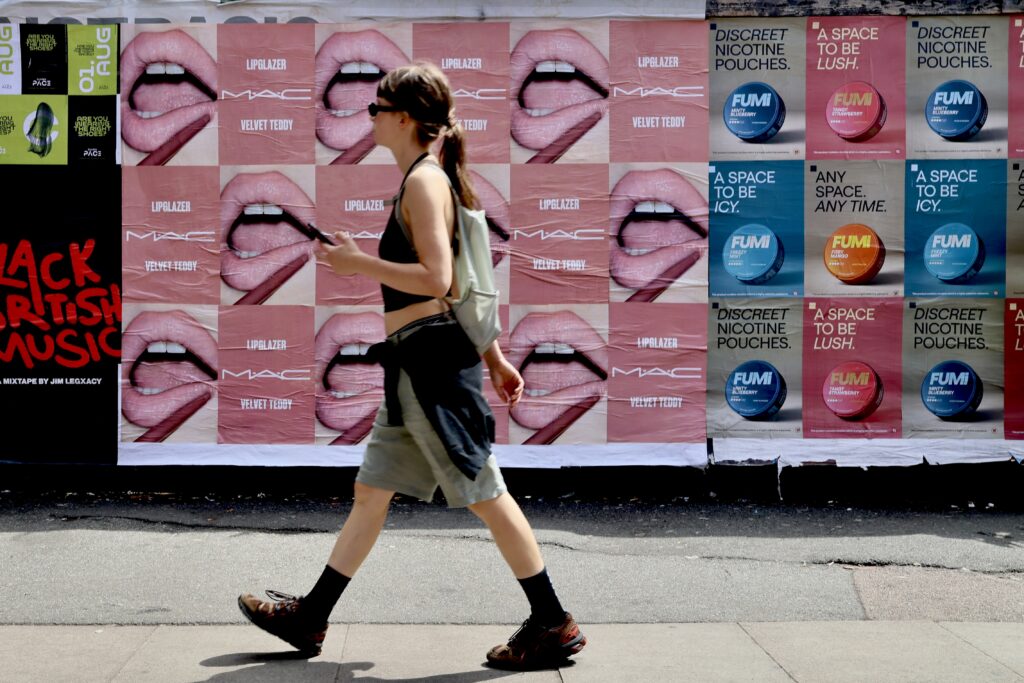
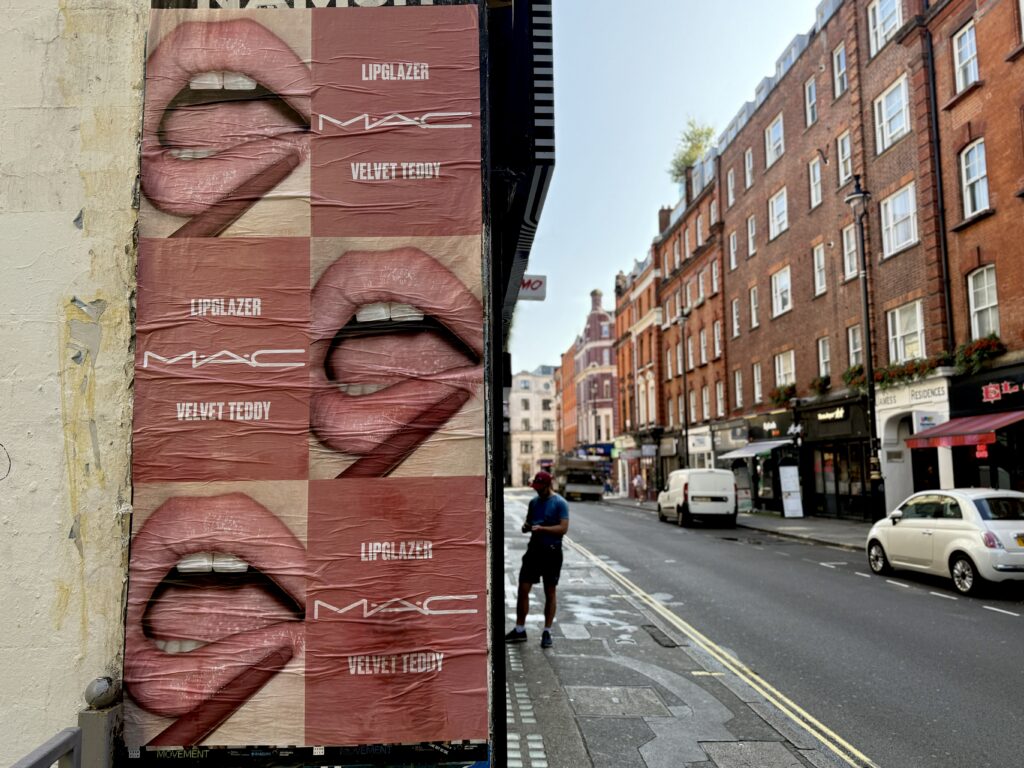
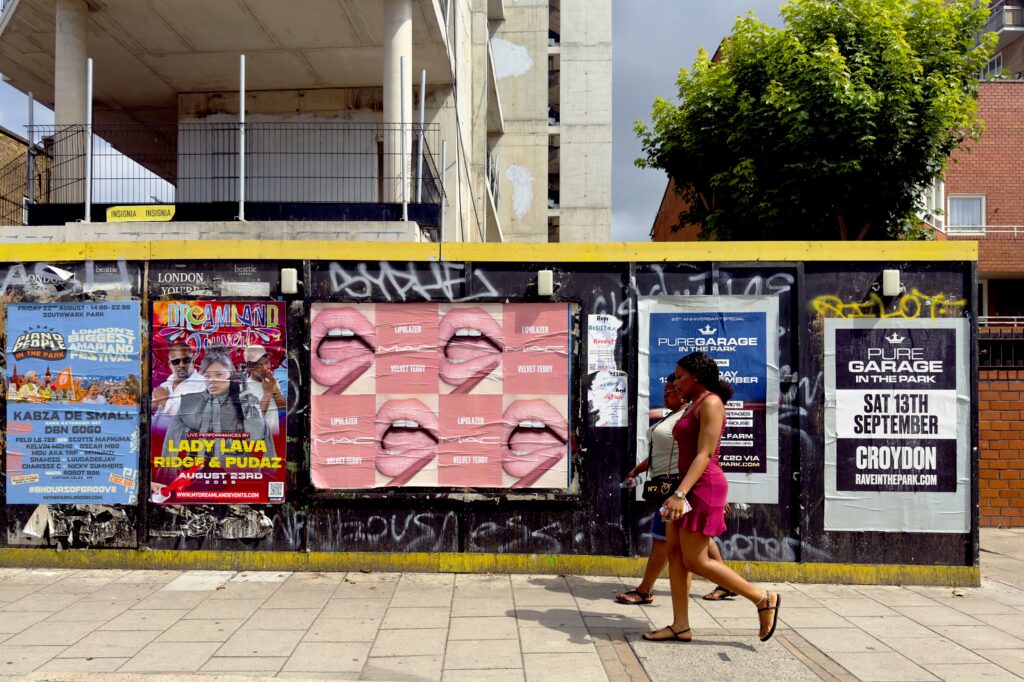
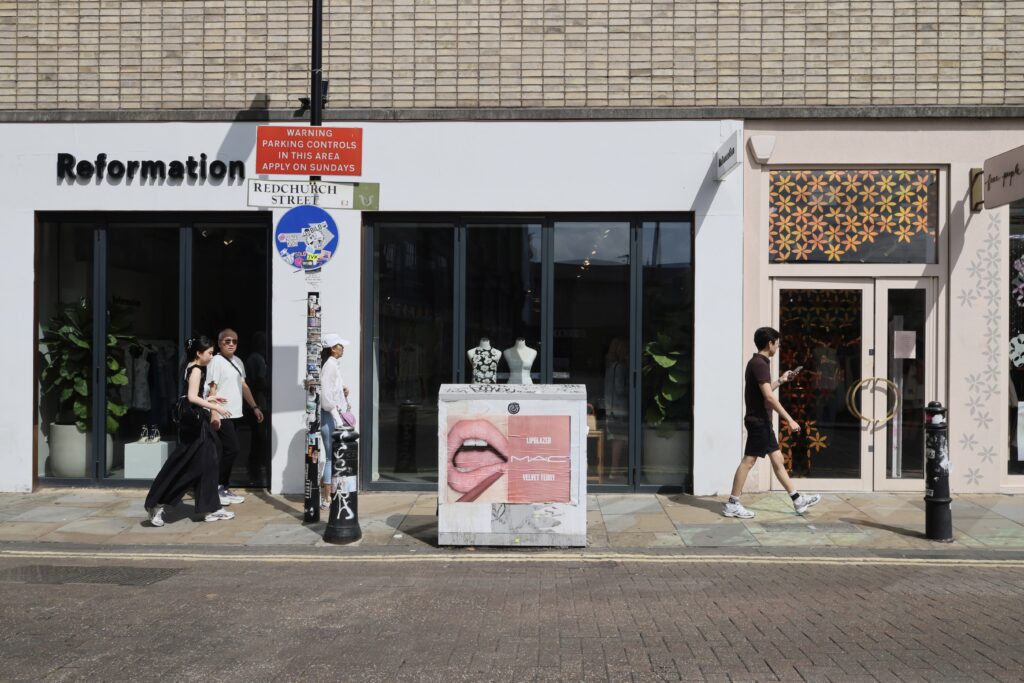
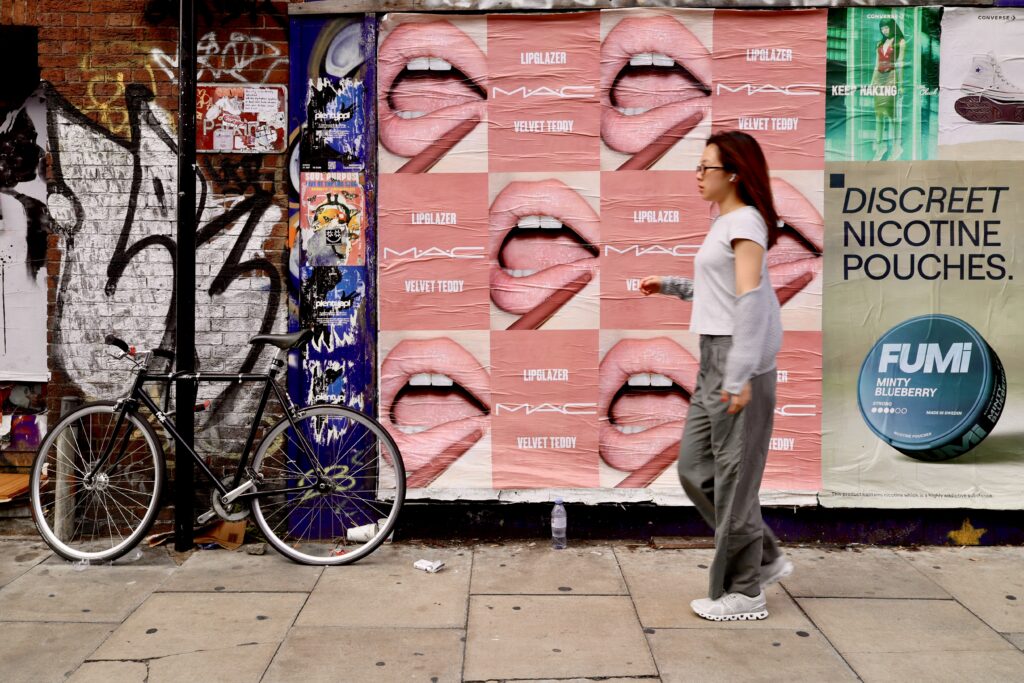
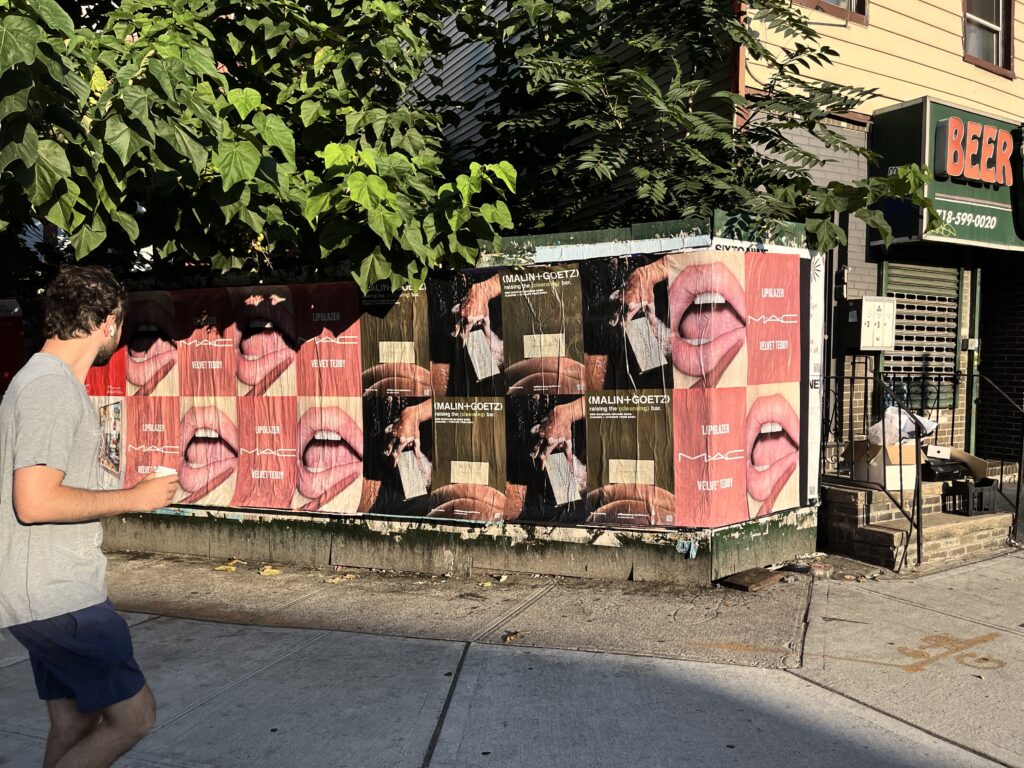
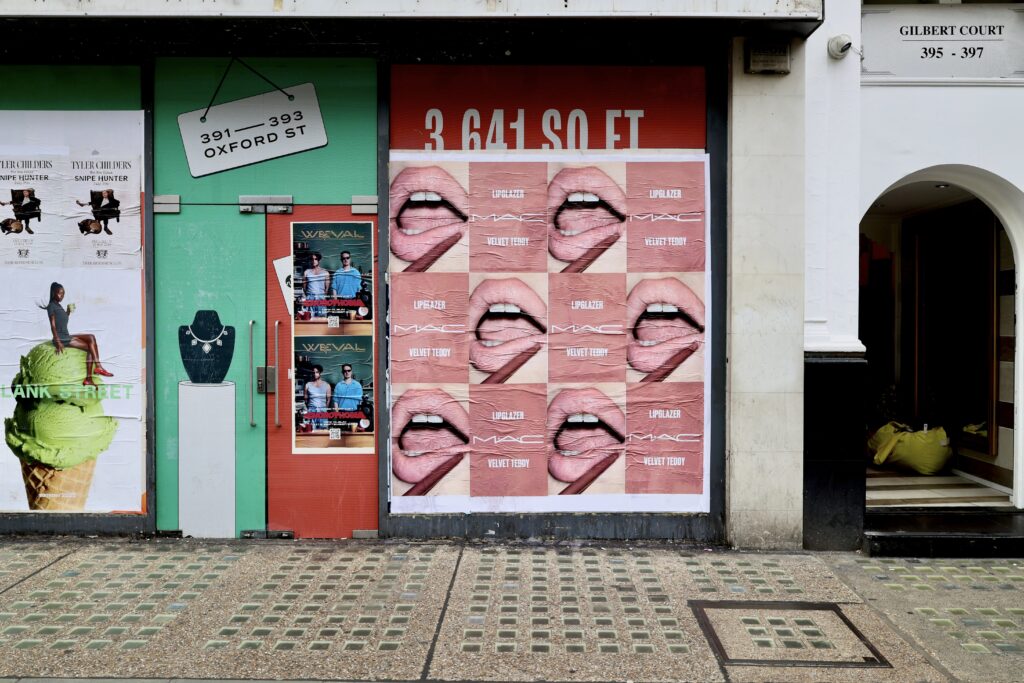
MACCosmetics, known for serving face, made a bold entrance with their new glossy liner, Lipglazer, teaming up with Beauty Papers and UNCLE on a wildposting campaign in London and New York. The striking creative features a suggestive, part-open mouth being painted in Velvet Teddy, a pinkish mauve shade. Plastered across walls in both beauty capitals, the seductive full lip and luscious colour popped against the urban backdrop and beckoned passersby in for a kiss.
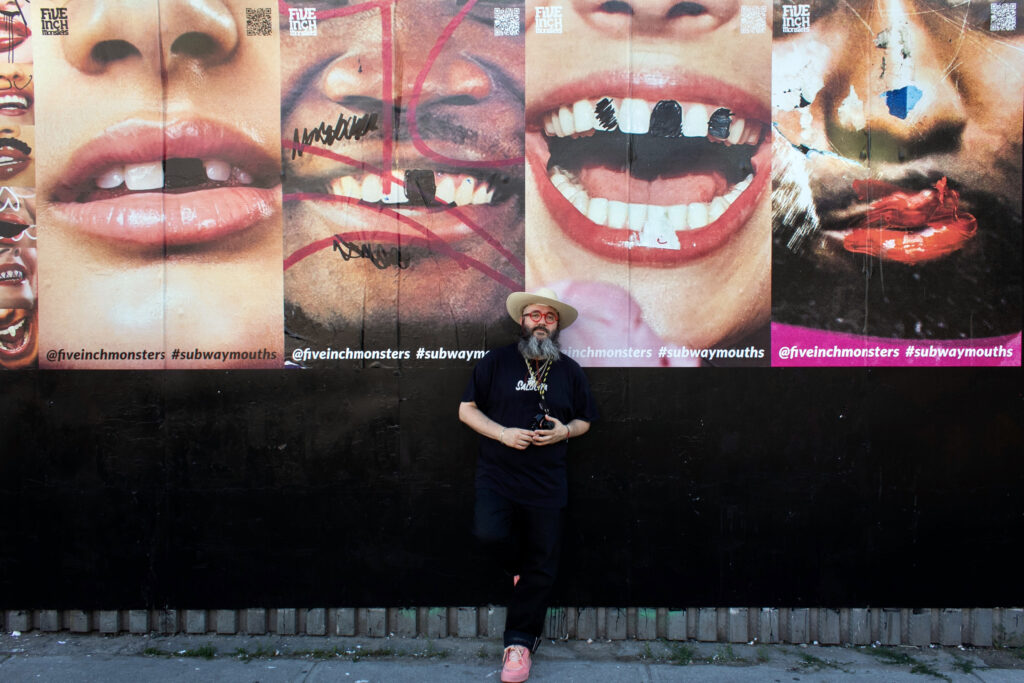
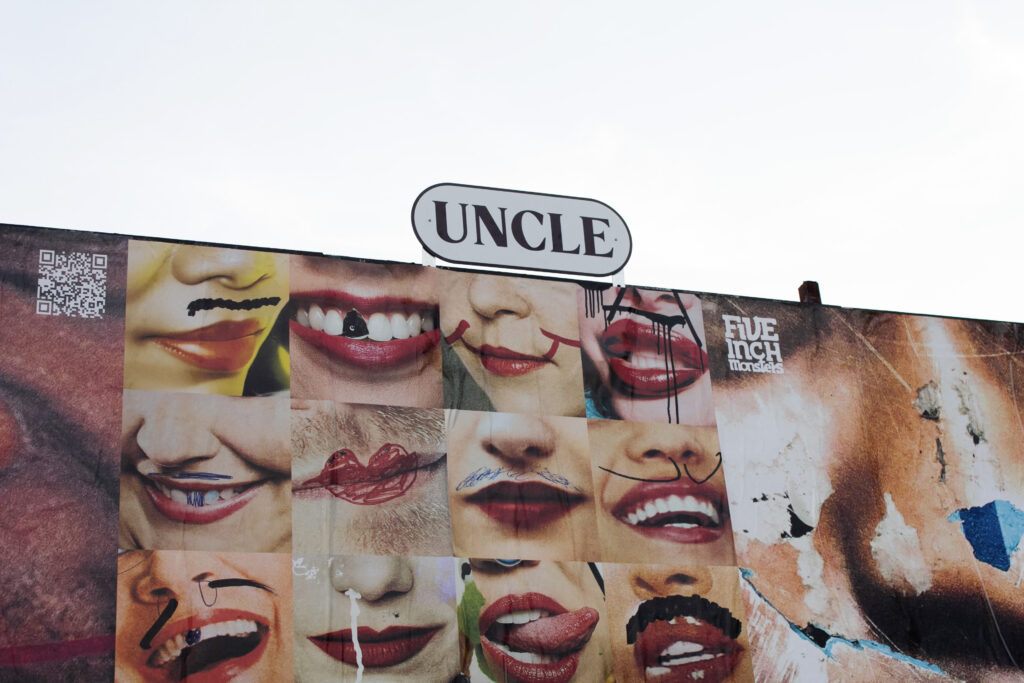
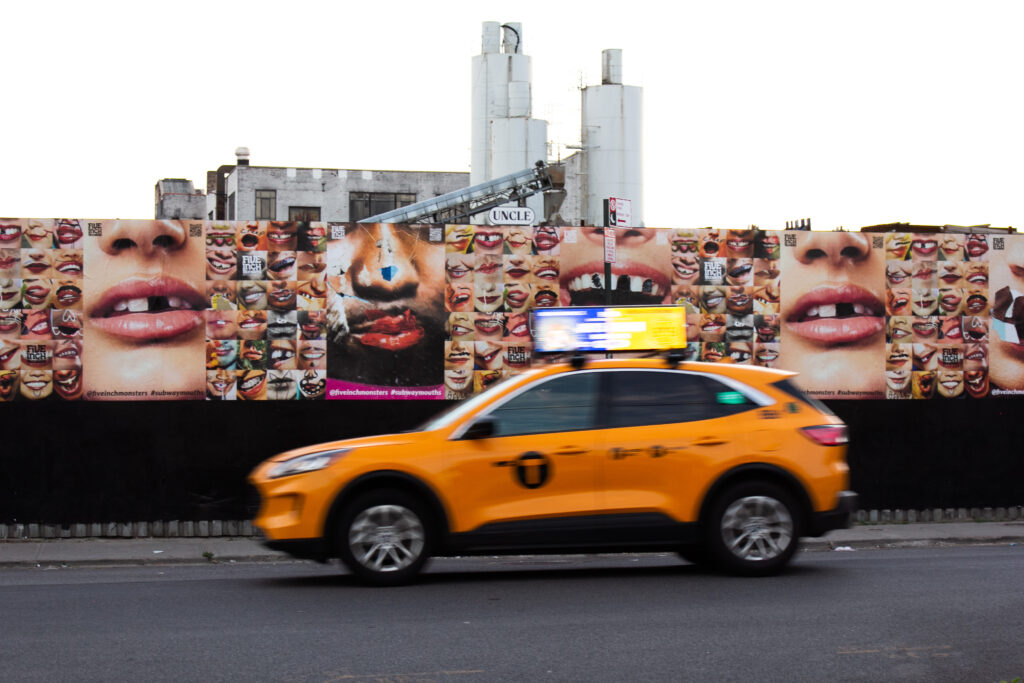
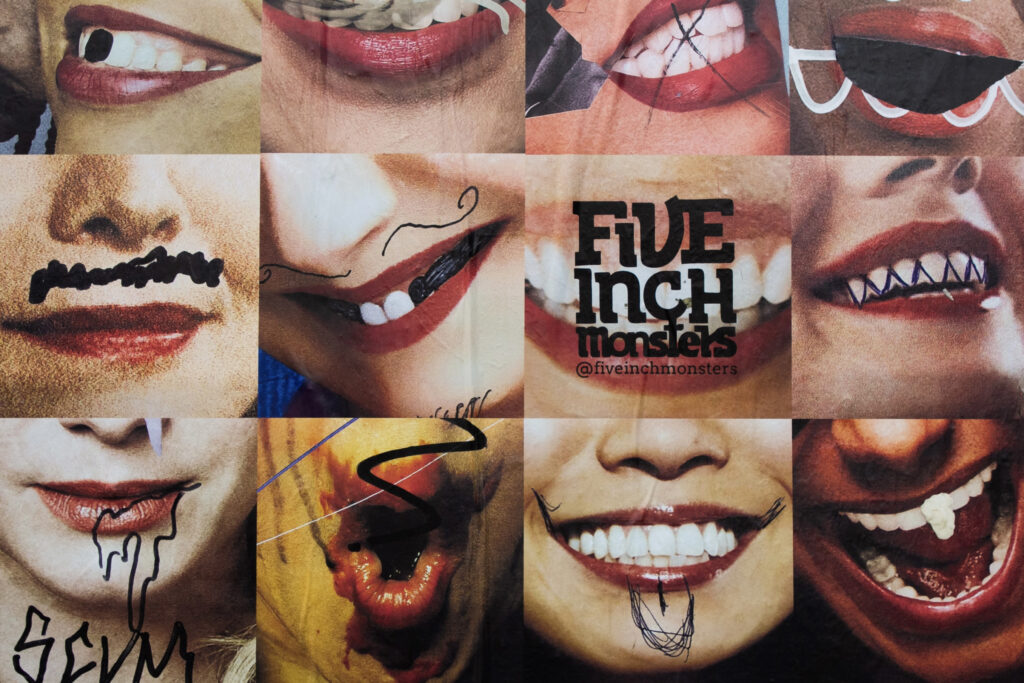
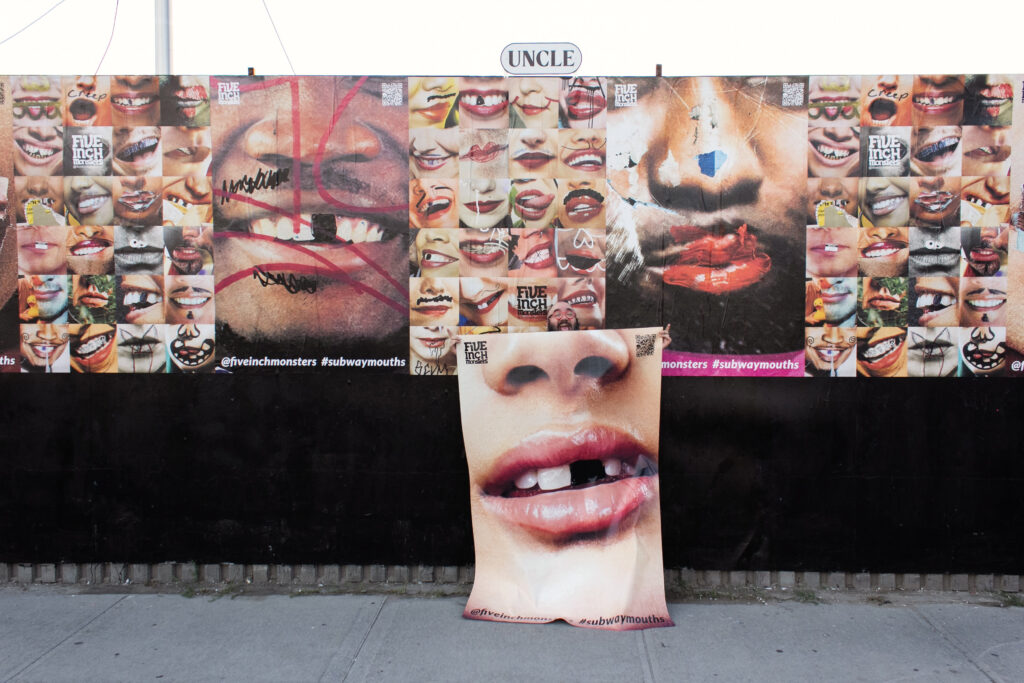
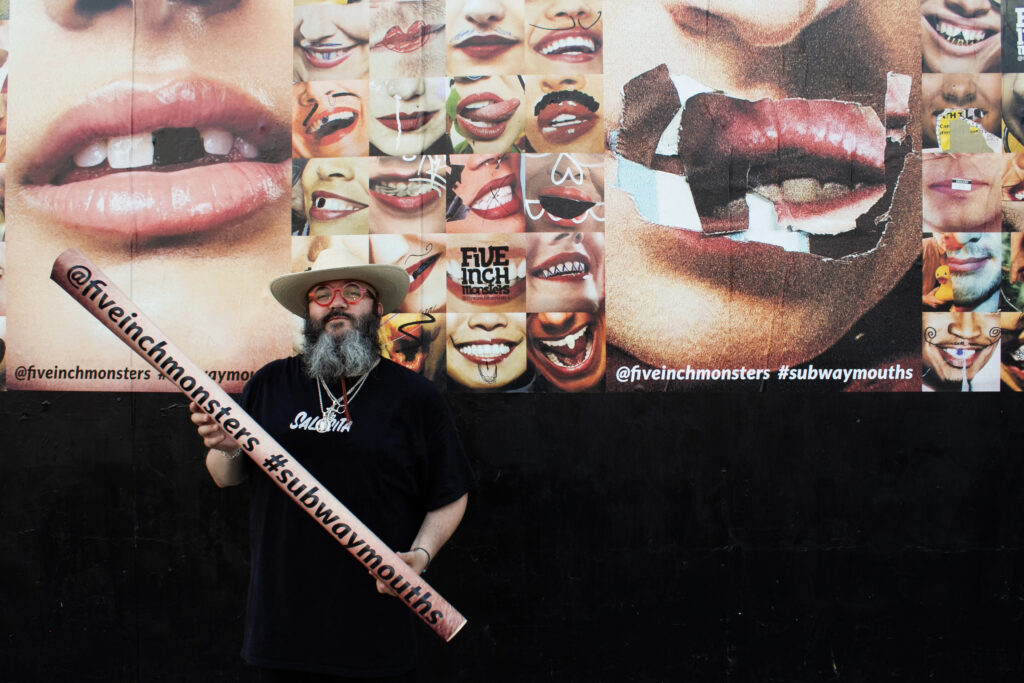
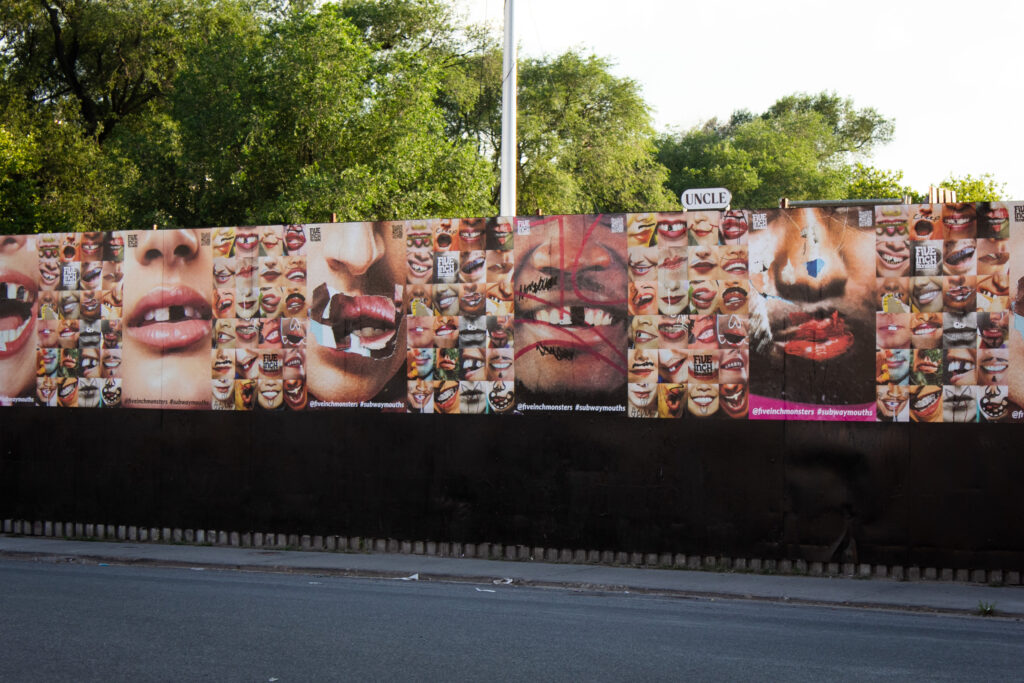
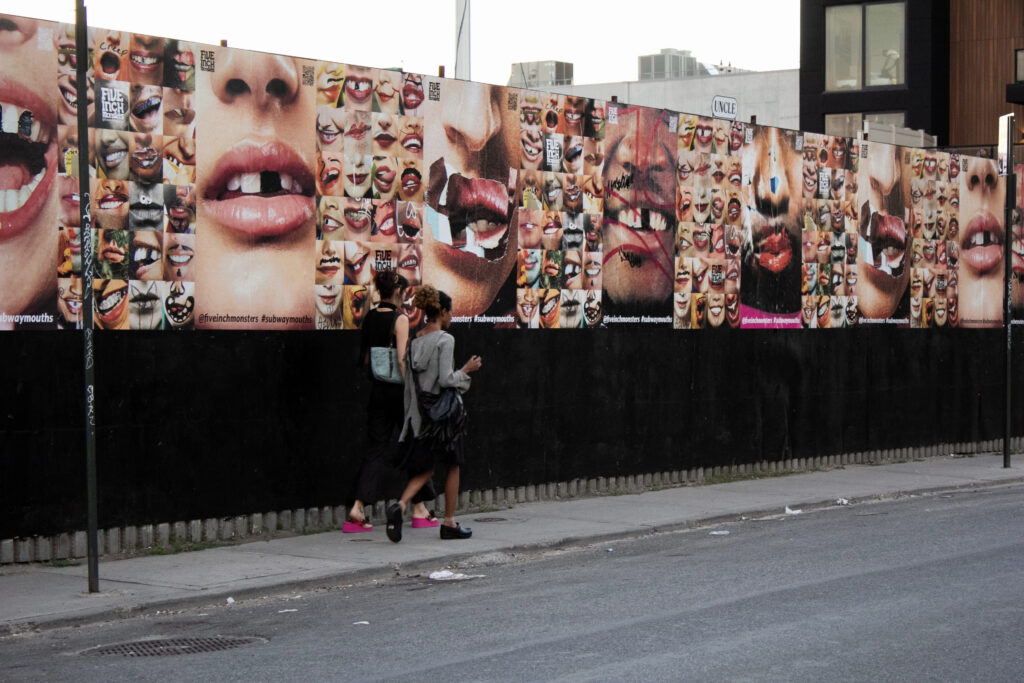
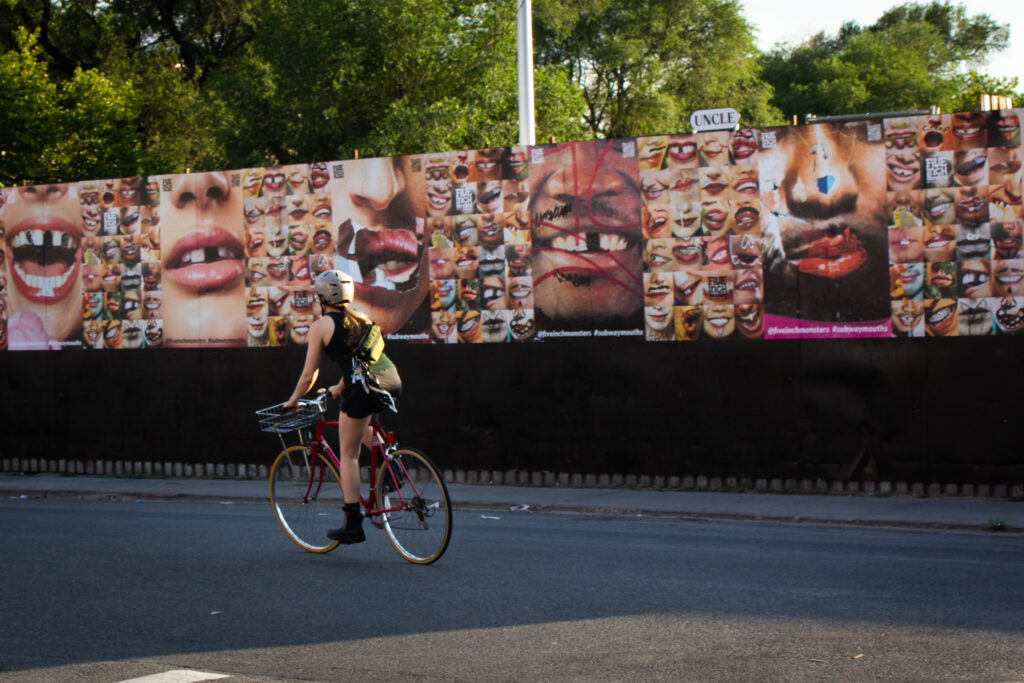
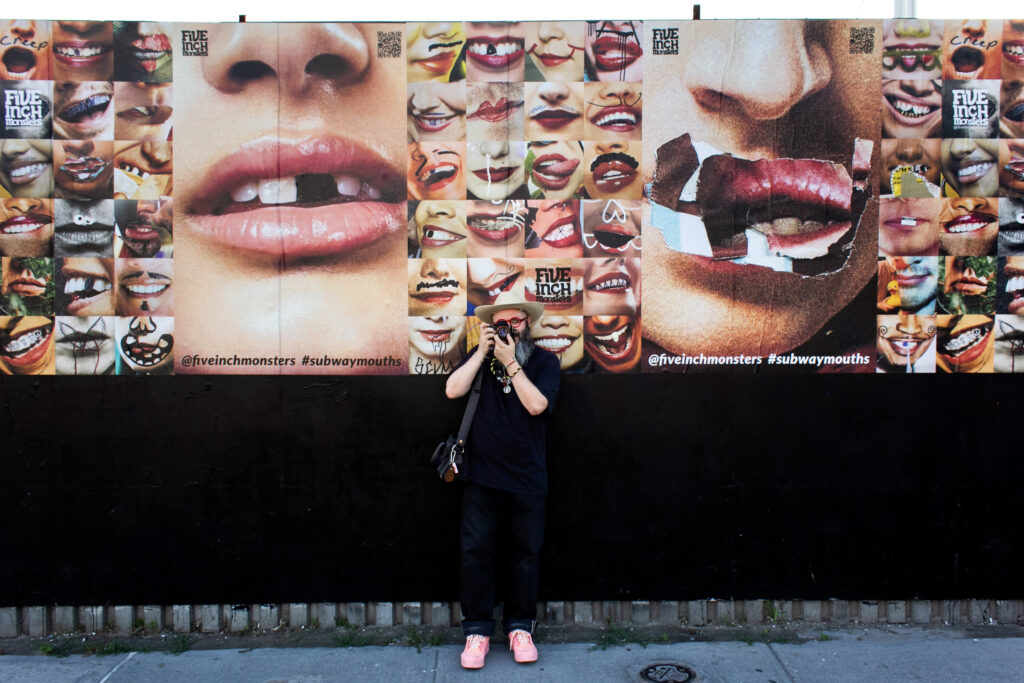
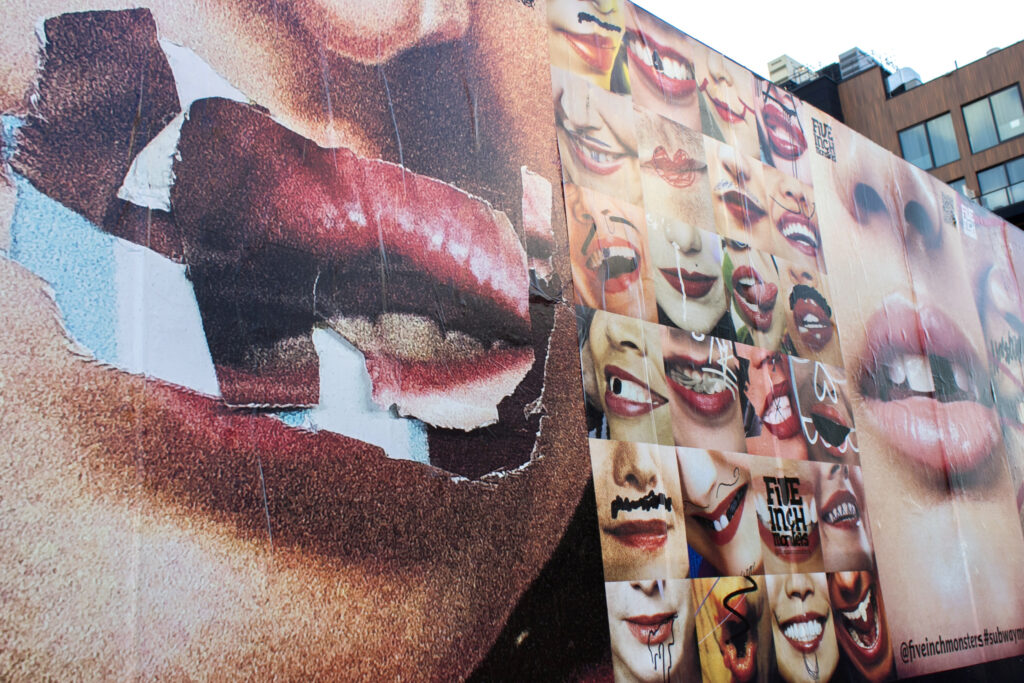
For most, the graffiti’d advertisements of the New York City underground is just vandalism, often rejected and dismissed. For Gabriel, who has spent the past decade or so documenting these #SUBWAYMOUTHS, they offer insight into New York City’s attitude.
Born in Mexico City, and now a resident of New York, Gabriel has always “gravitated in the art orbit”. He describes his childhood-home as being full of objects made by hand, with a camera always close by.
In the 80s, Gabriel and his cousins would send letters to the all-American corporations such as Coca Cola, Pepsi, The Dodgers, asking for any kind of “advertising swag”. Most wouldn’t reply. But every now and then, he and his cousins would receive stickers in the mail that they would trade between one another. One day, a red Marlboro cigarettes trucker hat showed up. Jackpot.
Now a professional in branding, photography, and design, it’s those stories, he tells UNCLE, where it all began.
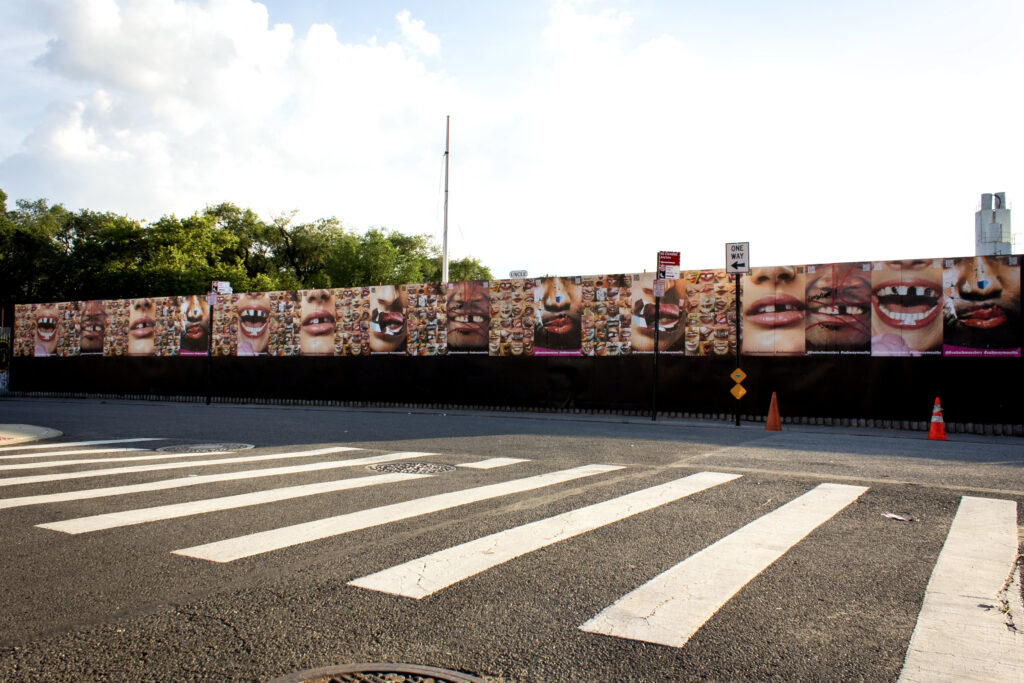
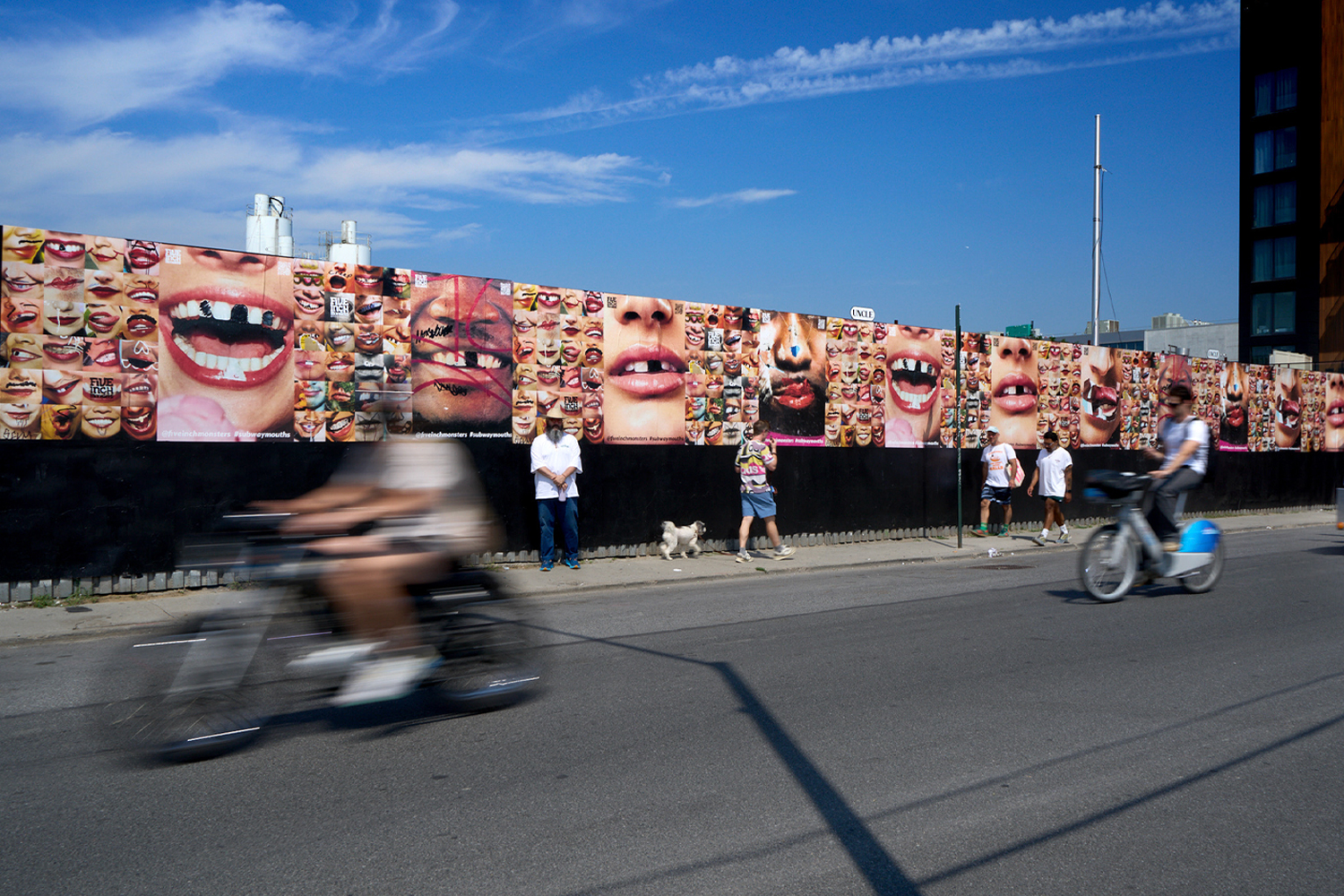
Before FIVEINCHMONSTERS, there was #SUBWAYMOUTHS, a project that began the day Gabriel moved to New York City. Twelve years on, it continues as both a daily artistic practice and a documentation of the city’s collective consciousness.
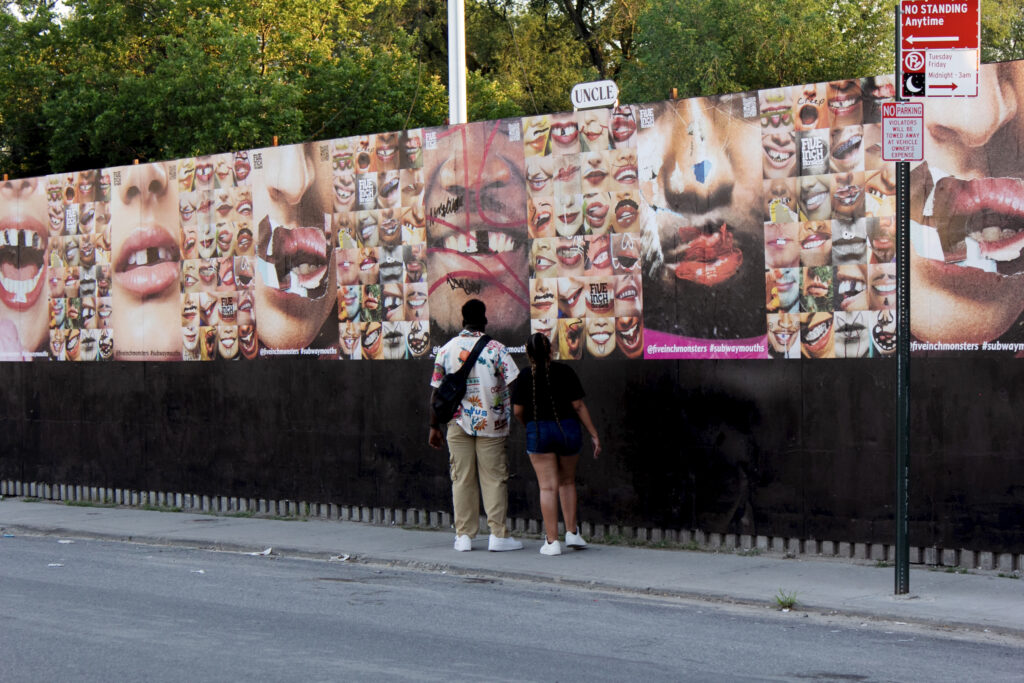
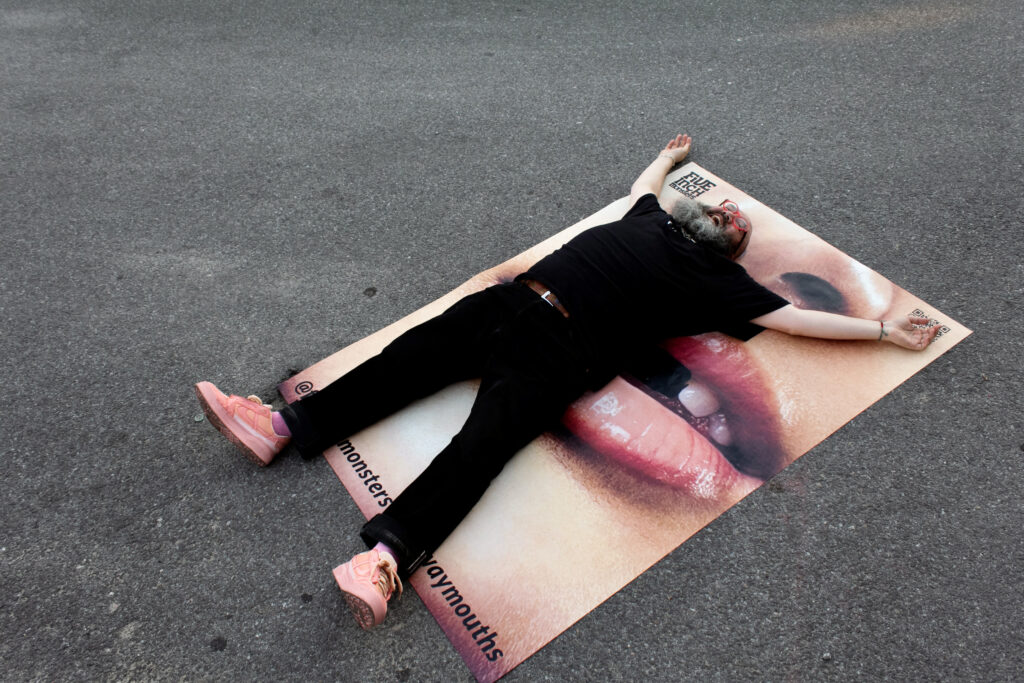
What follows is a conversation with Gabriel, to coincide with the emergence of these FIVEINCHMONSTERS – out of the subway and into the streets of New York, thanks to UNCLE.
CAN YOU INTRODUCE YOURSELF IN YOUR OWN WORDS? Mexayorkino since 2005, profesional del branding, fotografía y diseño. Descubridor empedernido de los detalles urbanos y obsesionado con los tratamientos e intervenciones espontáneos naturales y provocadas que suceden en día a día en las superficies de NYC. Por último self-proclaimed Transcultural visual Translator – Traductor visual transcultural – this last has to do with my eternal love of my mexicanidad, mis moles y mis mezcales.
Mexayorkino since 2005, a professional in branding, photography, and design. A tireless discoverer of urban details and obsessed with both spontaneous and intentional surface treatments and interventions that occur daily across NYC. Lastly, a self-proclaimed Transcultural Visual Translator — a title that speaks to my eternal love for my Mexican heritage, my moles, and my mezcales.
YOU REFERENCE NEW YORK AS A SOURCE OF INSPIRATION. CAN YOU TOUCH ON THIS AND HOW IT DIFFERS FROM MEXICO CITY?
I don’t think I could say in good faith that I know the CDMX of the NOW the way I live and Respiro my NYC. Nueva york es complejo y candido. Romantico y Salvaje, Demandante y Dadivoso. Nueva York te quita y te da! NYC is the city that you go to reinvent yourself and for many the city where you left your other self before reinventing the one that leaves the city happy knowing how much it learned on its way out. If you ask me what the difference is, I will say: “EVERYTHING… as it should be!”. I am ever grateful to have lived in both cities during different formative times in my life. Mexico nurtured me and Nueva York allowed me to be the human that I am.
New York is complex and candid. Romantic and wild, demanding and generous. New York takes from you—and gives back!
CAN YOU TELL US A BIT ABOUT YOUR BACKGROUND AND HOW YOU FIRST GOT INTO ART AND DESIGN? WHAT WERE SOME EARLY INSPIRATIONS OF YOURS?
I have always gravitated in the ART orbit. There was always a camera and photos being taken, just documenting life. My home was a ‘DIY-everything’ type of home. So, it was never strange to make things out of random objects. We travelled a lot by car, and I was able / forced to see the world differently, time elongates and warps when you are a kid in a truck for twenty-seven hours. Details become stories and you create full universes in your head. My mother’s side of the family lives in Culiacan Sinaloa and that is also part of my (norteño) history. I don’t think I ever said this out loud, but a defining moment was in the early 80s – my older cousins sent letters via snail mail to corporations like Pepsi, Coors, the Dodgers, the USA Olympic Committee 1984, asking for any kind of swag. Apparently, this was a thing with all their friends. There was a paragraph in English that was passed along, transcribed letter by letter, and FYI, no one knew English. So, this makes it even more Mexican – if you know, you know – and the result was that months later, from the dozens of letters you sent, one will send you back the wildest most American advertisement swag. From the highly valuable and tradable stickers to crazy things like a Marlboro cigarettes red trucker hat. I mention all of this because your question makes me realise this is where my love for branding design and advertising started. They had the door of their room covered with stickers and I always thought that was the coolest thing on earth. Years later I discovered by mere casualty the beginnings of what became El Sensacional Mexicano project.
I found myself in a underground parking lot in CDMX then DF, looking at people hand painting rótulos of Mexican slang phrases, this was right around my first years studying graphic design and it changed everything and allowed me to see the same design and work that I admire on the stickers from Culiacan but now in my own city and in my own language with the strength that only hand painted letters can achieve. This allowed me to develop my own graphic style and pay my education doing silkscreen jobs and wearables. Fast forward a few years, this took me to the FWM (The Fabric Workshop and Museum) apprenticeship in Philadelphia and eventually to live in NYC.
HOW DID FIVE INCH MONSTERS BEGIN? DO YOU REMEMBER THE FIRST #SUBWAYMOUTHS YOU PHOTOGRAPHED? It began the moment I moved to NYC. It was the first thing I noticed going down the stairs to the subway station. The #SUBWAYMOUTHS were impossible not to notice. Larger than life, right at the height of your face. Purposely designed to hit that stop of attention, whether you wanted it or not.
FIM took a little longer to collect. Every day observing, analysing my surroundings, everything was new and needed something to make sense of it. FIM had a few transformations from products (toys) to silkscreen fashion ideas – to become the artistic daily practice of documenting “the everything” around me.
WHAT DO THESE DRAWN MOUTHS, OFTEN ANGRY, GROTESQUE OR PLAYFUL, SAY ABOUT THE ATTITUDES OF NEW YORK?
This is something that I am constantly aware of but I don’t think it has a final answer; the #SUBWAYMOUTHS are always ever-changing. They do show a snapshot of the time we live in, often political and highly socially conscious. I would describe them as never-ending New York attitudes, Nueva Yorks has too many personalities to pigeonhole it into one.
THE PROJECT IS ALMOST LIKE A VISUAL DIARY OF THE CITY’S COLLECTIVE SUBCONSCIOUS. WOULD YOU AGREE?
It is and documenting it has always been its intention. I was and still am mesmerized by what it communicates in silence, in your face, with their unapologetic truths. And seeing them all together for the first time printed at the CHOLITA cafe show in June 2025 gave them the collective freedom that allowed the connection with UNCLE. They now peek out of their long-term-residency with Instagram.
WHAT THEMES OR PATTERNS HAVE EMERGED OVER TIME IN THE MOUTHS THAT PEOPLE DRAW? CAN YOU DRAW PARALLELS WITH THE ‘MONSTERS’ AND WHAT IS HAPPENING AROUND THE WORLD?
Patterns are everywhere and #SUBWAYMOUTHS are not an exception. The black tooth, dick on mouth, ripped-torn-scratched-destroyed-bullied-empty surfaces… It all sounds familiar and to me, it resembles and describes the social problems of major metropolitan cities.
DO YOU SEE THIS AS AN ART MOVEMENT, SOCIAL COMMENTARY, OR BOTH?
FIM is my personal artistic daily practice. But I am sure as the posts in the subway disappear, these may one day be studied, and their messages will be louder and amplified. Years ago, a friend of a friend of mine, a teacher, gave a class at an NYC university and used FIM as a reference of continuity and longstanding urban documentation and art practice.
WHAT HAS IT BEEN LIKE TO WITNESS THE PROJECT’S EVOLUTION ACROSS SO MANY YEARS? WHAT HAS IT TAUGHT YOU ABOUT NEW YORK, OR ABOUT PEOPLE IN GENERAL?
People throughout history like leaving their mark and people get bored quickly. As for FIM, there is an expiration date, the boards are being removed as I write this and their day as #SUBWAYMOUTHS are numbered. I probably need to look UP again.
WHY DO YOU THINK THE SUBWAY, AND NOT THE STREET, IS SUCH FERTILE GROUND FOR THIS KIND OF ARTISTIC EXPRESSION?
This happens everywhere, I just happened to narrow it down to the subway as a documenting subject, as their size and form were more standard and the encounters were inevitable. Capturing this on the street is more about timing. And as you guys know well, this is the bread and butter for wildposting in NYC. THIS WHOLE PROJECT SEEMS QUITE POETIC. FROM TRADITIONAL ADVERTISEMENTS IN THE SUBWAY, TO NOW BEING FLYPOSTED ABOVE GROUND THROUGHOUT NEW YORK. IS THIS WHAT YOU ENVISIONED OF THE PROJECT WHEN YOU STARTED DOCUMENTING IT BACK IN 2013? In all honesty, this is just magical and has allowed me and the #SUBWAYMOUTHS permission to dream bigger. So, I see this just as the beginning.
VIDA ETERNA A LAS SUBWAYMOUTHS! And many more reinventions for FIVEINCHMONSTERS GRACIAS TOTALES.
How Bushwick’s Zodiac-Themed Bar Embodies New York Nightlife
Plenty of places throw parties, plenty more serve drinks. But the ones that matter – the ones that actually feel like they belong to a city – are something else entirely. Maybe it’s the music, or even the lack thereof. Maybe it’s the faces behind the bar, or the heads that turn towards the door when you walk in. Or maybe it’s something less tangible – a feeling that this place isn’t just a setting, but an active part of the experience itself.
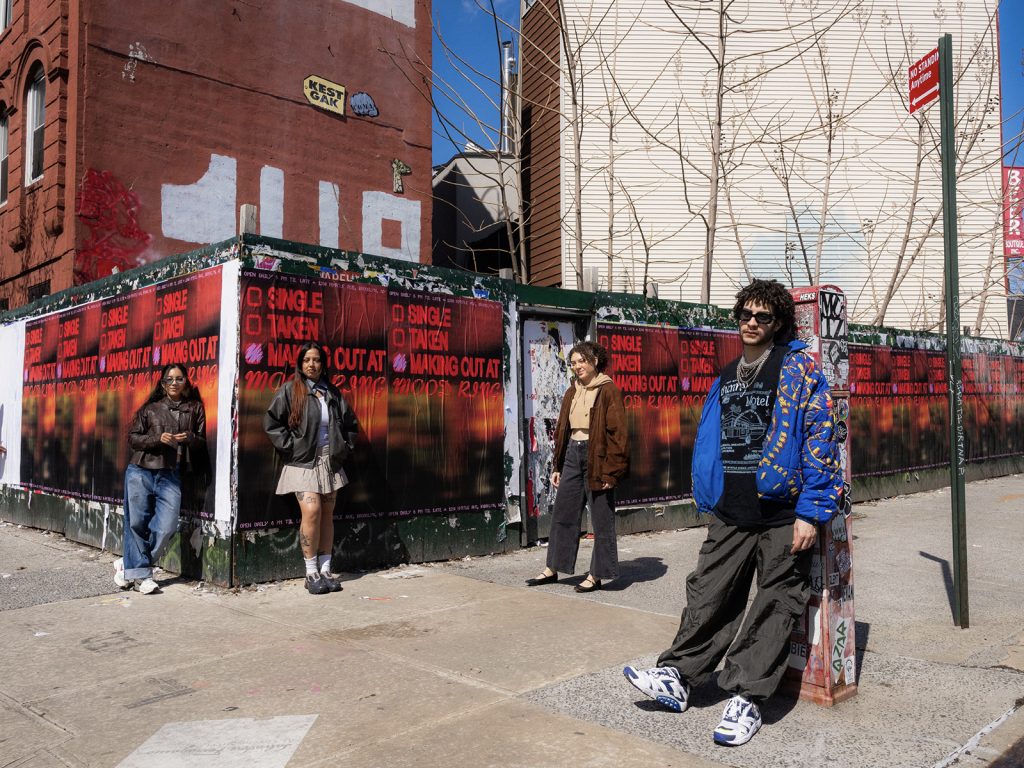
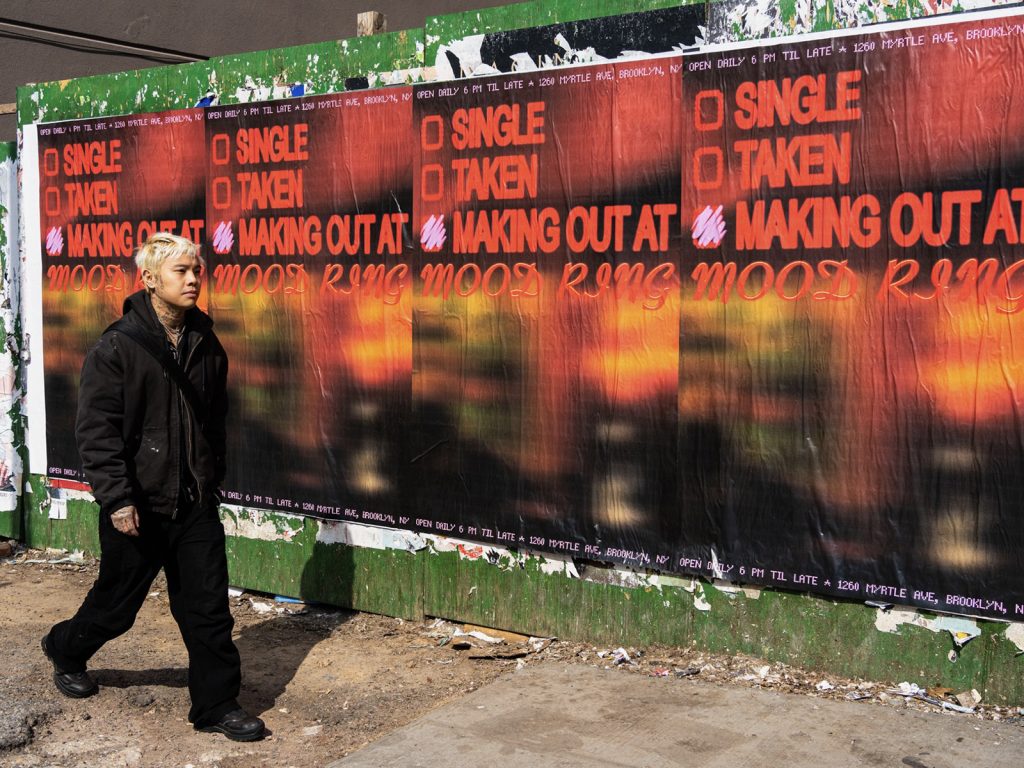
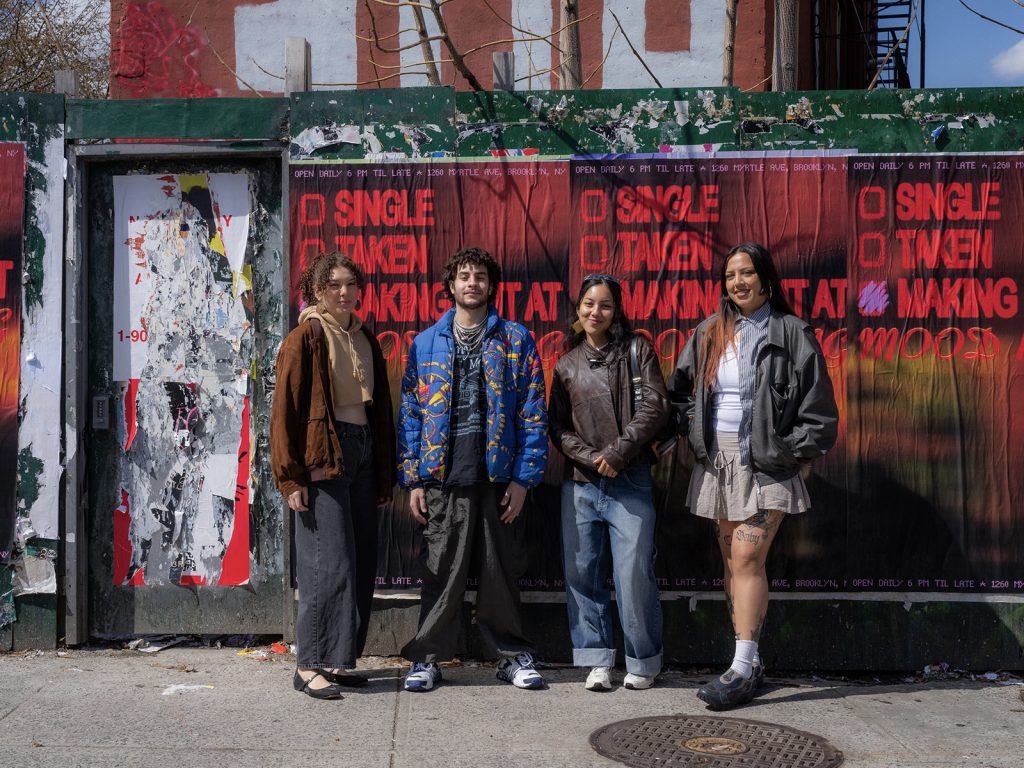
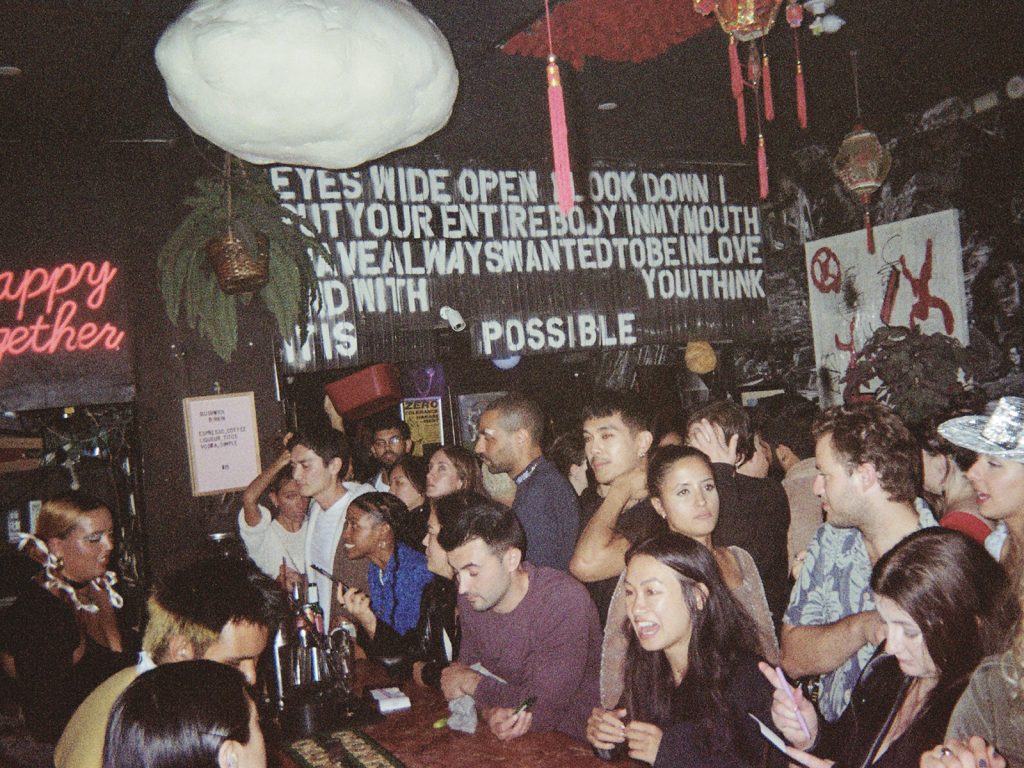
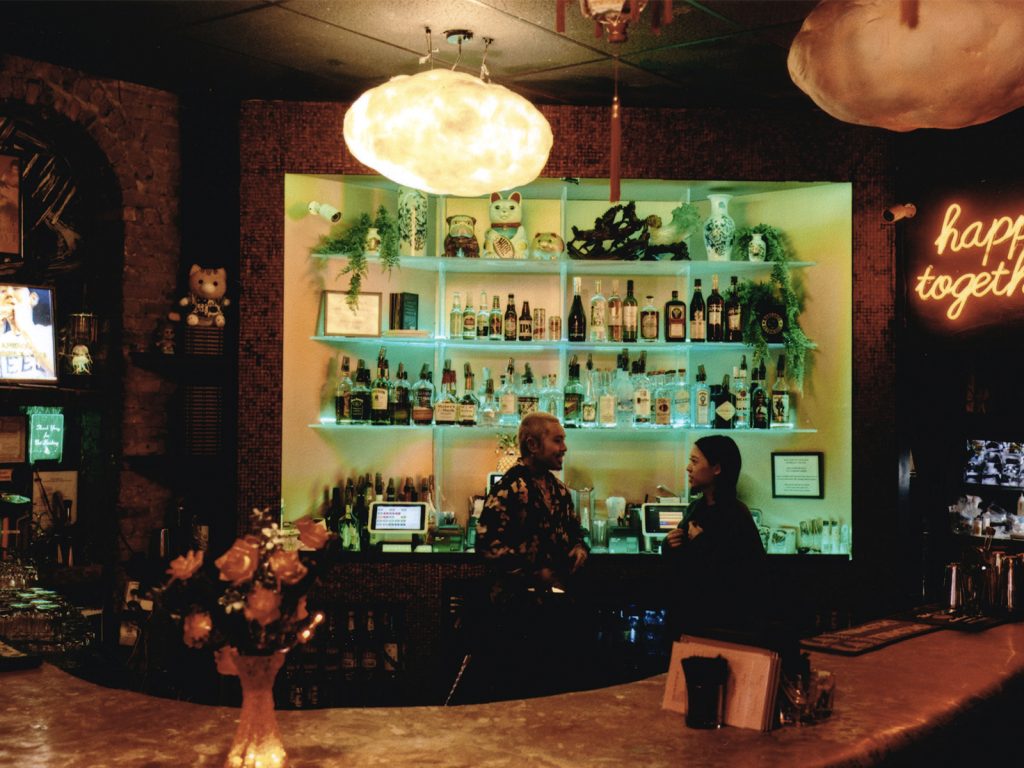
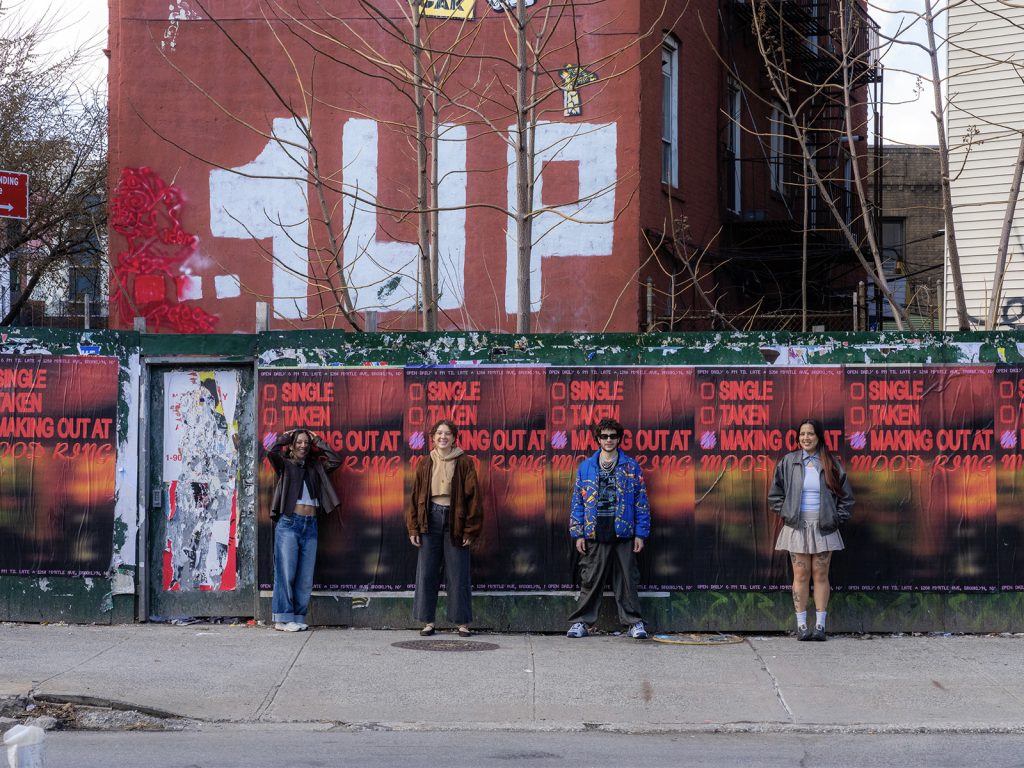
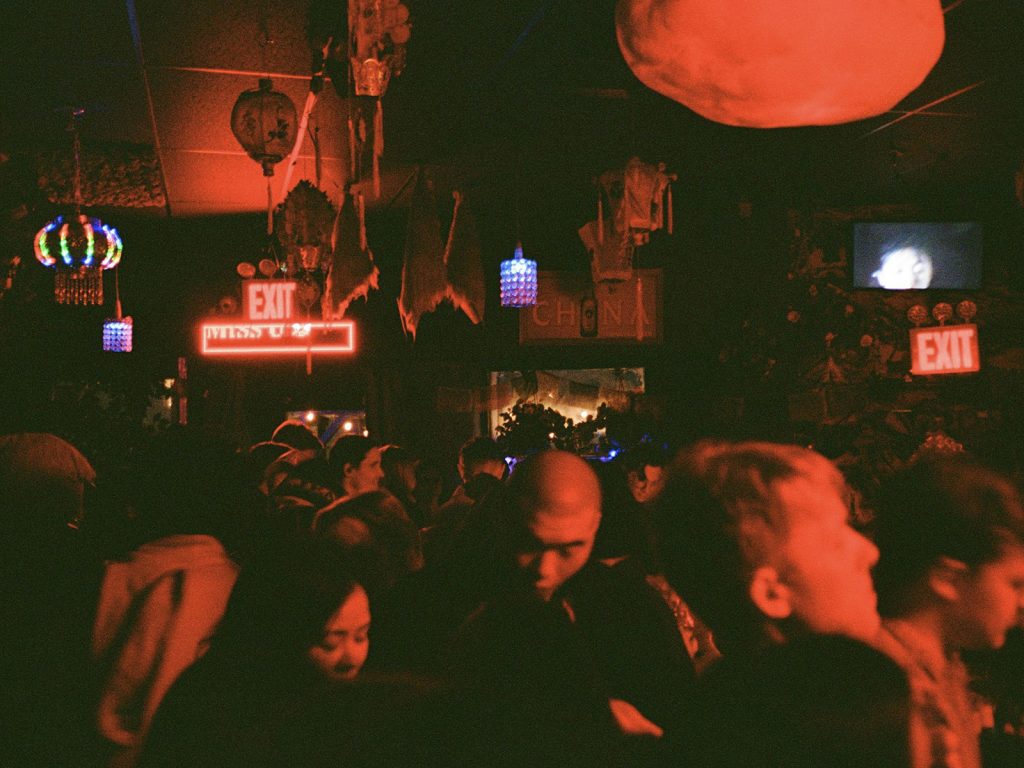
Mood Ring – a ten-minute walk from the centre of the Bushwick universe, Myrtle Ave and Broadway – is one such place. Open since 2017, it’s carved out its own space in New York’s nightlife, balancing the intimacy of a neighbourhood bar with the energy of a club that feeds the underground.
The zodiac-themed cocktails are the initial hook. “Virgo seeks discounted drinks from August 22nd to September 23rd.” But astrology alone doesn’t keep people coming back. What does is a space that constantly shifts with the city – a venue shaped by the people who run it, rather than a corporate identity rubber-stamped across multiple locations.
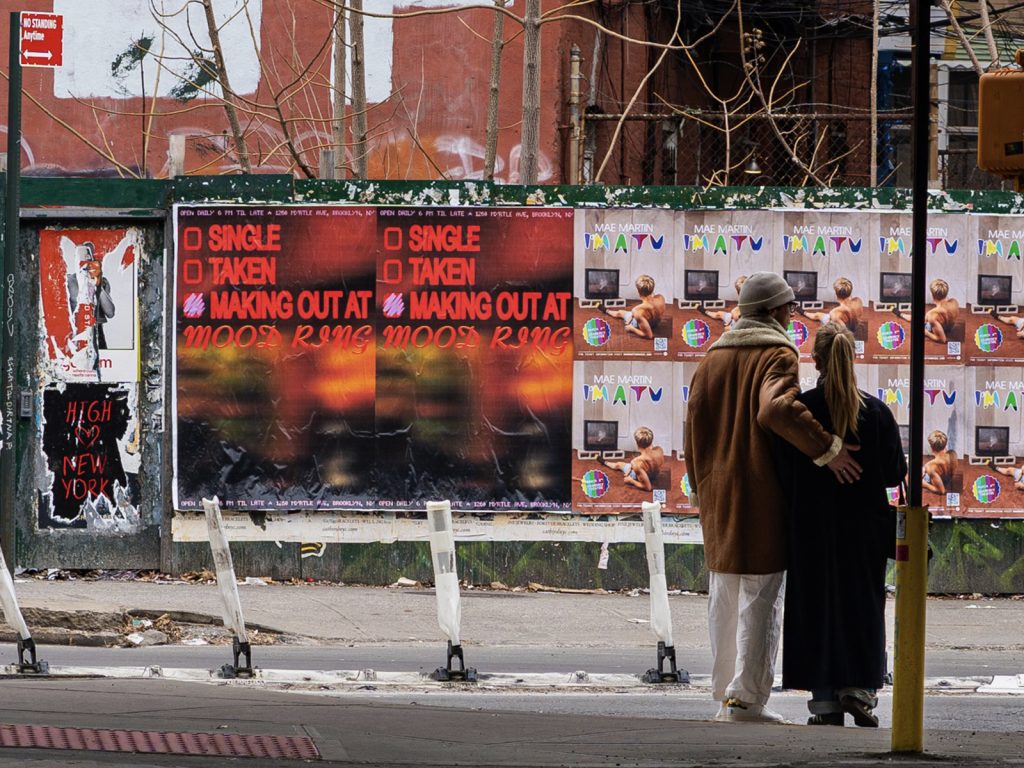
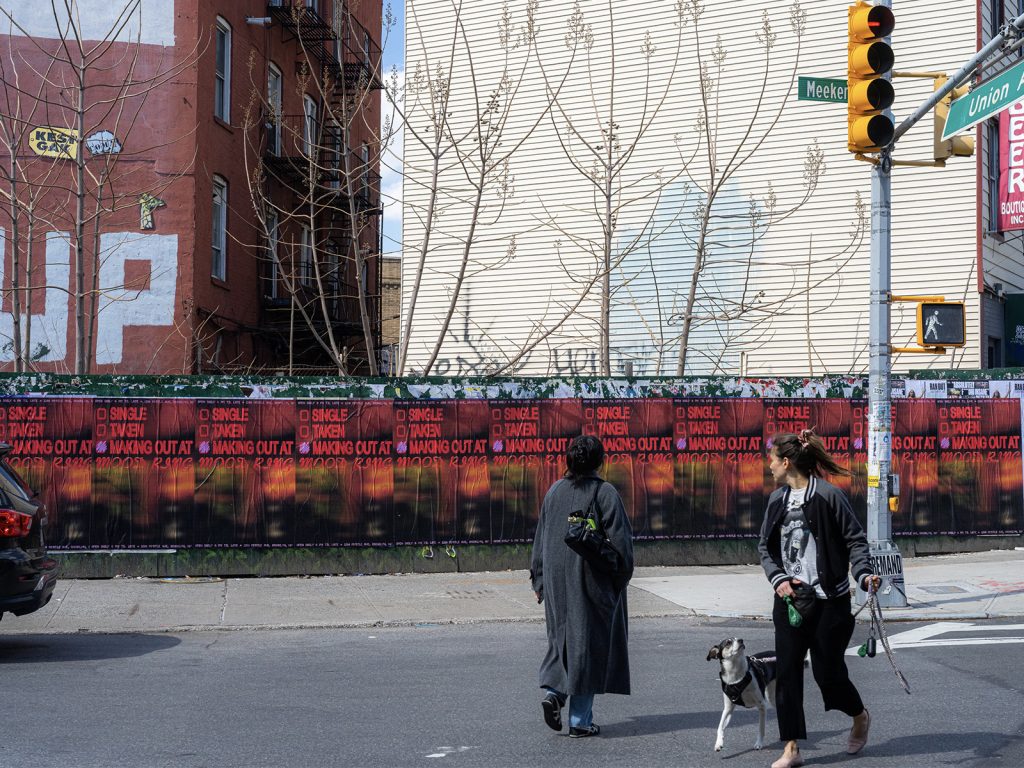
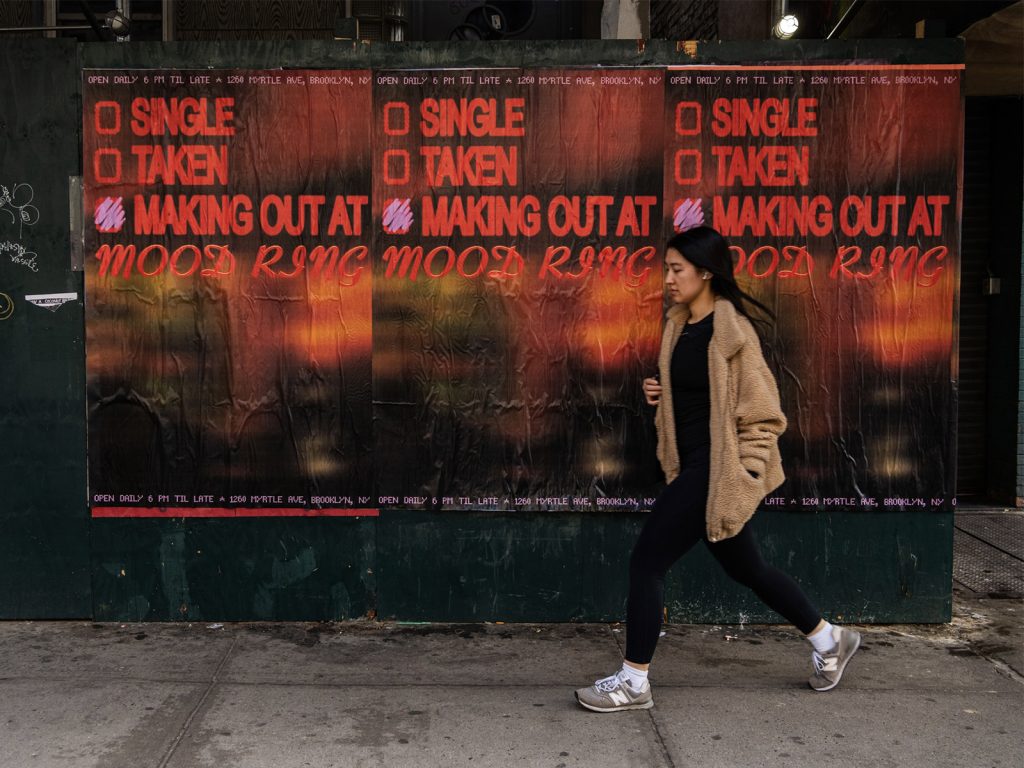
That flexibility allows it to be reactive in ways larger venues can’t. Its recent Valentine’s event, for example, a staple in their calendar as the bar’s theme and recent wildposting campaign with UNCLE would suggest – raised funds for those affected by the LA fires. They don’t have to wait for approval from a boardroom to make things happen. They’re defined by the people who fill them, from the DJs on the decks to the regulars perched at the bar, and the connection they foster extends far beyond a transaction. There’s also the bigger picture – the role that a venue like this plays in a city’s ecosystem. “If the only places to play are massive clubs with big fees and bigger expectations, you’re skipping a whole part of the process,” says co-founder Bowen Goh. Mood Ring, like other small venues, is where artists cut their teeth, where new sounds emerge, and where a DJ can experiment with an audience that’s open to the unexpected. Without places like this, the grassroots pipeline collapses.
And yet, in a city where rising rents and shifting trends force independent venues to fight for survival, Mood Ring keeps evolving. Like its ever-changing cocktail menu, the space adapts to the season, the moment, and the people who walk through its doors. Call it fate, call it intuition – whatever it is, it’s working.
Can you introduce yourself and Mood Ring?
Bowen Goh: I’m one of the founders of Mood Ring. We opened in 2017, and over the years, we’ve evolved into a bar and club that’s home to a lot of New York’s underground and up-and-coming artists. We started out with more of a house music focus, but as the scene has grown, so has our programming. We try to be a dynamic space—always shifting with what the city and its people want.
What was the original vision for the space, and how has it evolved?
We actually didn’t set out to open a club. The initial idea was a small restaurant, but my business partner was really involved in the underground techno scene. We took a trip to Berlin, and after a few nights out there, the idea of opening a club just felt right. Back home, there was a gap in Bushwick for something on the lighter side of the dance spectrum—not full-on heavy techno, but something with a bit more house music. We saw that opportunity and ran with it.
At first, we didn’t even plan to throw as many events as we do now, but the demand was immediate. We got a little press early on because of our astrology concept, and from there, things snowballed. The DJs came, the crowds followed, and we kept making improvements—better sound, a proper booth, more intentional bookings. Mood Ring just grew into itself.
Mood Ring has a strong astrology theme. What inspired that?
Astrology was just something that felt natural to us. Before we even opened, we saw how much people loved talking about it—especially in nightlife, where you’re constantly meeting new people. Asking someone their sign is an easy icebreaker, and we wanted the space to feel like that—somewhere you can strike up a conversation with a stranger without it feeling weird.
It also gave us a way to keep things fresh. We have a rotating cocktail menu based on the zodiac calendar, and over the years, we’ve constantly updated the space’s look and feel. We even put out an astrology-themed cocktail book, which was a fun way to extend the concept beyond the bar.
And how does the astrology theme influence the overall atmosphere at moodring?
The theme was never just a gimmick—it became part of the culture of the place. You’ll see people asking each other about their signs within minutes of meeting. It’s funny because, even if you don’t care about astrology, someone in the room will. It creates this shared language that people can tap into, whether they take it seriously or just use it as a fun way to connect. Beyond the cocktails, we’ve always treated Mood Ring as a space that shifts and evolves—kind of like how people see astrology as being tied to cycles and change. We update the decor, switch things up seasonally, and try to keep the energy feeling fresh. I think that’s why people keep coming back—there’s always something a little different, even if it’s subtle.
Mood Ring has become a hub for djs and electronic music. What’s your approach to programming and curating events?
Bowen Goh: From the start, we wanted to offer something different from what was already out there. Right across the street, you’ve got Bossa Nova Civic Club, which has been a staple for heavier techno. So, when we were setting up Mood Ring, we leaned toward the other end of the spectrum—more house, something a little lighter, more groove-driven. At the time, there wasn’t much of that in Bushwick, and it just made sense to carve out that space.
Over time, we’ve expanded to include club music, Latin nights, and other genres that reflect what people in the city are gravitating toward. But we always keep the core of it intact—it’s about energy, movement, and making sure the space stays fresh.
Mood Ring feels like an incubator for up-and-coming artists. Do you see it as a stepping stone for djs on their way to bigger venues?
Yeah, that’s something that’s just naturally happened. We’re a small venue, so we’ve always attracted underground talent—DJs who are on the come-up, trying things out, and building their following. Some of the artists who’ve played here have gone on to much bigger stages, but a space like ours is where they get that first real connection to a crowd.
I think a lot of people don’t realize how important that is. If the only places to play are massive clubs with big fees and bigger expectations, you’re skipping a whole part of the process. Small venues like Mood Ring are where DJs test out new sounds, build a vibe, and figure out who their audience is. We’ve had plenty of nights where you just know someone’s about to blow up. It’s a good feeling, seeing that progression and knowing we’re part of that pipeline.
How do you balance keeping things fresh while staying true to the space’s original vision?
We try to keep our ear to the ground. As much as we have our own tastes, it’s about what people in the scene are excited about. Some of the best nights we’ve had have come from just trusting the right people—whether that’s resident DJs who understand the crowd or collectives that bring something new to the space.
At the same time, we don’t want to overextend. We built this space with a clear vibe in mind, and while we’ve branched out, we always come back to the idea that Mood Ring is meant to be intimate, energetic, and a bit different from everywhere else. That’s what’s kept us going all these years.
Nightlife and club culture are in constant flux. From your perspective, what’s the biggest challenge for independent venues in nyc right now?
Bowen Goh: The biggest challenge is survival, honestly. Everything keeps getting more expensive—rent, insurance, staff wages, liquor, even just the cost of running a sound system. But that doesn’t necessarily mean more money is coming in. People are going out less often, and when they do, they’re more selective about where they spend their money.
A lot of that comes down to how nightlife changed after COVID. Right after the lockdowns, there was this explosion—people were out constantly, drinking, partying. But then came the backlash, where people started cutting back, drinking less, and being more mindful of how they spend their nights out.
Bushwick has undergone major changes over the years. How have you seen gentrification impact the neighborhood and the nightlife scene?
It’s changed a lot, even just in the time we’ve been here. A lot of people moved here because rent was cheap, and that led to an explosion of bars, clubs, and creative spaces opening up. Now, it’s shifting again. Rents have gone up, more luxury apartments are being built, and that always changes the kind of people moving in. A lot of the older spots have closed, and you see nightlife becoming more polished—more corporate, in some cases. It’s not necessarily a bad thing to have new places opening, but when independent venues start disappearing, it affects the whole culture.
What’s your favorite thing about New York?
It’s a cliché, but the energy here is unmatched. Everyone’s here to make something happen—whether that’s in music, art, food, whatever. You can feel it when you’re out. People don’t just go through the motions; they’re putting real intent behind what they do. That keeps things exciting, even when the city itself can be exhausting.
What’s one standout night at moodring that has stuck with you?
One that really stands out was right before the COVID lockdowns. We were doing a party with musclecars for their two-year anniversary, and you could just feel it in the air—everyone was in the moment, dancing, balloons flying everywhere, no one worrying about anything outside that room.
At the time, we had no idea things were about to shut down, but looking back, that night feels like a perfect snapshot of what we love about Mood Ring. It’s those moments where you look around and realize you’ve built something that brings people joy. That’s what makes it worth all the stress of running a venue in this city.
Event photo credits David Brandon Geeting & Lina Sun Park.
“Art is our chance to turn intangible things into tangibles.”
What does it take to release 10 albums of music?
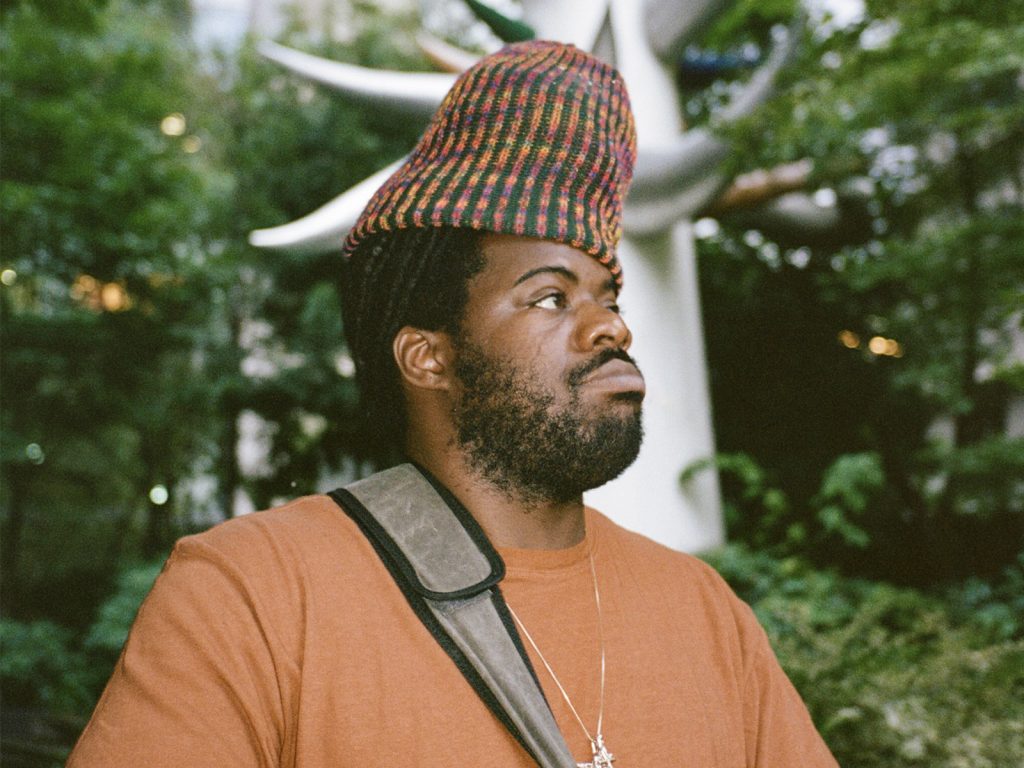
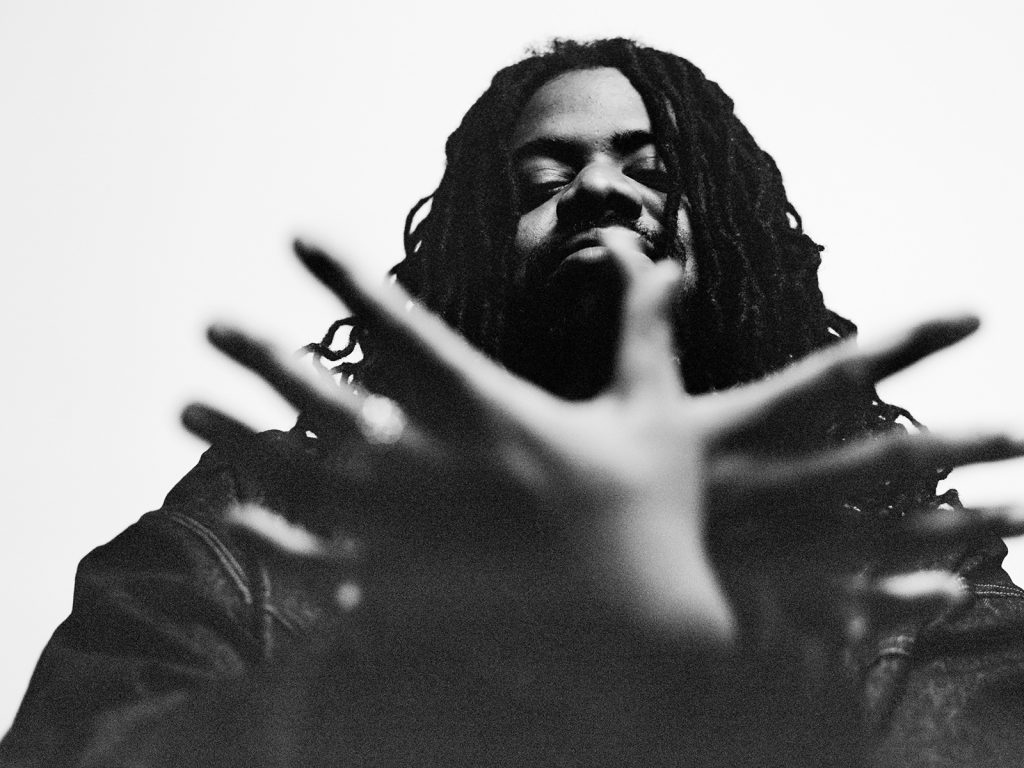
It’s not a question we put to MIKE directly, but his latest studio album, Showbiz!, serves as its own answer. Still only in his mid-twenties, the Brooklyn-based artist has lived a lot of life, and his commitment to the belief that music should be a lived experience is a testament to that.
`“It’s like, are you making art, or is art just a part of your life?” he asks. “I think for me, it’s always the second one.”`
Michael Bonema arrived in New York as a teenager. Having been born in nearby New Jersey, he has also spent time in Philadelphia and in London as a child. MIKE’s previously acknowledged that the now-nostalgic staple, Channel U – the British TV channel that platformed a generation of underground rap and grime artists – influenced his wide taste in music, as well as the 2000s R&B his sisters played in their home.
The rap music he makes – particularly when self-produced – has a tendency to pack two or even three different beats into one, sometimes flipping the same sample in two different ways. Something for the subway and something for a dj blackpower set (his producer alias), all within one track. ‘If I’m making a track and I feel like flipping the beat three times, I just go with it. It’s never a forced thing – it’s more about feeling,’ he says, speaking to us candidly from his home, the day after a studio session that went into the early hours of a Tuesday morning. ‘Hip-hop is already a freeform sport – you don’t have to follow rules if you don’t want to, and that’s what always excited me.
His music is shaped as much by the people and places around him as it is by his own creative impulses. Whether it’s his independent label 10k, which has grown from a close-knit collective into a globally recognised platform, or Young World, the free-to-attend New York festival that now belongs as much to the city as it does to him, MIKE’s vision has always extended beyond just making records and releasing them.
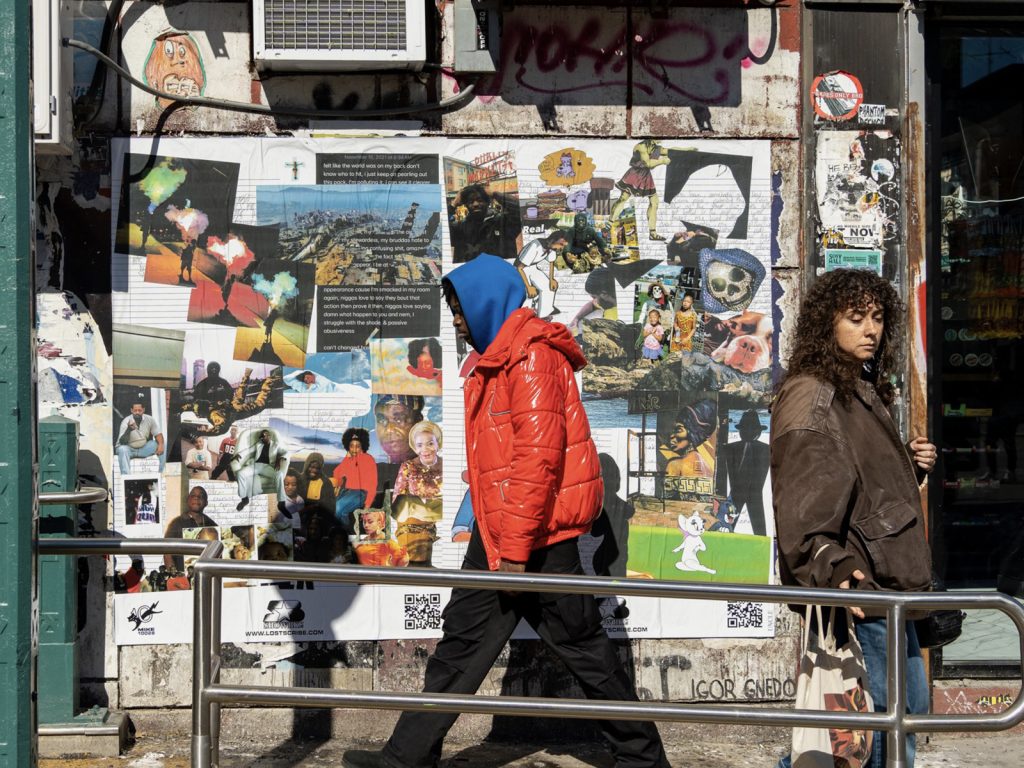
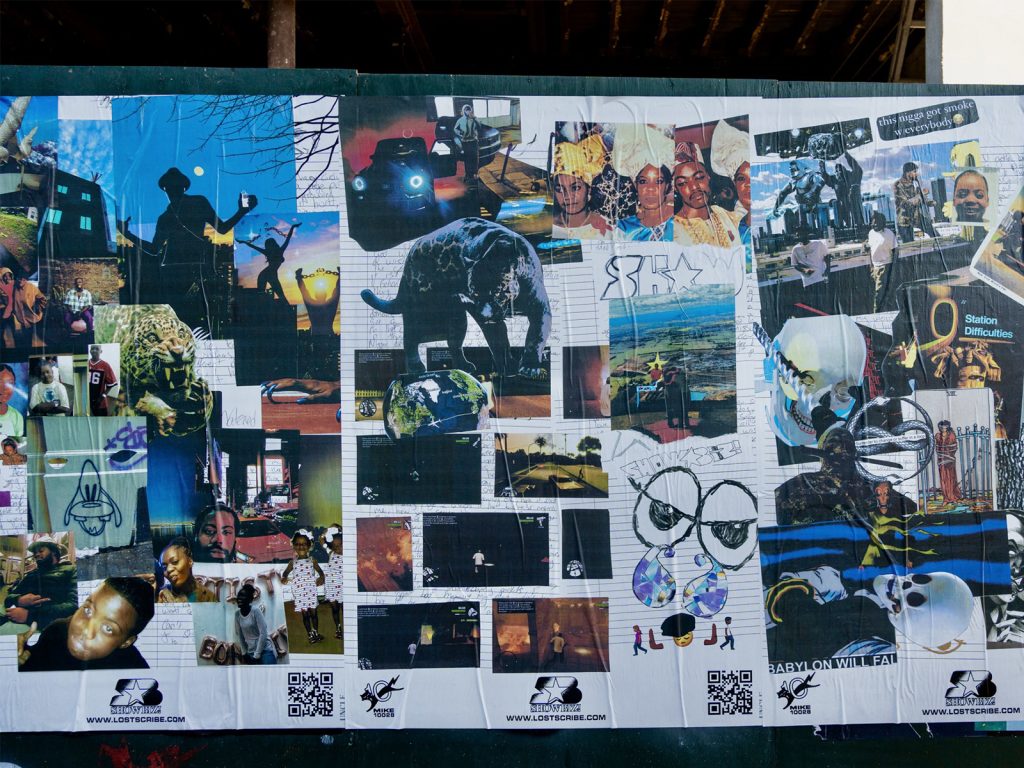
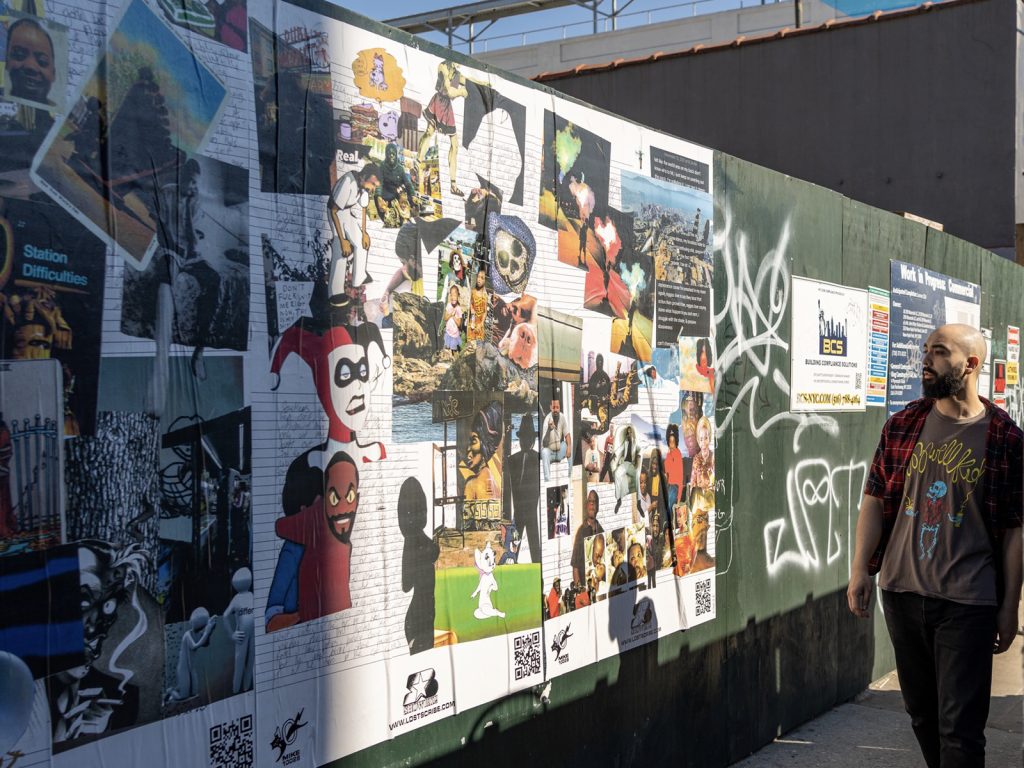
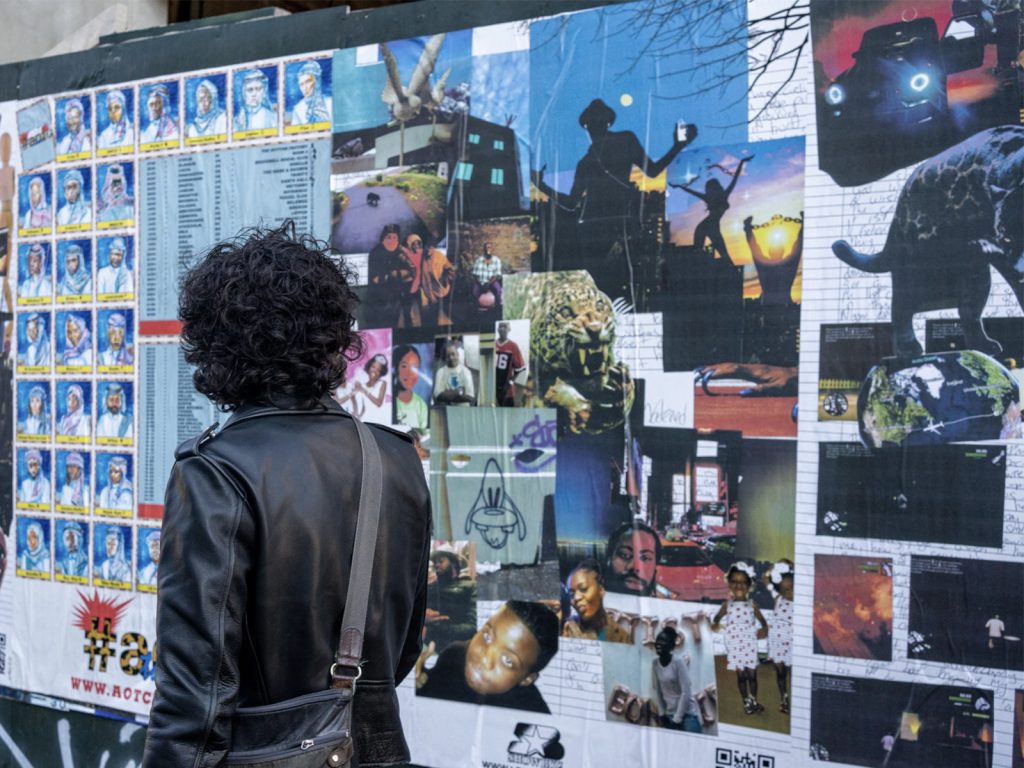
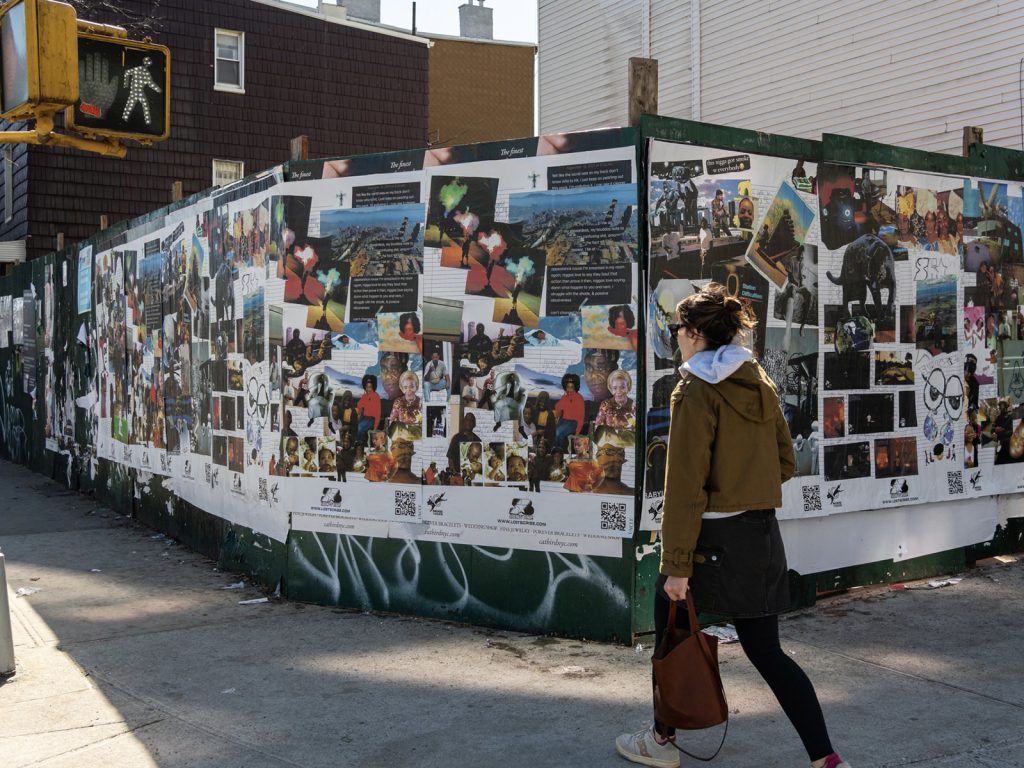
His partnership with UNCLE does more than promote this landmark tenth album. It brings 22 collages – one for each song on Showbiz! – onto the streets of New York. These pieces, designed in collaboration with a longtime friend, aren’t just promo, but an extension of the album itself – just as personal and vulnerable as the music. “The collages reflect each song and are very personal to me,” MIKE says. “I feel like the vulnerable nature of my music is something people appreciate, and this is an extension of that.”
This philosophy extends to his touring, too. His upcoming 71-date world tour is more than just his biggest yet – it’s a travelling community effort, bringing at least 24 other artists on stage across various dates, including duendita, Navy Blue, Liv.e, and Maxo, as well as label mates like Anysia Kym, Sideshow, and Jadasea. On stage, MIKE has always created space for younger artists, introducing them to like-minded crowds, while also sharing bills – and a song – with artists like Sister Nancy, the dancehall pioneer, adding an intergenerational essence to his approach.
“Everything we’re doing now is part of something bigger that’s been happening for decades,” he says. “Sister Nancy wasn’t supposed to be who she is – there were barriers, systems that weren’t built for her to thrive in. But she broke through anyway.”
“That’s how the lineage keeps going. If you’re truly part of something bigger, you can’t be scared of new people coming up. You want new contenders, because that means the culture is alive. The real ones always stick around.”
Whilst there’s no single answer to what it takes to release ten albums of music, it seems to be an amalgamation of all the above. And the below…
How long have you lived in New York for now?
The end of ninth grade. I graduated in 2016, and I was in New York from the beginning of tenth grade. So, 2013 – twelve years now.
Do you think moving to New York from elsewhere gives you a different perspective on things?
Definitely, but not in a way where I ever felt too much like an outsider. Nigerians, specifically, have four, five, maybe six home bases where you know you’re going to find a lot of Nigerians. I was moving around my whole life, so coming to New York wasn’t too big of a shift for me – I could already understand what was going on.
I had cousins in the city, and I used to visit them every summer. They were putting me on to what was happening – whether it was the first people to show me Pop Smoke before he was making music, or putting me on to different styles, the way people dressed. I’d be in the Bronx rocking hella Polo because that’s what I was seeing.
When I finally moved there, I was living with those same cousins, so it already felt normal. And I think moving around so much helped me figure out how to exist in different communities. Maybe not for the best reasons, but it gave me a broader understanding of how to find my people. So when I got to New York, it was easy to find my tribe.
Your music always embraces that tribe, and your albums have always embraced featured artists and collaboration. So does this latest, your 10th mike album, feel like as much of a community effort as it does a ‘Solo’ album?
Yeah, I think every project is always a community effort. Even if it’s just me writing or working on something alone, the experiences that shape the music come from the people around me.
I’ve been working on Showbiz! since the end of 2023 and just thinking about how much life has happened in that time – it had to be a collaborative thing. There are people who’ve saved my life in different ways, and I have to credit that. It could be a homie who looked out for me, or just the small moments that shift your perspective. Everything plays a role in the music.
It’s like, are you making art, or is art just a part of your life? I think for me, it’s always the second one. The music reflects what’s happening around me, so it’s always tied to the people, places, and energy that surround it. That’s why every album – this one included – feels like more than just me.
And where does Showbiz!, The name of this project come from?
I think Showbiz! started as an idea while I was on tour. We’ve been touring non-stop for the last three years, and I’ve been making music seriously since 2017. At a certain point, it just felt like my whole life had become this—like I had fully stepped into what it means to be an artist.
For me, Showbiz! is about coming of age, not just as an artist but as a person. In four years, I’m gonna be 30, which is crazy to me because I feel like I’ve already lived so much life, but at the same time, I haven’t done shit yet. That’s what this album feels like—coming into myself, realising that this is what I do, and fully accepting it.
I was talking to my homie the other day about how parents always say, ‘Don’t put all your eggs in one basket.’ And we were like – why not? We put all our eggs in one basket because this is the only basket we got. But that doesn’t mean the basket has to be small. It can be as big as we make it. That’s what Showbiz! Is – realising that I’m in this, all the way, and there’s no backup plan.
The album’s once again released on your own label 10K. From the outside looking in, at times 10K has felt like a platform for yourself and friends to release music via. Now it feels like it’s kept that ethos, but evolved and expanded – sonically and geographically – to be a record label that can compete with other indie labels. What’s the vision for 10K?
We don’t necessarily see it as a label—maybe more like a crime organisation. [laughs] But nah, for real, from the start, we always looked at it like a mom-and-pop shop. The idea was to do everything in-house, to build something where we didn’t have to rely on the same industry systems that a lot of people feel trapped in.
A lot of it comes down to figuring out what makes us different. How do we stand next to these other labels that have the resources to do all the crazy industry shit? And I think we found that answer by just staying true to the people around us. We’ve got homies who run venues, people who handle different aspects of music and events, and a network that isn’t just about one scene or one city.
So, the vision is really just to keep building on that – to create a space where artists can drop their art comfortably and do what they need to do without all the extra bullshit. If you prioritise the art and the artist, things can be okay. And I’m grateful to be part of something that pushes that forward.
You’re about to embark on a 71-date tour – your biggest yet. How important is touring for you as an independent artist, and what role does it play in sustaining your career?
Touring is super important. Besides just performing, we’ve been hitting some of these cities for three, four years now, so it’s deeper than just a show – it’s about the people we’ve met along the way. Every time we go somewhere new, it feels like the family gets bigger.
I have this theory that one day all the good people in the world are gonna link up – whether it’s in one big-ass Instagram chat or something, I don’t know. But every time I’m on tour, it feels like that’s already happening in real life. You go somewhere you’ve never been before and realise there are people out there who relate to you, who feel the same way about things. It reminds you that this music, this whole journey, is bigger than just me.
And in terms of sustaining what I do, it’s everything. Touring is how I connect with people, how I keep growing, how I survive as an artist. Performing is one of my favourite things to do – it feels spiritual, like church or something. It’s where I feel the most like myself. On stage, you’re supposed to be the master of the ceremony, creating your own world, and I love that shit every time.
What’s special about new york as a place to come home to after all that touring?
Man, good weather, good gas, good food—that’s what I’m coming back to. We’re about to be in some weird places, so when I get back, it’s just turn-up time. But honestly, even when the world tour stops, we just hit the city and keep it going. That’s how it always is. We go around the world in the first quarter, then do everything we just did overseas back at home for the summer. New York is special because it’s home, but it’s also not a place where you sit still. There’s always something happening, always somewhere to be. After being on the road, it’s not like I come back and just stop – it’s more like a shift in energy. The movement doesn’t stop, it just comes back to where it started.
And new york in the summer is also the location of young world, the free-to-attend festival that you’ve been organising for four years now. What inspired you to start that festival, and what’s been the most rewarding part of building it?
It actually started as a completely different idea. I wanted to do a series of shows in different warehouses, where all the stages would be set up in the middle and the crowd would circle around. That was the dream at first but figuring out how to actually make it happen led me to what Young World is now.
From the beginning, I wanted it to feel like more than just another show. I wanted it to be something that really brought people together, that felt like it belonged to the city. And over the years, I’ve seen it do exactly that—it’s a space where different generations of artists and fans all come together through hip-hop. Seeing that in real time, seeing how much it means to people, that’s the most rewarding part.
What makes new york the perfect place for a festival like this?
New York is built for something like this. It’s already a place where different generations, different cultures, and different sounds are always crossing paths. That’s what Young World is about – bringing all those worlds together in one space.
Even from the first one, when we had the deal with the art centre in the Lower East Side, it just made sense. The people involved, the energy of it, the way it brought everyone together – it all felt like a natural extension of what’s already happening in the city. When we moved it to the park in Brooklyn, it became even bigger. That was the moment where I really saw how much it meant to the community.
Now there are people who don’t even know me for my music but know me for putting on Young World. I was walking in my neighbourhood, and someone called me “the guy who does the park thing.” Didn’t even call it Young World – just “the park thing.” That’s crazy to me. Or I’ll be in the gym, and one of the security guards who’s been there for years didn’t recognise me at first, then he’s like, “Oh, you’re the guy from Young World?” That’s wild because that means it’s reaching people beyond just the ones who listen to my music.
That’s what makes New York the right place for this. It’s not just my thing anymore. It’s something that belongs to the city now.
You’ve been working with a designer to create collages for each song on the new album – these will be seen across new york as part of your collab with uncle. What do these visuals add to the experience of the album?
The visuals are just as important as the music. They tell the story in a way that sometimes the music alone can’t. Every project starts with a loose idea – something that visually sticks with me – and I let it build from there. With Showbiz!, I was thinking a lot about performance, about stepping into a role, and about how real life feeds into that. For example, I say a prayer to my mother before every show – praying that she can see it and that people enjoy it – and so I’ve been able to incorporate that tradition into this album and into the visuals ‘You’re the Only One Watching’.
The collages reflect each song and are very personal to me. I feel like the vulnerable nature of my music is something people appreciate, and this is an extension of that. It’s not just about promotion – it’s about being able to present the art in a different way, separate from the music. Art is our chance to turn intangible things into tangibles, and that’s what these visuals do. They make the emotions and ideas behind each track something you can actually see and experience in the real world.
How do you feel about bridging that gap between the digital and the real world?
It’s exciting because there’s no algorithm in real life. Anyone can walk past it, interact with it, and be introduced to something they weren’t looking for. That’s the part I love – the randomness of it.
It reminds me of how I’ve been put onto things in life. Someone shows you something, takes you somewhere, and suddenly your whole perspective shifts. That’s what I hope can happen with this – people coming across the art in their day-to-day and maybe discovering something that sticks with them.
On the topic of connecting with audiences, how has your relationship with social media evolved, particularly as an independent artist? It wasn’t too long ago that you turned your instagram off private…
Man, I’m about to go back on private. [laughs] Social media sucks, bro. But at the same time, it’s powerful. And anything that’s powerful – if it can be used for good, it’ll also be used against us. Every social media platform now just feels right-wing.
I do be a scroller, though. I rap, and I scroll. That’s really my shit. [laughs] And when you sit back and really look at it, it’s like a hamster wheel. My homies who have kids tell me about Cocomelon – how it’s just playing with their dopamine, messing with their brains. And I’m like… bro, we’re all on Cocomelon too. Social media does the same thing to us, just dressed up differently.
That’s why I try to remind myself – and other artists – that we still have free will in this. You can step away, you can use it how you need to without letting it run you.
Whether they interact with it on the streets or via the music in headphones or at a show, what do you hope people take away from the new album?
I just hope the music gives people a space to feel themselves. I want the shows to be a safe space – somewhere people can listen and maybe connect with feelings they’ve had but didn’t know how to put into words or be able to portray.
Even outside the music, with the collages or seeing it in the street, I just want people to experience something that sticks with them. Maybe it inspires them to look at their own life in a new way, or to reflect on where they are and where they’re going. That’s really all I could hope for.
That’s part of the ethos of Queens-raised, Brooklyn-based artist Emily Manwaring. Her paintings and sculptures capture moments, memories, and joy – like a shared camera roll for New York’s Caribbean community. From busy dancefloors to self-care in solitude, from Haitian Tap Tap buses to the changing streets of the Brooklyn, Manwaring collects hundreds of references for each piece she lovingly curates: smartphone photos, items found on the streets of her Flatbush neighbourhood, flyers for dancehall raves from yesteryear, and jewellery lost and found at Carnival.
Her work – both finished and in progress – is the backdrop of our interview as she chats from her apartment during New York’s bleak mid-winter. The art warms the scene, combining brushstrokes, dyed canvases, and real-life artefacts to create something transformative: future artefacts, archives of culture that, in her own words, “hasn’t been preserved or remembered in the ways it deserves to be.”
This approach is evident in works like ‘SoUNd Bath’, where two women bask in sunlight and sound, a pink iPod Nano by their side as they share headphones. It’s a scene as intimate as it is universal – a snapshot of quiet joy shared between friends. For Manwaring, these moments of closeness, especially among women, are at the heart of her art. Her early fascination with family photo albums – frozen frames of love and connection – inspired her to honour these relationships on a larger scale.
Inspiration has also come from artists like Kerry James Marshall and Jordan Casteel, both of whom showed her how identity could take up space on a gallery wall. But Manwaring’s early experiences in Queens were equally formative. With limited access to the arts in her hometown, she would often cut school to visit galleries in Brooklyn or Manhattan. Those trips, along with her time working at the Studio Museum in Harlem, taught her to value art as a form of storytelling and preservation.
Manwaring’s work has been featured in prominent galleries such as Thierry Goldberg, Great Hall Gallery, Swivel Gallery, and Monti 8 in Italy. She’s also received critical acclaim in publications like The New Yorker, JUXTAPOZ, Artnet, and It’s Nice That. Most recently, she was selected to exhibit in the Brooklyn Museum’s Brooklyn Artists Exhibition – a significant milestone that cements her place among the city’s most exciting emerging artists.
Yet her work is not confined to galleries or institutions – if anything, the idea of having it on the streets excites her more. Her art thrives in public spaces, where it can directly connect with the communities it reflects.
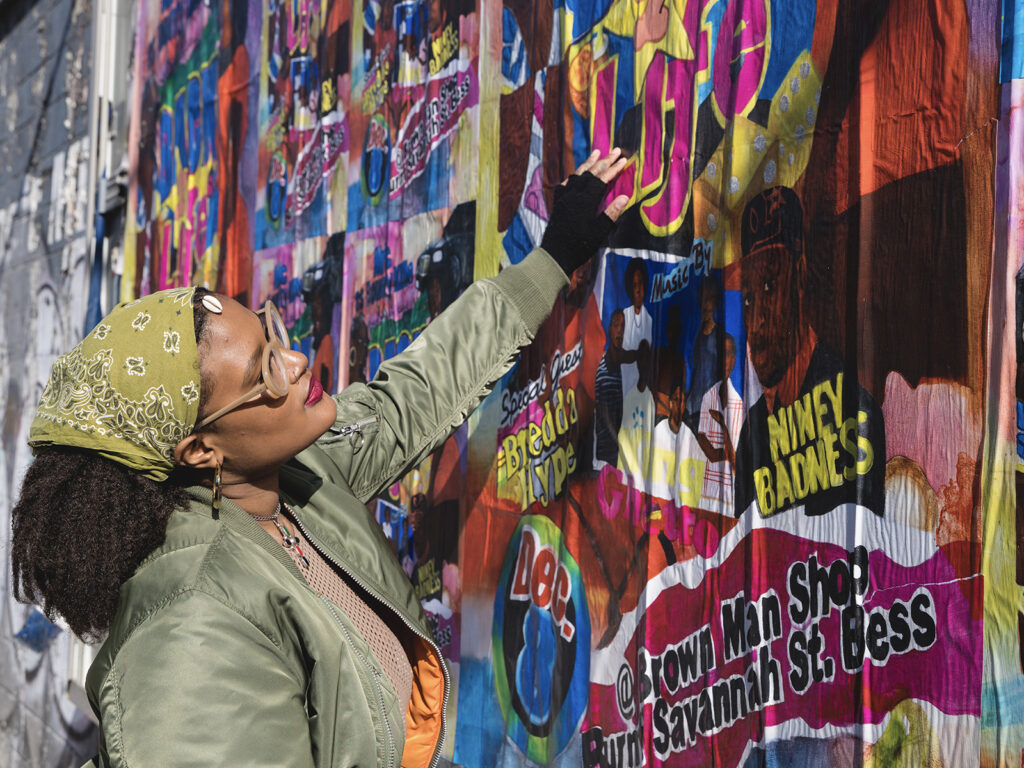
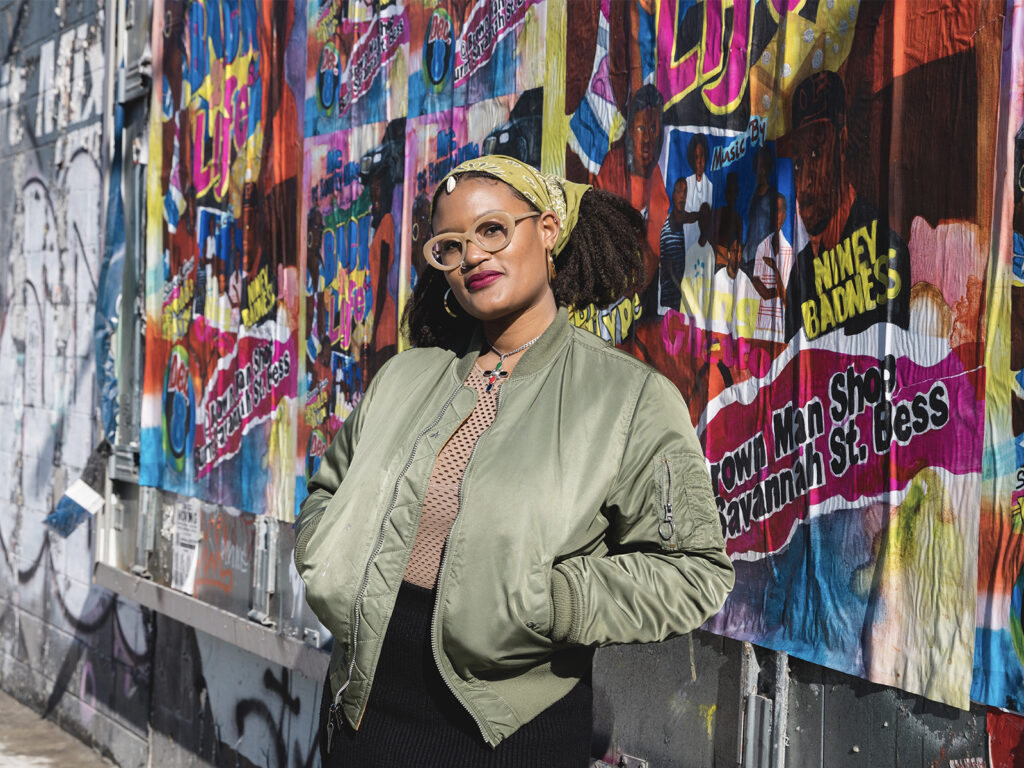
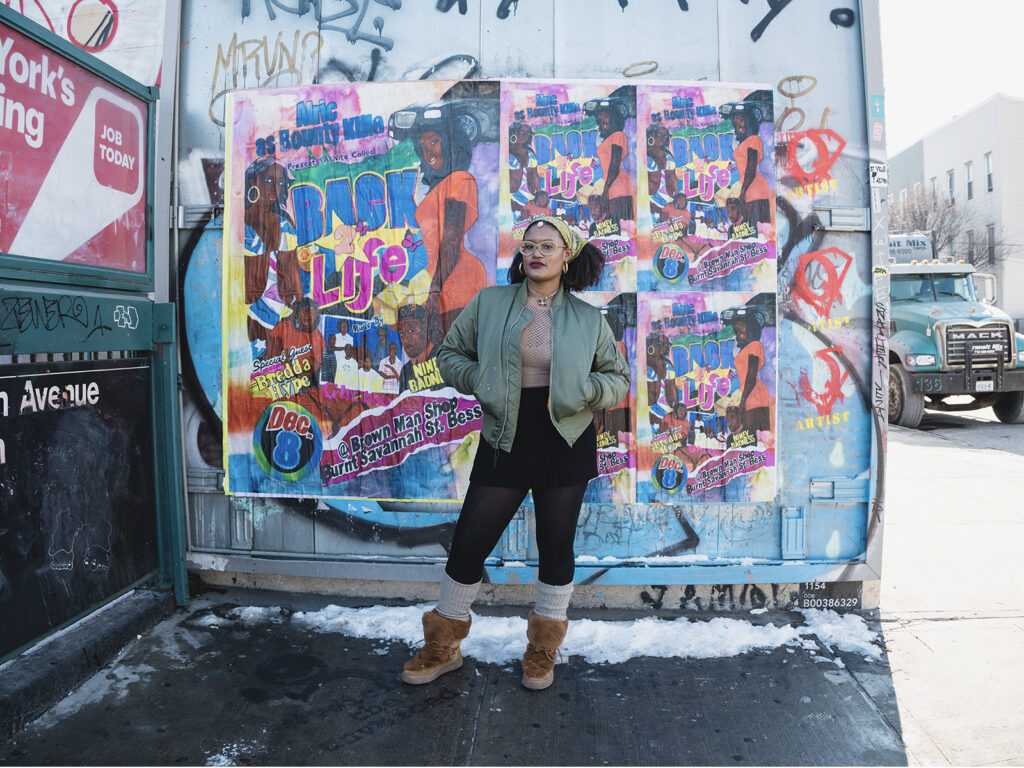
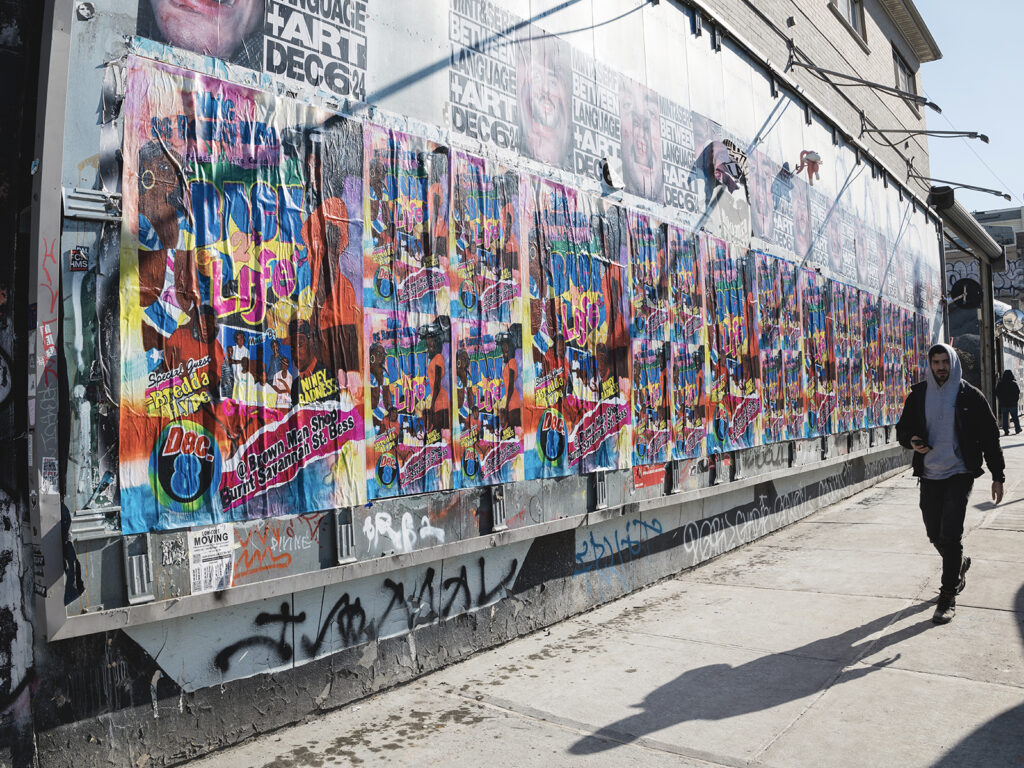
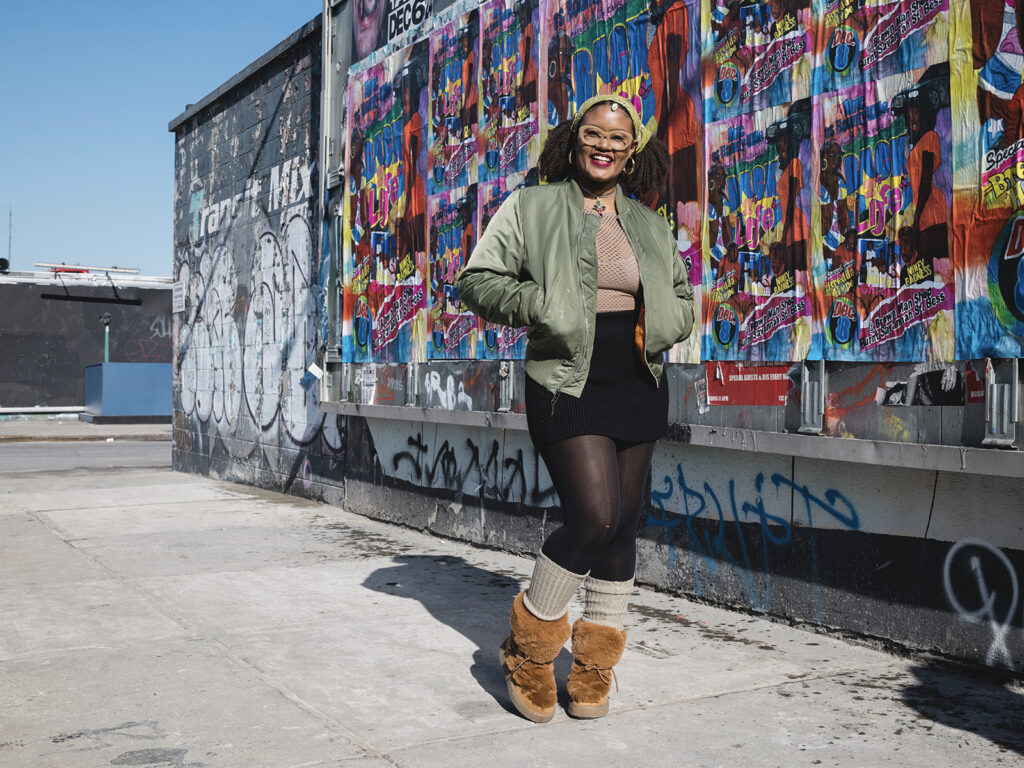
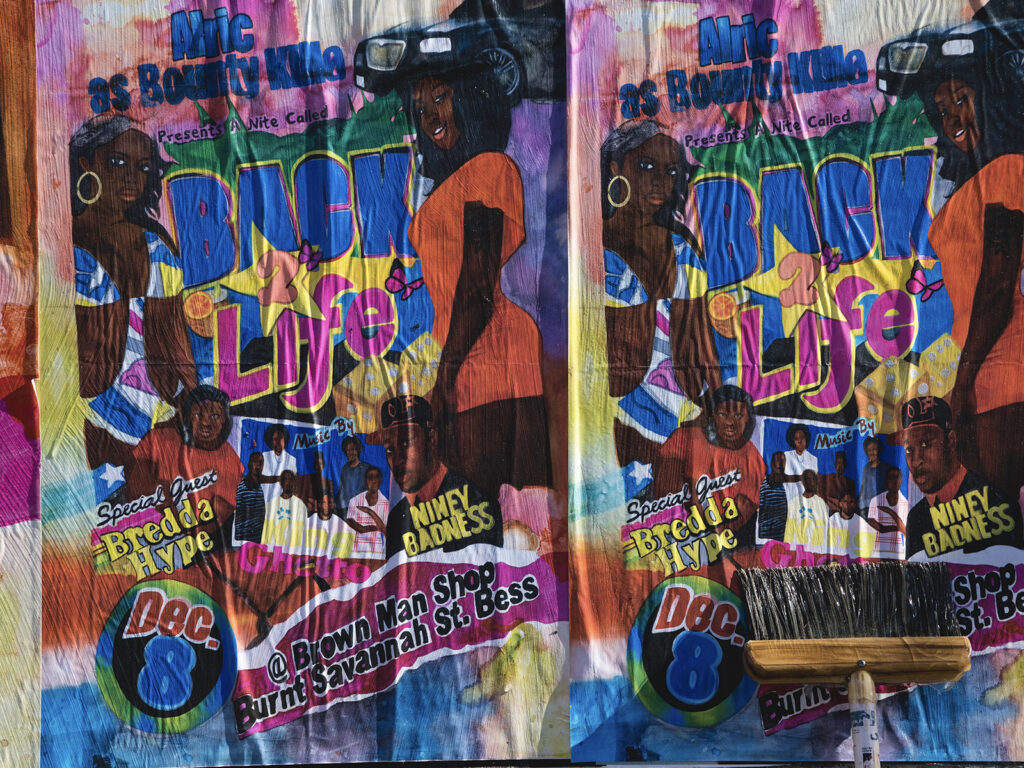
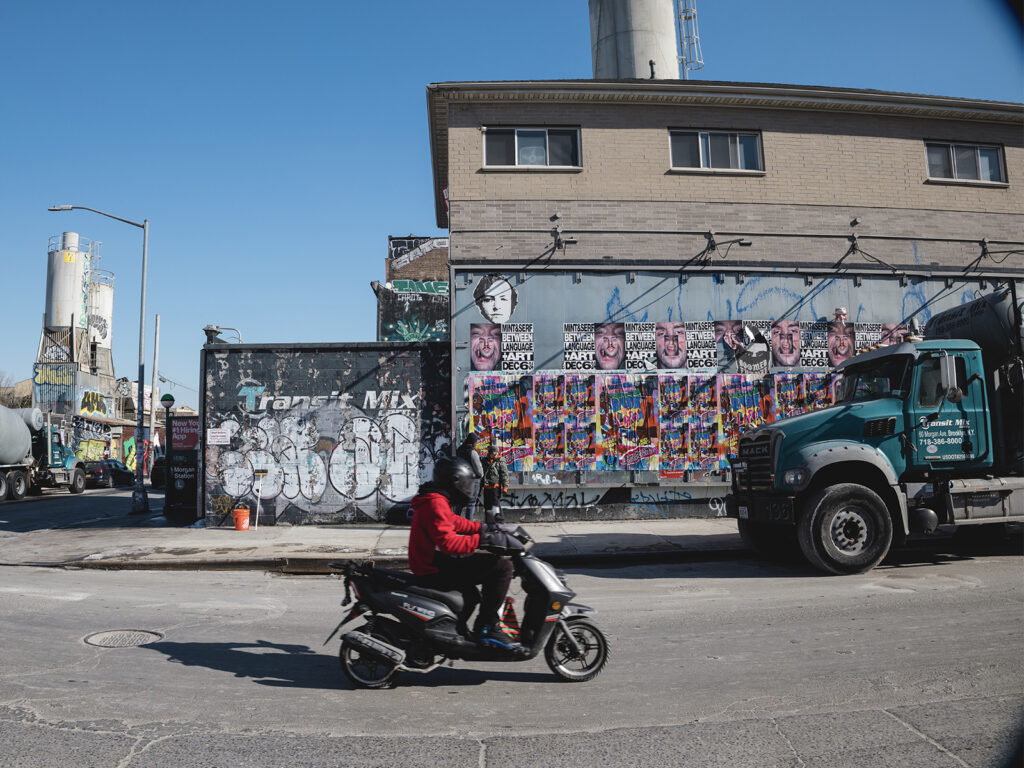
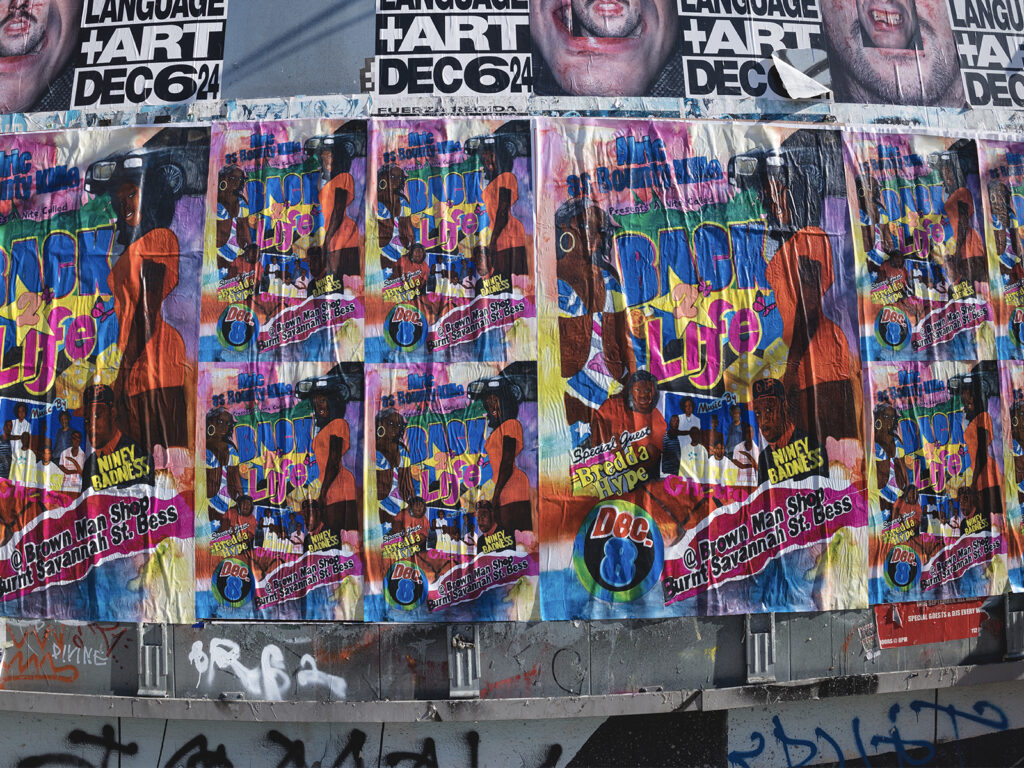
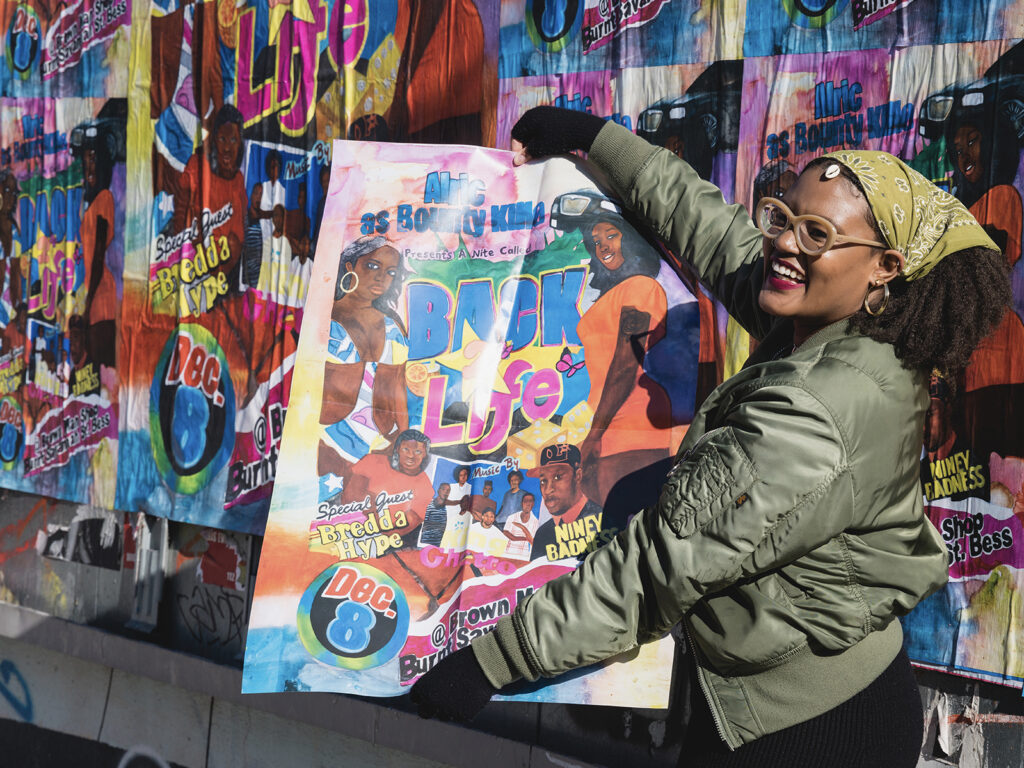
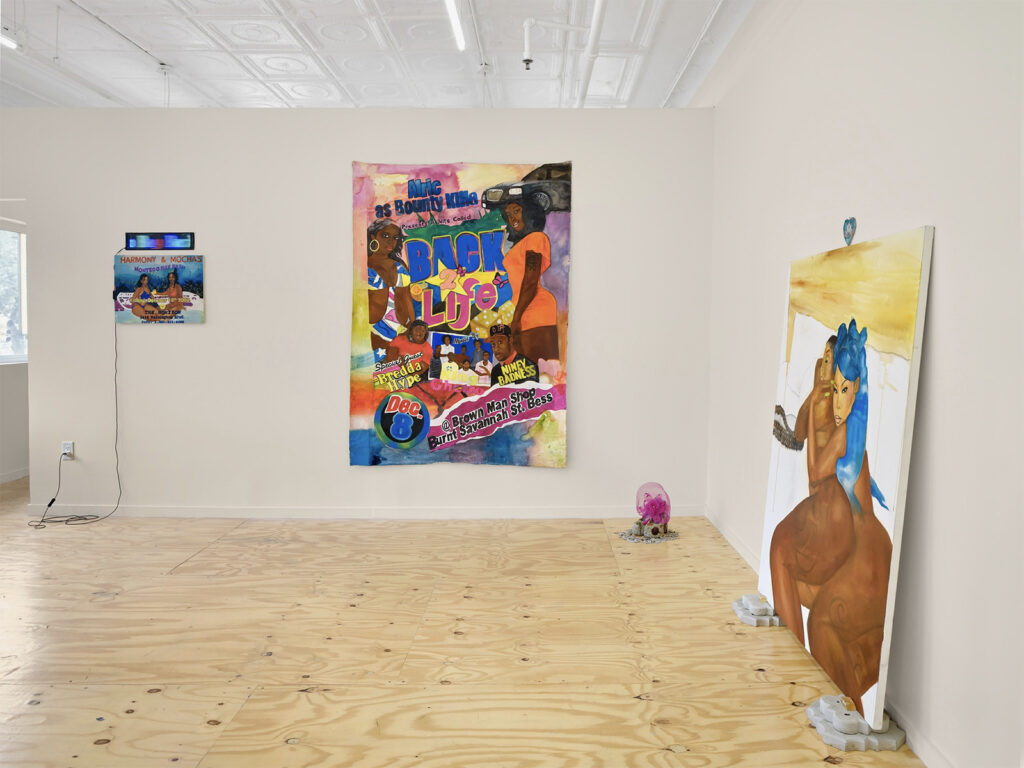
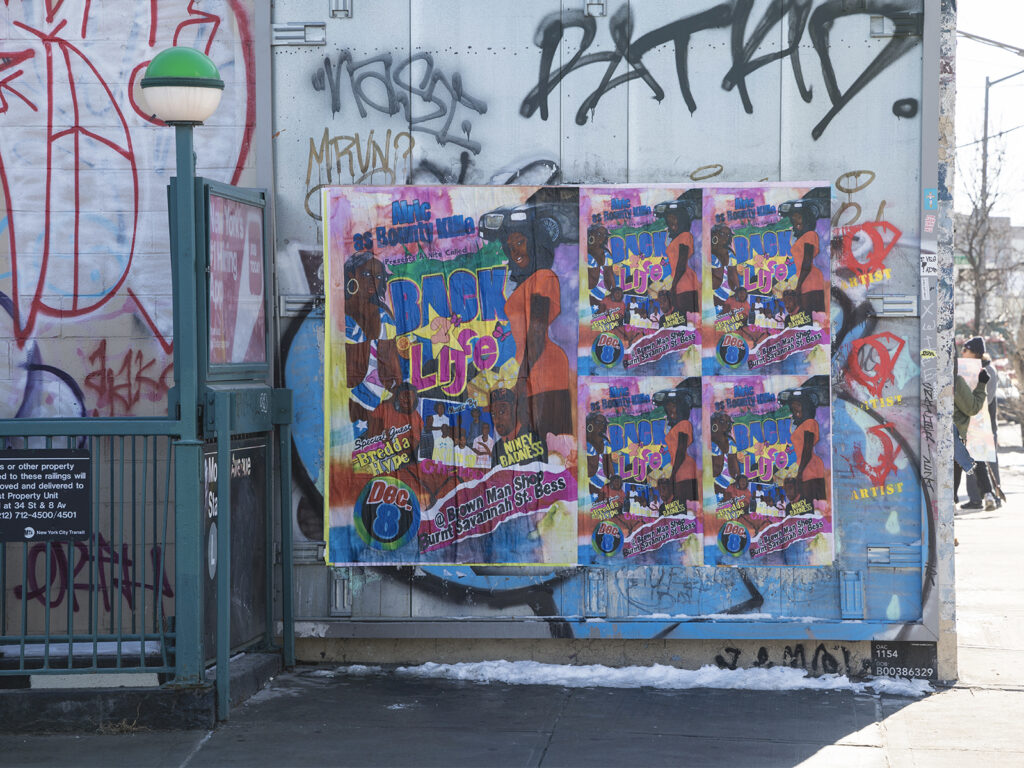
Her collaboration with UNCLE brings her Back 2 Life project to these public spaces. Inspired by dancehall flyers’ bold colours and compositions, this work reimagines those designs at a monumental scale. “I’m imagining an auntie walking past one of my wild posters and seeing herself in it,” Manwaring says.
Archiving moments and shared memories, her art takes up space where it matters most – on the streets, where stories of joy can be celebrated by the people they belong to.
HOW DO YOU APPROACH A NEW PROJECT OR IDEA? COULD YOU WALK US THROUGH YOUR CREATIVE PROCESS, FROM INITIAL INSPIRATION TO THE FINAL PIECE?
It often starts with a memory – a specific moment that sticks with me—and I begin thinking about how I want to bring that to life. From there, I map out the composition, especially if I’m working with a square canvas. I’ll think about what’s happening in each corner, what’s coming out of the frame, and how the shapes will work together. Sometimes I break the frame entirely and explore how to present the work in a completely different way.
I use a folder filled with references – hundreds of photos for a single painting. It might be a colour I noticed on the street, the texture of a feather on the pavement, or the way jewellery sparkles. I also take my own reference images, which might capture a pose, an outfit, or the way light hits a certain surface. All of these pieces come together to create something cohesive – a sort of amalgamation of all these little inspirations.
I also think a lot about 3D elements. What can pop out of the canvas? How can I ground the viewer in the world I’m creating?
TELL US ABOUT THE ROLE OF MATERIAL AND THESE 3D ELEMENTS IN YOUR WORK… HOW DO YOU CHOOSE THEM?
My boyfriend and I are always collecting things we find on the street – flyers, objects, anything that feels like it could spark inspiration. Those materials sometimes end up in my work, and I love the idea that they bring a piece of the world into what I’m creating.
Materiality is so important to me because it bridges the world I’m creating in my art with the real, tangible world around us. When I include objects like a bracelet, a necklace, or even concrete, they act as grounding techniques. These elements bring familiarity – they make people stop and think, “I know that; I’ve worn that; I’ve seen that before.” It draws them into the piece, helping them feel connected to the world I’m portraying.
For example, I did a painting with a hammock, and I used lamps to hold it up. Those lamps weren’t just decorative; they became part of the sculpture, part of the functionality and presentation of the work. It was about making the piece feel alive, like it existed in a space rather than just on a canvas.
WE’VE ALREADY SPOKEN ABOUT JOY AND CARIBBEAN CULTURE, BUT ARE THERE ANY OTHER THEMES THAT ARE CENTRAL TO YOUR WORK?
A lot of my work is centered around women and the interactions we have with each other. It’s about what it means for me to be a woman and the spaces where we find connection, joy, and sanctuary. Those moments of interaction, whether they’re big or small, are something I love to explore through my paintings.
“Back 2 Life” is inspired by flyers for dancehall waves, combining nightlife and visual culture in such a striking way. Could you tell us about the inspiration behind this piece and how it fits into your broader body of work?
Back 2 Life is such a special piece for me because it represents a shift in my practice. It was one of the first times I broke free from the square frame and traditional stretcher bars to really ask myself: What am I trying to say here? The inspiration came from walking around Brooklyn, especially in Flatbush, and seeing all these incredible Jamaican and Caribbean flyers pasted up everywhere.
There’s something about the composition of those flyers – the colours, the faces, the text—that feels so alive and futuristic, even though many of them come from years ago. I started collecting them, building this archive of visuals, and one flyer in particular stood out to me. It became the foundation for Back 2 Life.
The process was just as important as the inspiration. I began by dyeing the canvas, letting the colours bleed and interact with each other naturally. That was like creating a living, breathing base layer. Then I started layering the imagery on top – rendering the figures, adding the vibrant text elements, and blowing up the flyer’s scale to almost command the space it’s in.
What’s exciting about this piece is how interactive it feels. People look at it and ask themselves, “Is this a real event? Should I call the number on the flyer?” It creates a sense of curiosity, almost like the flyer is coming alive again. For me, this work is a way to honour the visual culture of the Caribbean diaspora and to get it back on the streets.
DO YOU SEE PAINTING AS A USEFUL WAY TO ARCHIVE?
I definitely see painting as a form of archiving, especially for Caribbean culture. There’s so much that hasn’t been preserved or remembered in the ways it deserves to be. When I was younger, I’d spend hours looking through my family photo albums and thinking about how to honour those moments in a new way. That’s how I first started painting, by recreating those photos and reflecting on what they meant to me.
Now, my work has grown to include not just personal memories but collective ones too. I’m working on a piece right now that holds objects you’d find during Carnival, like pieces of jewellery or feathers and that’s another way of capturing these moments that are so rich but often fleeting.
For me, painting is about saying, “This mattered. This deserves to be remembered.” It allows me to take fleeting or ordinary moments and transform them into something lasting, something people can look at and connect with for years to come.
WHAT’S BROOKLYN LIKE AS A PLACE TO LIVE AND WORK AS A CREATIVE?
Living in Brooklyn is just amazing. I don’t want to talk too deeply about Flatbush because I don’t want them coming in and gentrifying all my shit. But being here is so special to me, it’s full of Caribbean culture, and it feels like home in every way.
I take what I call grounding walks, where I’ll just go out and photograph anything that inspires me the colours, textures, moments. Brooklyn has so much life and history; you’ll see something on the street that unlocks a memory from years ago, and suddenly, I’ll want to create a whole body of work based on that.
I walk down the street and I’m a reflection of it.
WHO ARE SOME OTHER ARTISTS FROM NEW YORK WE SHOULD KNOW ABOUT?
I have to shout out my boyfriend, Oji Haynes, he’s an all-around artist who works in photography and sculpture. Our home is filled with our creations, and it’s such a unique way to live and collaborate.
I’ve gotta shout out my friends, basically. Tyinghe Fleming who works in photography and Aicha Cherif who works in cinematography, directing and production. What I love about New York is this culture of mutual support, we’re all pushing each other to create and grow.
FAVOURITE PLACE TO SEE ART IN NYC?
MoMA holds a special place in my heart. It was the first major museum I explored as a teenager, often skipping school just to spend hours there. Those early visits shaped my understanding of what art could be.
I also love the galleries in Chelsea, where you can find some of the most inspiring contemporary shows. And of course, the Brooklyn Museum, it’s such a dynamic space that feels connected to the community.
FAVOURITE MUSIC VENUE IN NYC?
Brooklyn Paramount is a standout for me I’ve seen some incredible shows there, like Chief Keef and Cash Cobain. It’s got that real New York energy.
Another favourite is Nowadays, where I’ve danced until the early hours with friends. Those DJ sets mean so much to me, music and dancing are such important parts of my life. Dancing is definitely my love language. If I weren’t a painter, I think I’d be a dancer!
FAVOURITE PLACE TO GET FOOD IN NYC?
I’d have to say Brooklyn. I love Fisherman’s Cove – unfortunately they’re taking it down due to gentrification, but that’s the best ox tail.
Your art belongs in the physical realm, but much of its audience discovers it online. What challenges do you face translating the vibrancy of your work to digital spaces, and how do you approach sharing it on platforms like Instagram?
Instagram is weird, but it’s also necessary. For me, it’s like a LinkedIn now, just a way to connect with people and share what I’m doing. I grew up in the Tumblr era, and I think I still treat Instagram like a blog, posting things that remind me of different moments in my life or my work.
I try to use it as a tool to show my process or highlight parts of my paintings, but it will never compete with seeing the work in person. When someone sees my art online, I hope they feel drawn to come experience it physically because it’s a completely different energy. Social media is useful, but I value real human interactions and the experience of seeing art in real life so much more.
WITH YOUR UPCOMING COLLABORATION INVOLVING WILDPOSTING IN NEW YORK, WHAT EXCITES YOU MOST ABOUT DISPLAYING YOUR ART IN PUBLIC SPACES?
What excites me most is how accessible it is. Art shouldn’t only exist in galleries or fairs, it should be part of the world, on the streets, in places where people actually live their lives. With this project, I’m imagining someone in Flatbush walking past a billboard or a wild poster and seeing themselves in it, seeing their culture reflected back at them.
There’s one scenario that keeps coming to mind – aunties, the elders in our community, walking by and seeing themselves or their stories represented. Maybe it’s someone who hasn’t had the chance to go to a gallery or a museum, but they look at that poster and feel seen. That’s what I love about this format, it’s for everyone.
It’s not locked behind closed doors or dependent on who can afford to visit a gallery. It’s right there for people to engage with, and that feels really powerful. The streets are full of stories, and this is my way of adding to that, of giving something back to the community while connecting with people in a real, direct way.
Jacob Consenstein believes New York art is in a golden age right now.
It’s a big statement, but one made by someone who has covered lots of ground and documented just as much in the last decade or so. Jacob was one of the teenagers snatching disposable cameras off CVS shelves – not for mischief, but to capture what was happening around him and his peers in his hometown.
It wasn’t about capturing a “scene” – labels like that come later, applied in hindsight. It was about instinctively preserving moments that felt meaningful: friends creatively reinterpreting the city around them, graffiti becoming more than marks on walls, skating, and parties where hanging out might be the main prerogative, but the sharing of new music and meeting of like-minds an unexpected party favour.
Inspired by those who came before him in street photography, film, music, and more, Jacob sees young New Yorkers carrying on a lineage of creativity that, from the outside, can seem like a rite of passage for growing up in the city. But the idea that New York’s culture and creativity simply “happen” is a myth. The competition, the cost, and the constant motion drive people to connect, collaborate, and create.
For Jacob, this dynamic is reflected in the way art forms intersect. His photography doesn’t just stand alone; it blends seamlessly with music, writing, and storytelling. Projects like his self-published Artist Series – currently wheatpasted by UNCLE on city walls – amplify voices across disciplines, featuring the likes of MIKE, duendita, Deem Spencer, and Sabrina Santiago. Through portraits and interviews, Jacob captures not just individuals but the collective energy of a city that thrives on collaboration.
It’s this hustle and exchange that has fueled Jacob’s wider success, from commercial campaigns with NIKE and adidas to exhibitions across New York. These accomplishments don’t just showcase his talent; they underscore how deeply his work is rooted in the city’s ethos – one that rewards those who contribute something meaningful to its ongoing narrative.
This exchange of energy, effort, and ideas is what keeps New York ticking. Its rich cultural history sets a high bar but for Jacob, it’s a source of inspiration and a challenge to contribute something meaningful to the city’s ever-evolving creative lineage. As he puts it, “If you contribute positively and are prolific, what you give to the city, it gives you back tenfold.”
Even a city as famous for culture and creativity as this one needs people to get off the couch, snatch a couple of film cameras, and make it happen. Golden age or otherwise.
INTRODUCE YOURSELF IN YOUR OWN WORDS. HOW WOULD YOU DESCRIBE WHO YOU ARE AND WHAT YOU DO AS A PHOTOGRAPHER?
My name is Jacob Consenstein. I’m a photographer and director, born and raised in New York. For the past twelve years, I’ve focused on capturing streetwear, youth culture, music, graffiti, and fashion. Over the last few years, I’ve also delved more into commercial and campaign work. At my core, though, I see myself as a creative and a storyteller – someone who uses photography to reflect and amplify the culture around me.
HOW DID YOU FIRST GET INTO PHOTOGRAPHY, AND WHAT DREW YOU TO IT AS A CREATIVE MEDIUM?
I didn’t come from a family with a background in the arts – both of my parents were community college teachers, and most of my extended family worked in education or social services. So, I stumbled into photography pretty organically.
I transferred high schools and ended up at one that offered internships instead of traditional classes. My advisor there was the first person to suggest that a creative path was even viable. That idea had never really been presented to me before. I ended up leaving high school a semester early and cold-emailed people at places I was drawn to at the time, like Mass Appeal magazine and Only NY.
At the same time, my friends and I were immersed in graffiti, skateboarding, and throwing parties around New York. I was so proud of what was happening in that world that I wanted to document it. I started shoplifting disposable cameras from CVS to take photos constantly. Eventually, a friend gave me my first real camera in 2014 or 2015. Photography was the first thing I felt genuinely good at, it clicked with me in a way school never did.
From there, I just kept documenting my surroundings and figuring it out as I went. It’s been a very non-traditional route to get to where I am now, but it’s always felt natural to me
WERE THERE ANY EARLY INFLUENCES I.E. PHOTOGRAPHERS, ARTISTS, OR MOMENT THAT SHAPED YOUR APPROACH TO PHOTOGRAPHY?
A lot of my early influences came directly from my surroundings. Growing up on the Upper West Side of Manhattan, I was constantly surrounded by culture. It’s the birthplace of hip-hop, and my sister, who’s eight years older than me, was into punk, ska, and hip-hop. My dad was a Deadhead, my mom loved disco and the B-52s, and I got deeply into ’90s hip-hop and boom bap. That mix of styles and cultures really shaped me.
I was fascinated by uptown New York culture – how vibrant and raw it was. The ‘old heads’ on the street, the music, the style, it all inspired me. I also admired downtown kids like Harold Hunter and the OG Supreme crew. They were like blueprints for how creativity and culture could intersect.
A lot of my inspiration also came from streetwear. When I was working at those brands, I met a lot of scrappy people doing cool stuff. One founder used his friends’ screen printing labs at FIT (Fashion Institute of Technology) to launch his brand. People were just hustling – skateboarders, graffiti artists, musicians – they were all making things happen, and I thought it was amazing and I really connected to the grassroots nature of it.
That passion turned into an obsession. I started to nerd out about the culture, researching and dedicating time to understanding it. My peers and surroundings were my biggest inspirations. They still are, in many ways.
YOU OFTEN SHOOT ON FILM, WHAT APPEALS TO YOU ABOUT FILM PHOTOGRAPHY COMPARED TO DIGITAL? DO YOU FIND THE PROCESS OR RESULTS DIFFERENT?
There’s something about film photography that feels timeless. For me, it’s the process as much as the results. I love the delayed gratification – taking a photo, letting the roll sit until it’s finished, and then waiting to develop and scan it. That slower, physical process makes each shot feel more intentional.
Film also has a tactile quality that I find really appealing. Even with my digital work, I’ll sometimes print and scan it to give it more texture and life. There’s an innate depth to film that’s hard to replicate digitally – it feels more human, and I think people naturally respond to that.
I started on film, too. Someone gave me a Pentax K1000, and it was the first camera I owned. It taught me the fundamentals—how to understand aperture, lighting, and the mechanics of photography. That hands-on learning shaped how I approach every photo I take.
That said, I’ve grown to appreciate digital photography in its own way. It’s industry standard for commercial work, and I’ve found a creative relationship with it over time. I wouldn’t say I prefer one over the other anymore—they’re both equally interesting to me now, just in different ways.
SOCIAL MEDIA PLATFORMS LIKE INSTAGRAM WERE ONCE PHOTOGRAPHY-FIRST SPACES, BUT THEY’VE SHIFTED TOWARD VIDEO CONTENT AND ALGORITHMS. HOW HAS THIS IMPACTED YOU AS A PHOTOGRAPHER?
I think there’s no denying that Instagram and similar platforms have shifted significantly over the years. When I first got on Instagram, it felt like a space where photos could be appreciated as an art form in their own right. Now, with the push toward video content and algorithm-driven trends, it’s harder for photography to stand out in the same way.
That said, I’ve always seen the value of presenting work physically. There’s something uniquely impactful about seeing art in person on the street or in a gallery, rather than on a screen. That’s part of what I love about this project with UNCLE, where the work exists in public spaces for everyone to see. It removes the hierarchy of galleries and makes art accessible in a raw, immediate way.
The changes in social media remind me how important physical displays of work are. They’ve encouraged me to focus on projects like this, where the art exists outside the digital space.
DO YOU SEE SOCIAL MEDIA AS A TOOL OR A CHALLENGE FOR SHOWCASING YOUR WORK TODAY?
For me, social media has been mostly positive. I’ve always treated Instagram like a portfolio – a way to share my work and tell the stories behind it. I think that mindset has helped me stay grounded as the platform has evolved. It’s a tool for connecting with a community and showcasing what I do, but I try not to let the pressures of algorithms or trends affect my creative process too much.
Of course, social media has its challenges, especially with how saturated it’s become. But I’ve been lucky to grow a network of people who genuinely appreciate my work. Every post feels like an offering to them, and I focus on creating something meaningful with each one. It’s not without its frustrations, but overall, I’d say it’s been a tool that’s opened up a lot of opportunities for me.
THE ARTIST SERIES, YOUR PROJECT CHOSEN TO COLLABORATE ON WITH UNCLE, HIGHLIGHTS PORTRAITS OF NEW YORK’S CREATIVE COMMUNITY. WHAT INSPIRED YOU TO FOCUS ON THESE INDIVIDUALS, AND HOW DO THEY REFLECT THE CITY’S CREATIVE ETHOS?
This project started in early 2020 as a way to capture and celebrate the people in my immediate circle who I felt were doing something truly special. These are individuals I’ve admired for a long time – people I’ve partied with, collaborated with, or just been inspired by.
The focus is on artists in New York who are making substantive contributions to their fields, whether that’s music, painting, or other creative disciplines. What ties them all together is their dedication to their craft and their ability to bring something unique to the cultural landscape.
For me, this series is about more than just documenting – it’s about weaving a narrative. Each artist I feature represents a thread in the larger web of New York’s creative community. They’re people I believe are contributing to what feels like a golden age in New York art right now. Through their portraits and accompanying stories, I want to show how interconnected and vibrant this scene truly is.
HOW DOES IT FEEL TO SEE YOUR WORK PRESENTED ON THE STREETS OF NEW YORK, AS PART OF A WILDPOSTING CAMPAIGN, INSTEAD OF IN A GALLERY OR ONLINE?
There’s a rawness to presenting art in public spaces that you just don’t get in a gallery or online. It feels immediate, accessible, and democratic – anyone passing by can engage with it, no matter who they are or where they’re from.
What I love most is how it removes the barriers that often exist in the art world. There’s no hierarchy to it. It’s not about exclusivity or curated experiences; it’s about the art being part of the city itself. For me, that’s a beautiful way to connect with people and to bring art into their daily lives.
WHAT DO YOU LOVE MOST ABOUT NEW YORK CITY?
To be honest, it’s hard for me to talk about New York without sounding biased – it’s such a big part of who I am and the growth I’ve experienced as an artist. The city has this incredible, unmatched energy. The pace, the movement, the constant exchange of ideas – it all creates an environment where creativity thrives.
What you put into New York comes back to you tenfold, and that’s something I’ve experienced firsthand. There’s also this sense of history here. Growing up, I was surrounded by the stories and images of people who had made their mark on the city. It’s inspiring to be part of that legacy, to contribute something to a place that has already given so much to the world.
And of course, the cliches are true, ‘If you can make it in New York, you can make it anywhere.’ It’s a tough city, but if you navigate it the right way, it pays you back in ways you couldn’t imagine.
WHAT DO YOU FIND CHALLENGING ABOUT BEING A CREATIVE IN NEW YORK?
New York is an amazing place, but it’s also one of the toughest cities to make it in, especially as a young artist. The cost of living is sky-high, and working independently can feel like an uphill battle. You really have to be on top of your game to sustain yourself here while also trying to create meaningful work.
WHAT DO YOU HOPE PEOPLE TAKE AWAY FROM YOUR WORK, WHETHER THEY’RE SEEING IT ON THE STREETS OR SCROLLING PAST IT ON A SCREEN?
I hope people take the time to really look at my work and see the connections within it. Across everything I do, whether it’s street photography, portraits, or more conceptual projects – I’m telling one interconnected story. It’s about culture, energy, and the things that bring people together.
What I want people to understand is that my work isn’t about isolated moments; it’s all woven together. I think of people like Wolfgang Tillmans, who can present vastly different projects and still make them feel like part of a larger, cohesive narrative. That’s the kind of impact I hope my work has.
Whether it’s someone walking past my photos on the street or scrolling through them online, I want them to pause and see the depth and substance behind the image. Each photo is more than just a moment – it’s part of a bigger cultural conversation, a reflection of the energy and movement happening around us.
Ultimately, I want people to feel something, to connect with the story I’m telling, and maybe even be inspired to look at their surroundings a little differently.
WHAT WAS THE LAST ALBUM YOU LISTENED TO ALL THE WAY THROUGH?
Ultimate Love Song Collection by Doris. It’s such a great listen – 41 minutes of beautifully crafted songs. It’s an underground gem I came across, and I’ve been playing it almost every time, start to finish.
WHAT IS YOUR FAVOURITE PLACE IN NEW YORK TO SEE LIVE MUSIC?
Brooklyn Paramount. It’s this stunning old theatre in downtown Brooklyn that they recently reopened. The high ceilings make it feel open and vibrant, even when it’s packed. Every show I’ve seen there has been incredible.
ANY ADVICE FOR PEOPLE WALKING PAST YOUR WORK ON THE STREET WHILST IT’S UP ON THE WALLS OF NEW YORK CITY?
Take a moment to really look. Read the passages and learn more about the artists featured. Everyone in this series is doing something substantial in music, painting, or other forms of art. It’s a chance to engage with work that you might not see anywhere else, it’s all right there in front of you.
WORTHLESSSTUDIOS is an organization dedicated to fostering creativity by providing artists with the necessary space, materials, and technical support to realize their artistic visions. UNCLE partnered with them on their notable recent imitative “FREE FILM: NYC LES” a public art endeavor that engages both aspiring and professional photographers in documenting specific New York City neighborhoods using analog film. We brought their posters to city streets to drive eyes to the exhibition that focuses on Manhattans Lower East Side.
Their projects emphasize artistic activation, community engagement, and education, aiming to go beyond merely creating artwork. This ‘community first’ attitude does not go unnoticed amongst New York streets that thrive in pulling together factions and uniting them in a history driven by the city itself. This project’s prompt – “ONE SQUARE MILE,” focuses on the Lower East Side, creating a collective archive of images that encapsulate the essence of the area. Already steeped in a deep history, the exhibition acts as a point of camaraderie for the people of Manhattan and beyond.
In the interview we conducted we touched on the studio’s conception, goals and how each photographer contributing to the exhibition is tied to the location itself as well as the broader cultural narrative of New York City. We also explore the work they do outside of this project and how their residency programme elevates its members through public activities like workshops and educational courses. There is more than meets the eye to WORTHLESSSTUDIOS and UNCLE couldn’t wait to delve deeper.
CAN YOU DESCRIBE THE CONCEPT AND GOALS BEHIND FREE FILM : NYC?
FREE FILM : NYC is a public art project engaging a community of photographers, both aspiring and professional, in the documentation of specific New York City neighborhoods using analog film. Each time the program is activated we distribute 100 rolls of 35mm black-white film to local photographers for free. They bring back film shot on a specific prompt, this time “ONE SQUARE MILE”, and we develop, scan, and curate a show and book. We are interested in creating a collective archive of images that describe a time and place, and for the past two years NYC has been the focus.
HOW DID YOU CHOOSE THESE NEIGHBORHOODS AS THE FOCAL POINT FOR THIS ITERATION OF THE FREE FILM PROJECT?
We started with an open call to photographers who applied with a specific neighborhood that they have a special relationship to. They took up residency in our converted 1970’s Airstream Darkroom. During the residency, the selected photographers were asked to run activities open to the public, such as workshops and photowalks, as well as youth education programs in collaboration with our institutional partners, which we identified to serve the local community, through art and photography. The relationship the Photographer in Residence has with the neighborhood is what drove the focal point of the programs.
HOW ARE THESE NEIGHBORHOODS TIED TO A WIDER NYC?
We let the photos taken by the 150+ photographers included in our book and exhibition tell the story. Like previous iterations of FREE FILM we tend to see a lot of overlap in cultural motifs, styles, and iconography throughout the city, no matter which neighborhood you are in. However, there is a distinct attitude and geography that can be seen and felt in each neighborhood that shows how unique and bonded the individuals in the neighborhood are as a community.
WHAT HAVE BEEN SOME OF THE MOST MEMORABLE OR IMPACTFUL PHOTOGRAPHS YOU’VE RECEIVED FROM PARTICIPANTS?
A few images come into my head with this question, all very different. We had really heartwarming moments from families playing during a parade around Sunset Park, a group of young men playing basketball under the FDR Drive with the Brooklyn Bridge as the background around the Lower East Side, a few images of young girls running and playing with the open hydrants during the Bronx’s hottest summer so far. Others are very iconic places such as the Williamsburg bridge, a few churches in Harlem, Lady Liberty seen from Red Hook. Each neighborhood had its own charm, and surprising images.
WHAT ARE SOME OF THE BIGGEST CHALLENGES YOU FACED IN EXECUTING THIS PROJECT?
The biggest challenge at first was to drive the Airstream throughout the city, through the narrowest streets while cars were double parked, but the team was always able to make it work without a scratch.
With the help from picturehouse + thesmalldarkroom we were able to keep all rolls and scans in order to return to the participant photographers, without any mix up on delivering scans and negatives.
Editing the book was also a big challenge, as we collected over 15,000 images, editing down to 124 published images was a great effort, tackled between the Resident Photographers and the WORTHLESSSTUDIOS team.
HOW HAS THE PROJECT EVOLVED SINCE ITS INCEPTION, AND WHAT FUTURE DIRECTIONS DO YOU ENVISION FOR IT?
The project started in 2018 when Neil Hamamoto developed the concept to hand out free 35mm film to strangers for free as a pop up project on Canal Street in lower Manhattan. The participants of FREE FILM : CANAL had 24 hours to take all 36 exposures with the prompt “CANAL” and return the roll of film to us. We spent a week in the darkroom developing the film and using our enlargers to make silver gelatin prints of the selects that really stood out to us. We were amazed as to the way people took the concept in so many directions in such little time. As an organization seeking to assist artists through materials, space, fabrication, and one-on-one guidance we see the future of this project as a Resident Photographer-focused program that helps elevate their body of work and knowledge of the process. Our Photographer in Residence Application is now open for submissions at https://www.worthlessstudios.org/photographer-in-residence
WHAT IMPACT DO YOU HOPE “FREE FILM: NYC LES” FREE FILM WILL HAVE ON THE LOCAL COMMUNITY AND THE BROADER ART SCENE?
WORTHLESSSTUDIOS’ mission to provide space, materials, technical assistance, and resources to artists to realize their creative visions is clearly reflected in FREE FILM. One of our goals is to help photographers keep making analogue photography, as well as helping others get back into it. From years of talking with the participants, the project has been a community builder for them – they have come into a passionate group of analog photographers where they can dig deeper into their art practices.
Our hopes are that these photographers will stay connected with photography, keep practicing it and growing with it, as well as building a community between themselves and WORTHLESSSTUDIOS.
HOW DID YOU DESIGN THE VISUAL COMPONENT OF THE PROJECT?
For the FREE FILM : NYC exhibition we wanted to set a scene reminiscent of each neighborhood program: The Airstream parked in front of a green, graffiti-covered construction wall. Since the Airstream was always onsite we decided to bring it inside and create an immersive environment for the photographs surrounding it. Then we let the photographs do the talking.
When designing the posters and advertising for this project we focused on spreading awareness of our available resources and programs, hence our legibility and clarity-centered digital design.
JWords and maassai. An innovative music producer and a poetic, rapping raconteur who met at a low-key gig in New York, embody what’s good about the city’s underground music culture.
Known collectively as H31R (pronounced heir/air), their self-described ‘weird and groovy’ take on Hip Hop embraces the traditions of self and social consciousness found in the heralded East Coast rap of t2he mid-nineties, intermingled with an ethos – sonically and holistically – to never go backwards.
maassai was born and raised in Brooklyn and takes great pride in being from the city where rap originates from. Directly influenced by the culture of Hip Hop, the artist grew up around vocalists and got her first experience of taking part in music through church. But by the time of maassai’s EP C0n$truct!0n, released in 2019, it was clear that she was taking on influences from far and wide. With production from the influential keiyaA on that debut project, a composition from South Carolina’s Contour on 2021’s With the Shifts – and an ability to freely weave singing with raps or sub-genres with scenes – maassai’s music galvanises different pockets of ‘what’s what’ in underground music, whilst remaining avant-garde.
Which makes JWords the ideal partner. Raised in New Jersey, JWords cut her teeth as part of a band in Union City’s comparably small music scene before following her growing production credits across the George Washington Bridge to New York. It should be a challenge to cut through the noise in a city where beatmakers are ten-a-penny and everyone and their housemate has an SP-404, but JWords does so with sped-up, club-ready drums and the embracing of synthesisers and drum machines that few are experimenting with. A monthly residency on New York’s crucial creative touchpoint, The Lot Radio, has become a space for JWords to experiment with music in real-time, inviting friends on air for broadcasts that champion New York’s new wave of expressive underground music.
The duo’s friendship extends beyond the studio and stage, acting as the cornerstone of their latest collaborative album HeadSpace. The record touches on self-acceptance and authenticity, themes that unravel organically thanks to the comfort of creating amongst those who care for each other.
Released at the tail end of 2023 by London-based Big Dada Recordings, an independent level run by people of colour for artists of colour, HeadSpace has further built an audience for H31R outside of Brooklyn where the beatmaker and lyricist originally met. They are soon to tour Europe for the first time off the back of the record, whilst a collaboration with UNCLE will ensure their album is fittingly plastered all over New York – the city where their record came together and a city where life-changing friendships can be made at the next gig you attend.
JWords: We’ve known each other since the beginning of Fall in 2017. We were both performing at a showcase event. I was playing a beats set and maassai was doing a live set with a sax player and a drummer. She was singing and doing poetry. I didn’t even know maassai was a rapper until after – I thought she was a singer because her voice was so amazing. Then I heard her rap and they were even more amazing.
maassai: Well, that’s because… JWords didn’t see my whole set.
JWords: I was actually upstairs smoking. But when I came down, it was just amazing sounds.
AND YOU TWO HAVE NOW VERY MUCH BECOME FRIENDS OUTSIDE OF MUSIC. WHAT EFFECT DOES THAT HAVE ON THE MUSIC YOU MAKE? AS A RAPPER CAN YOU BE A LITTLE MORE VULNERABLE ABOUT A PRODUCER YOU’RE CLOSE TO, OR AS A PRODUCER, ARE YOU MORE LIKELY TO TAKE A FEW RISKS?
maassai: I generally don’t like to make music with people I don’t like. To be in a group together is a relationship of sorts. We have to get along, care about each other and respect each other to make it work. And make the commitment to working together, too.
JWords: It was probably four years until we started making music together. We made songs together that were used on each other’s solo projects, but even then we knew it was like ‘We need to make an album, we need to make a group.’
maassai: We cultivated our friendship more so first before we got into the weeds of being in a group together.
WHAT IS YOUR CREATIVE PROCESS AS A GROUP LIKE?
JWords: I make a lot of music on my own, but there are specific beats that I will make with maassai in mind. I know what style she wants and what she tends to like. Stuff that is a little unorthodox. Let’s say I make a real good beat, the first person I often want to send it to is maassai, and usually, she feels it.
A perfect example of this was the Backwards beat. We had an upcoming studio session booked in and so I showed her the beat, and she had written that song to it within fifteen minutes.
maassai: She’ll send me packs (of beats) too. I’ll go through them and see what speaks to me.
AND WHAT BEATS DO SPEAK TO YOU?
maassai: I like the gritty, weird beats and the really groovy beats. So somewhere between the two where they have a kind of Hip Hop or housey groove to it, mixed with a load of stuff. All of J’s beats are weird.
JWords: I think the ones with a bassline and some thumping kicks are the ones maassai gravitates towards. Although I think she’d be able to rap on almost all of my beats, even the really fast ones.
HEADSPACE IS NOT H31R’S FIRST RELEASE HAVING RELEASED VE·LOC·I·TY IN 2020. HOW IS THE NEW ALBUM DIFFERENT FROM THE PREVIOUS ONE?
JWords: ve·loc·i·ty was a case of us just compiling all of the songs that we have together, whereas this one feels a little more organised and thought out with a theme in mind. Mutual experiences. Since we’re friends and hang out a lot, we go through many similar experiences. This one was more tied to growth
maassai: And I think sonically this one is more cohesive. It all sounds like it fits whereas the album was everywhere – which was also cool. We were younger on the last album too so there’s more angst and anger. I think HeadSpace is more grown and more mature. We’re more at peace with the world around us.
Even though parts of that are fucked up, it’s about understanding that and accepting that and being like… ‘we’re here.’
ANOTHER DIFFERENCE IS THAT HEADSPACE WAS RELEASED WITH A RECORD LABEL AS OPPOSED TO COMPLETELY INDEPENDENTLY. HOW DID YOU FIND THAT EXPERIENCE?
maassai: It was great to have that support system. We released ve·loc·i·ty on Bandcamp, real quick out of nowhere, a lot of people liked it thankfully. Working with Big Dada on this album, like J said it has been more thought-out, we’ve been able to get feedback on things.
And we’ve still had complete creative control. All of the concepts and creative direction are all us, but the label has been there as a support system to support us do what we want to do. As artists who haven’t had that in the past, to be able to have this experience is great.
JWords: Having the label push it, helping us to get more international press, bringing us into new ears and getting us new fans… the team have been great to work with – and they’re mainly women as well who have been helping us out, which is important to us.
WHAT WAS IT ABOUT BIG DADA THAT MADE THEM AN APPEALING OPTION TO WORK WITH? WERE YOU AWARE OF THEIR HISTORY AND THEIR IDENTITY BEFOREHAND?
JWords: The fact they approached us rather than the other way around was important. And then you look through their history and iconic artists releasing with them – MF DOOM, for example. That kind of approach to Hip Hop is a good fit for our sound.
maassai: It seemed like they were approaching things from a very ethical standpoint. They are run by People of Colour (POC) for POC artists. It seemed like they cared. If we were going to be a part of any label, it felt right that we would be a part of a label like that.
JWords: They care about us, as humans.
maasaai: And they stand for something that we also stand for. That’s cool.
BIG DADA HAS RELEASED THE RECORD ON VINYL AS WELL. IS THAT AN IMPORTANT LANDMARK FOR YOU BOTH?
JWords: It’s important. I feel like our work exists well in physical formats. The last project we released together sold out on cassette, so to have people be able to support this one on vinyl is big. Especially because of how costly it is, so that’s another way the label helped. It’s a dream come true.
maassai: This is my first time on vinyl, ever. I feel like the cover is iconic as well. Our friend Yatta who is a photographer took those pictures of us. It’s the front and back of the record sleeve is one picture. I’m really pleased with how that came out.
ON THAT ‘PHYSICAL’ THEME, THERE’S GOING TO BE A FLYPOSTING CAMPAIGN FROM UNCLE PUTTING THIS PROJECT ALL OVER THE PLACE IN NEW YORK. WHAT ABOUT THAT PROSPECT APPEALED TO YOU?
maassai: First of all, it’s sick. Everyone wants that!
JWords: These social media sites, it feels like they’re dying. I think being able to see promo in real life will be so sick to see. Having that in-real-life connection is going to feel so great. Sometimes it be feeling like so much work to post on Instagram. So doing promo work like this feels good.
maassai: The way the algorithm works online as well, our music is shown to a specific demographic of people. So random people just walking down the street being able to see what our music stands for, to be able to expose our ideas to a whole new demographic of people, that is exciting.
THERE IS AN EXCITING CLUSTER OF PEOPLE MAKING ALTERNATIVE HIP HOP IN NEW YORK RIGHT NOW. PEOPLE LIKE AKAI SOLO, NAPPY NINA, STAS THEE BOSS, MIKE AND ARMAND HAMMER. MANY OF THESE YOU HAVE COLLABORATED WITH OR PERFORMED ON THE SAME LINE-UP AS, SO WHAT IS THE COMMON ETHOS THAT YOU SHARE?
maassai: Everyone that you just named, it’s an honour to be on a list with them. They are all artists who are doing their own thing, breaking boundaries and not following the status quo.
JWords: Yeah they’re all super unorthodox, creating their lane. It’s super cool to be associated with each other because, we don’t really make similar music but we’re able to be a community still. There’s no competition, no one is stepping on each other’s toes. We’re able to co-exist with each other and love each other. It feels like in 20 years we’re going to be able to look back and be like; ‘Wow, we’re iconic…. Legendary.’ (laughs)
STICKING ON NEW YORK, WHAT’S THE BEST THING ABOUT NYC AS FAR AS BEING AN ARTIST GOES?
JWords: The access to so many things, such as the random opportunities and random gigs that are so helpful when it comes to income. And being able to hang out with so many amazing people.
maassai: I’m not gonna be cocky but New York is one of the best cities in the world. If I was feeling a little more cocky I would say it is the best city in the world. It’s also changing a lot, so there are pros and there are cons. It’s very noisy. You’re constantly active but, you’ll never be bored.
AND WHAT’S THE WORST PART OF NEW YORK CITY?
JWords: Gentrification. All the apartments are super expensive right now. It feels like they’re trying to kick us out of there. I love it so much though, I wanna spend all my little coins there and that sucks.
maassai: Yeah it’s also changing a lot. It’s super expensive.
MAASSAI, ON SHADOW SELF (TRACK 7),YOU SAY THAT ‘WE DON’T FEEL SEEN.’ WHAT WAS THAT LYRIC ABOUT?
maassai: That was a play on community. It is a play on this act that sometimes is put on. Sometimes with visibility comes a spectacle, a performance of sorts. And that, if you are performing rather than being authentic, you’re not giving yourself the space actually to be seen.
But it’s difficult to not perform sometimes. Being vulnerable is difficult, so the lyric is not there to condemn those who conform to the spectacle, it’s just a testament to how I want to be in my life – and how Jen wants to be in hers – based on the conversations that we have had.
IF THERE WAS ONE LESSON YOU HOPE LISTENERS TAKE AWAY FROM THE ALBUM, WHAT WOULD IT BE?
JWords: Mine would be about authenticity and staying true to yourself. In this life, we’re going to go through a lot of growing experiences and that’s okay. You don’t have to guilt trip yourself. There are people out there who love you for you and it’s important to gravitate towards those people.
maassai: Self-acceptance. Being on your own vibe and being unapologetically okay with that.
WHERE DO YOU IMAGINE PEOPLE LISTENING TO THE ALBUM?
JWords: A long drive. Time to get into your thoughts, your feelings. Or at the club. Get real emotional in the club and start crying with your soulmate. Or get emotional and meet yourself at the club… what about you maassai?
maassai: I think HeadSpace works at a house party. Not too many people, more of a G2G (get together). With people who you actually like. Y’all are getting lit, but you’re having conversations. That’s perfect.
AND FINALLY, WHAT’S NEXT FOR YOU BOTH?
maassai: We’re going on tour in Europe for the first time which is so exciting. Last time I checked, our biggest location for listeners was in London, so it’ll be great to take the music there. And we gon’ turn up for these performances.
JWords: To sell the vinyl to people in person, to meet some of the fans out there, is something I’m grateful to have the opportunity to do.
maassai: And we gon’ turn up for these performances. This album is a lot of fun to perform – there’s a lot of different energies. At some points, it gets introspective and at others, it’s really dancey.
JWords: The beats sound amazing live. And maassai will be rapping her ass off.
Horrox has been hotting up the fashion scene with a poster campaign popping up internationally courtesy of UNCLE. Our continued partnership with the androgenous clothing brand seems an opportune moment to home in on the effective and varied methods UNCLE uses in cities worldwide to create campaigns worth talking about.
London is the foundation of UNCLE’s existence; we were borne in the rebellious beginnings of the fly format, it’s our roots. Our mindset for our home market tends to be ‘go big or go home’, using all our format types to create a high frequency and saturated campaign across the city. Whether that be three billboards in a row for a street takeover or a paste up to play with a unique square creative, Horrox took advantage of all this city has to offer.
European markets themselves each carry with them individualistic elements that are iconic in their own rights. Amsterdam always makes for a campaign that transitions to the digital well, being a city so instantly recognisable, our sites work wonders across social channels. Barcelona, a sunny haven where pillars cut through crowds, high foot traffic are always on the cards for those who are displayed here. Ever the crowd pleaser is Berlin, a sought-after mecca for brands that like an edge, our sites have an industrial feel, and this grittiness certainly added a sense of intrigue to the Horrox campaign itself. Milan – one of the world’s fashion capitals – it’s sunny streets and refined site design always lead to a clean looking outcome for campaigns, a favourite of brands going for class. Finally, we have Paris, whose arguably most important feature being the context that comes with it – all things fashion needs to have a presence here. A combination of these cities made a unified stamp across the continent for Horrox and built brand image in alignment with each city’s perspective.
Let’s not forget our overseas cousin America – a beast that brands always want to conquer. The cities Horrox appeared in are all key players in the vast market that makes up the country. Whether the relaxed west side with Los Angeles and San Francsico – where your poster can be backdrop to a beach walk and golden sunset or the red-hot west side that offers a streetside catwalk in fashion hub New York or a fiery addition to Miami’s iconic skyline. Horrox is a brand based in Brooklyn, and the campaign felt at home amongst its streets, UNCLE made sure to emphasize the homecoming with a focus on distribution surrounding the area.
Tokyo needs no introduction; the powerhouse city of the east has an unmistakable feel. Formats here are clean cut and perfected – an apt style that seems to reflect the general feel of the city itself. Due to lack of competition with advertising space, Horrox had no trouble standing out against the brutalist architecture. The striking red was a key colour in eyeline with all onlookers, working perhaps best on the digital screens that offer a distinct look that posters cannot replicate.
The true definition of global includes that of Australia; laid-back and homegrown posters here feel part of the woodwork and have no trouble looking like they belong. Sydney makes for a city that offers a casual edge that capitals tend not to include, this only grounded the Horrox campaign and approachability is important within advertisement. Whereas Melbourne delivers on locations that are unmissable, want to be noticed? Melbourne is the one for you if you want eyes down under.
Every city offers its own opportunities, and if you can align yourself with the pulse of that city you can appeal to its onlookers. Horrox was at home in all markets, reaping the benefits of the cultural markers and standing out amongst the grey.
Horrox is not a brand that exclusively pulls from the past but also the present, with some of its most prominent pieces being collaborations with artists and charities. In continuation of UNCLE’s partnership with Horrox we put a spotlight on one of these collaborators. JV Aranda, an artist based in San Francisco uses a mixture of colour, printing and repetition to make an impact with his graphic designs. His playful graphics prioritise impactful, layered motifs that are reminiscent of a pop art and dadaism which seemed a fitting match for the first collaboration of Horrox as the brand also borrows from the past for its creative direction. We took a spotlight and enquired about how his contemporary techniques and style have developed as he’s grown as a creator.
HOW DID YOU GET INTO ART?
Fortuitous museum visits during my formative years. For instance, in 1998, while on a trip to Los Angeles to celebrate my 16th birthday, I had the good fortune of being introduced to the work of Yayoi Kusama via a retrospective exhibition of her work at LACMA, which was mind-blowing and incredibly influential in a multitude of ways: from her enthusiastic experimentation across different mediums to how her practice overlapped with her mental health, nationality, gender, era, and pure intuitive visual talent. Her work has always served as a wonderful example of the limitlessness of Art as a storytelling device and her resilience and prolific output continues to be an inspiration.
WHY COLLAGE?
Collage was always a medium that just made sense to me since first being introduced to it at school. The materials needed were accessible and the process of destruction, manipulation and reinvention has always felt liberating and cathartic.
Additionally, with the amount of content being generated daily in this day and age, Collage has grown in importance as a method to utilise the world’s growing collective archive, showcasing and re-contextualising imagery that would otherwise be ignored or forgotten.
DESCRIBE YOUR DESIGN PROCESS?
It’s a mix of following my intuition and problem-solving. I’ve always loved being commissioned and receiving a brief to interpret with various constraints to meet. So the design process can vary due to the project at hand, and my favourite experiences have been the ones that allowed me the opportunity to widen my scope and try new things, like working with Horrox, which gave me the chance to use the comic-strip panel format as a structural device and incorporate speech bubbles in my work for the first time.
WHAT IS THE THING YOU LIKE MOST ABOUT BEING AN ARTIST?
I love how artwork can form a life of its own while retaining that psychic link to its creator, who essentially become visually invisible when the work is finished. As a Queer, Person of Colour, creating artwork feels like one of the few realms in which I’m not immediately judged by any of my physical or sociological attributes, though my work is always representative of all of those things purely from being filtered through my vantage point.
TELL US MORE ABOUT THE COLLABORATION WITH HORROX?
Legs somehow found my work out there in the ether and got in touch with her vision for the prints that she had wanted to commission for Horrox. I was enthused after being introduced to her work and learning where she wanted to go conceptually with the prints and was pleasantly surprised to discover the strange parallels we had with one another; Namely that I was an American living in the U.K. at the time and that she was British and living and working in my home state of California.
WHY ARE YOU DRAWN TO USING COMIC STRIPS IN YOUR WORK?
When working with Comics, I’ve primarily been drawn to utilising work from the Golden Age of American comics, which spans from the 1940’s and 50’s, since I not only enjoy the aesthetics of that era but additionally have gotten a kick out of re-contextualising work that was originally found in arguably quite wholesome environments, and reconfiguring the work with more modern narratives that reflect our current realities and collective discourse.
HOW HAS CALIFORNIA AND LONDON INFLUENCED YOUR WORK?
Growing up in California, I was surrounded by pop culture and the grandeur of nature. I was essentially raised by cartoons and theme parks. And I’ve often felt that the hyper-saturated colour palette of my work is very much informed by being a Californian. Living in London was quite a contrast and helped me realize that pursuing the arts was not only valid but important, and it was incredibly inspiring to be in such a global and diverse city, absorbing such a range of stories. My work may be incredibly influenced by California conceptually, but I learned how to become an artist thanks to London.
HOW HAS SAN FRANCISCO HELPED SHAPED YOU AS A DESIGNER?
When Legs got in touch about the commission, I was living in London and when she mentioned she was based in San Francisco at the time and wanted the prints to reflect the city and it’s musical history, specifically during the Jazz age, I was absolutely delighted as a former San Franciscan, previously living there for a number of years in the early 2000’s, back before I even realized I was an Artist and Designer. So, I’d say my time in San Francisco planted a lot of seeds, that still grow to this day. There’s an organized chaos to the city, or rather, a battle between structure and hedonism, that definitely shapes my work.
DOES THE CITY INSPIRE YOU?
Absolutely. Living in San Francisco was my first experience as a young adult with the wonder and perils of embracing spontaneity. I was raised in San Diego, which is very much a car-based city, so it was quite liberating living in San Francisco, which is much more pedestrian friendly. I’ve always been inspired just walking around the city and getting immersed with the different personalities of both the different neighbourhoods and the characters who happen to be around on any given day.
WHAT ARE SOME OF YOUR FAVOURITE PLACES THERE?
I’m biased towards the neighbourhoods I previously lived in: the Castro and the Mission, which includes my absolute favourite place in the city, smack dab in the middle of those areas: Mission Dolores Park, which is situated on an incline with a gorgeous view of Downtown San Francisco, and has been the setting of many meditative walks, sunny celebrations and heartfelt conversations with loved ones in the past.
WHAT’S NEXT FOR YOU?
More Collages! Currently, I work as an Editorial illustrator for a variety of clients. Most recently, I’ve been working with the esteemed American automobile magazine, Road & Track, creating collages for a column called the ‘Department of Overthinking’ and I’ve also begun to participate in different art fairs, showcasing all of the different adaptations of my Collage work, in preparation of opening Sinewy Sea Fine Art, which will be a hybrid of an Arts Space, Tea Lounge and Gift Shop, showcasing modern curiosities and storytelling, to be based in San Diego.
Based in Brooklyn, New York fashion brand Horrox are launching their debut collection to a global audience promising to deliver on an informed and cultural array of designs. Horrox marries culture, art, music and collaboration with fashion that culminates in an informed yet edgy drop. This emerging fashion brand seemed a great match for UNCLE to support in their beginnings with a partnership.
Horrox was born of music. From the intrigue of record sleeves and music publications, to clothing synonymous with music subcultures throughout history, it all serves as muse for the core Horrox product. Whether it be the new wave stylings of Talking Heads or punk rock powerhouse The Clash, the brand infuses distinctive eras into its pieces with a modern edge. These aesthetic choices could often misinterpreted as vapid, but instead are rooted in politics, class structure and other poignant moments within the zeitgeist. Horrox revels in research that elevates design beyond the visual and strikes a balance between concept and composition.
The brand’s founder – Riona Horrox – a graduate of the Royal College of Art used Motifs have most commonly been drawn from the ‘77 punk era, alongside elements that borrow and modernise 50s and 60s styles. Shrunken t-shirts and jeans lend themselves well to the inherited seventies influence on the west coast.
As part of the partnership, UNCLE will be continuing to dive deeper into the core of the brand with interviews with collaborators. This is only the beginning. Fashion can be a portal of education for its audience. Horrox is a brand that plays with nostalgia; style can intertwine with who you are and pull you into whichever community you wish to be a part of – let Horrox be yours.
Anonymity and intrigue form the perfect storm for Chicago based artist DONT FRET. His signature illustrated portraits feature a combination of witty remarks rooted in societal commentary and humour. DONT FRET has been able to carve out a place in the zeitgeist that takes advantage of modern-day oversaturation by offering refined and funny critique.
DONT FRET got his start with paste ups and murals so a collaboration with UNCLE felt like a natural fit. We got to work bringing a selection of his pieces to both New York and London. The collaboration features four designs that blend irreverence with thought provoking sentiment – in a world more introspective than ever, his sharp takes feel relevant without being intrusive.
His selection of artwork worked well in the fast-paced cities as a visual break for passers-by. He used sarcasm to pose a question to a smiley face – “What is he so goddamn happy about?” in New York whilst across London he was equally tongue-in-cheek playing with politics and voting habits as well as a metaphoric fly and light – “I know it will kill me but I can’t resist it…”. Perhaps his most famous motif is portraiture and his final offering features a face behind a wall quoting “What are you hiding from? I am hiding from myself”. The collection sees DONT FRET sparking conversation on the streets – winking as he goes.
This is a collaboration with Flying Leaps who are constantly bringing forward thinking artists and their work to light. Check out their website for more on DONT FRET and other upcoming artist spotlights.
With all eyes on football this month, UNCLE have teamed up with Goal Click on project One Game to celebrate the unity football can bring to communities across the globe. Goal Click are an international football storytelling organisation who specialise in bringing real stories to light via an assortment of mediums. UNCLE have collaborated with Goal Click to show how football can be used as a force for good for people across the globe. We have adorned our poster sites with beautiful photography showcasing extraordinary stories that exhibit the true power of the beautiful game.
Project One Game is bringing visibility to the movement worldwide; Goal Click have provided important stories that range from the USA to Europe. Across UNCLE’s three poster designs we showcase Maria Romanchenko, Fatima Rouina and Samuel Gedeon. We wildposted their respective cities – London, Paris and NYC – with imagery indicative of the countless ways football can fit into the lives of many. Football is the most popular sport in the world, but not every game is played on a pitch, and it is this flexibility that allows the sport to touch so many. The stories told by One Game hope to portray this range and the transformative nature of the game.
Maria Romanchenko is a Ukranian refugee now living in London, she played at a professional level in Odesa, Ukraine. Football has shaped who she is, playing a formative part of her settling into her new home – “Football gave me a lot: friends, endurance, character and determination. This is something that I will never tire of doing. With the help of football, I maintain my physical and spiritual health”.
Fatima Rouina champions the beauty and freedom of street football, she is empowered by the versatility of the game – “Football is the place where I feel myself the most. I love playing on the street. There is freedom to play in the city. Football has this magic of being a sport that brings people together without borders. My friend Sarah was juggling the ball in a typical street of Montmarte area. You just need a ball to play on any type of field”.
Finally, is Samuel Gedeon, a refugee originally from Haiti, and aspiring diplomat, who sought out Rooklyn (RIFA) – a disadvantaged youth charity that provide integration into New York City life through football – “I tried to show how passion for soccer has brought immigrants from different countries together and created a community”.
We orchestrated a visit to their respective sites so they could see the impact that their story can have on the masses – reflecting the very ethos of Goal Click. The project is in partnership with BUILDHOLLYWOOD who have also set up sites exploring UK based communities. Please visit the Goal Click website to learn more about the positive impact they make and to read the full stories of those involved in the One Game project.
Artist and illustrator Magda Archer’s irreverent, colourful pieces play with nostalgia and innocence to convey relatable feelings. We partnered with Archer to bring that tongue-in-cheek relatability to the streets with posters featuring an ice-skating, happy mouse with the headline “THIS CHRISTMAS…STAY POSITIVE ABOUT STAYING NEGATIVE.”
Playing with the fatigue that we all felt entering yet another Christmas during the COVID-19 pandemic, Archer’s unique and upbeat style offers a different perspective. We pasted the posters on the streets of London and New York, brightening up the world at Yuletide. Posting on Instagram, Archer said, “WE’RE TRYING HERE little ice-skating mouse in the hand-knit!” and got a major positive response from her followers, which is all you can really ask for!
Archer is an accomplished artist with an instantly recognisable style. She trained at Ravensbourne College of Art, Chelsea School of Art and the Royal College of Art. Her CV includes a number of group exhibitions, the children’s book Watch Out Arthur!, and a solo show in Manchester. Speaking to Ingenue Magazine about developing her unique style, she said, “It’s something that changes, that develops, all the time. Simply put, I paint what I would like to see. My paintings tend to be little references to things that are happening to me. Why they look how they look is a bit of a mystery to me, but they have evolved. That’s the way it works. I like bright, cheerful colours and I do laugh when things go wrong in my life – so I guess these things come out in what I am painting.”
That ability to not take things too seriously is needed during such a dark time, and we’re proud to have brought just a little bit of that levity to our struggling city streets and passers-by.
Patti Smith needs no introduction. The punk poet laureate has been making her unmistakable mark on our culture since the ‘70s, inspiring artists as iconic in their own right as Shirley Manson, Courtney Love and Madonna. Her unique fusion of poetry and awe-inspiring rock makes her a voice for our times, as epitomised by her collab with CIRCA Art. CIRCA is an art and culture platform with a purpose, collaborating with vision-driven artists like Ai Wei Wei, David Hockney and Jenny Holzer to stop the clock and spread important messaging every single day at 20:21. Their billboards and projections are seen across the world, and they seemed a natural partner for Patti Smith’s impactful words.
CIRCA commissioned a series of curated poems, imagery and texts to celebrate Greta Thunberg’s 18th birthday, featuring this handwritten poem by Smith calling Thunberg a herald of “wonderful tomorrows”. In an effort to bring attention to the dire effects of climate change that Thunberg herself has been so adept at raising awareness of, the posters celebrate a tomorrow that can only happen if we join together. As well as the posters and imagery, “A NEW YEAR” by Patti Smith streamed online every evening throughout January at 20:21.
Award-winning artist, designer, and creative director Jason Naylor has a pretty impressive background. With clients including Guess, Xbox, Fenty and Space NK, Naylor was previously working in the Creative Department of MAC Cosmetics and brings that flair for colour to his art. For our collaboration, he crafted large-scale typography featuring phrases like “Love you miss you” and “You are my magic” and “You feel close even though you’re far” with colourful lettering, bold backdrops, and plenty of clashes.
The project was pasted on the streets of New York City during the first lockdown, an attempt at uplifting the citizens during a dark, gloomy time. Naylor is passionate about spreading life and colour across his own projects and the world. Based in Brooklyn, he has a BFA in graphic design and runs his own studio. According to his website, his work contains messages of love and positivity because he believes “that kindness is the key to success”. Working across all types of media, Naylor has won awards for his work.
Speaking to Roger Smith, Naylor said that his passion for street art is deep-seated, but that he was scared to try it until he had to. He said that he was asked to create a mural for Microsoft for their SXSW installation when “The wall graphics fell through. It was very last minute, and I didn’t have time to worry about tools.” He added that street art is therapeutic: “Painting in the street, in public is the most meditative place I have. Despite being in public, it’s a very peaceful, magical place I go when doing it. I love the energy of people watching, it energizes me to stay focused and productive. The process can be gruelling, going up and down a ladder all day, but it’s very rewarding.”
Baron Von Fancy, AKA Gordon Stevenson, is a New York born-and-bred artist working across mediums. Stevenson’s trademark is typography of boundary-pushing, funny, often cliché, always current phrases like “Mercury was in fucking retrograde”, “You don’t have to be crazy to do this, but it does help” and “Against all authority except my mom’s”.
As long-time fans of his work, we wanted to collaborate with Stevenson on something special. During the first lockdown, when New York City was experiencing a dark, lonely time, we teamed up with him on a series of posters that intended to bring some light to the streets.
Featuring the uplifting phrase “Moments like this never last”, the series combined his trademark typography with a simple white background to get across a message of hope and togetherness at a time when optimism felt distant. It served as a powerful reminder that this too will pass, however painful for now.
Known for his public art and bold messaging, Stevenson “Constantly strives to push the boundaries of his art and designs, employing boldly expressive lettering, incredibly vivid colours, and a range of materials including fluorescents, glue, dyes, and reactive paint.” Born to a hedge fund father in New York City and privately educated, Stevenson partly got his start in the art world via Instagram, sharing pictures of his works to an audience of over 77k. Speaking to High Lark, he said, “Instagram has been the most valuable thing to me in terms of my career.”
His website says that he “Seeks to question conventions by infusing his work with elements of street art that have inspired him since he was a child,” and that energy comes through in our collab, pasted on the streets of New York. We wanted to play with his unique style, bringing some levity to a difficult time for the inhabitants of his home city.
This website uses cookies to improve your experience while you navigate through the website. Out of these, the cookies that are categorized as necessary are stored on your browser as they are essential for the working of basic functionalities of the website. We also use third-party cookies that help us analyze and understand how you use this website. These cookies will be stored in your browser only with your consent. You also have the option to opt-out of these cookies. But opting out of some of these cookies may affect your browsing experience.
> NECESSARYAlways enabled
Necessary cookies are absolutely essential for the website to function properly. These cookies ensure basic functionalities and security features of the website, anonymously.
> FUNCTIONALDisabled
Functional cookies help to perform certain functionalities like sharing the content of the website on social media platforms, collect feedbacks, and other third-party features.
> ANALYTICSDisabled
Analytics cookies are used to understand and analyse website traffic and user behavior. This helps us improve our website and services.